

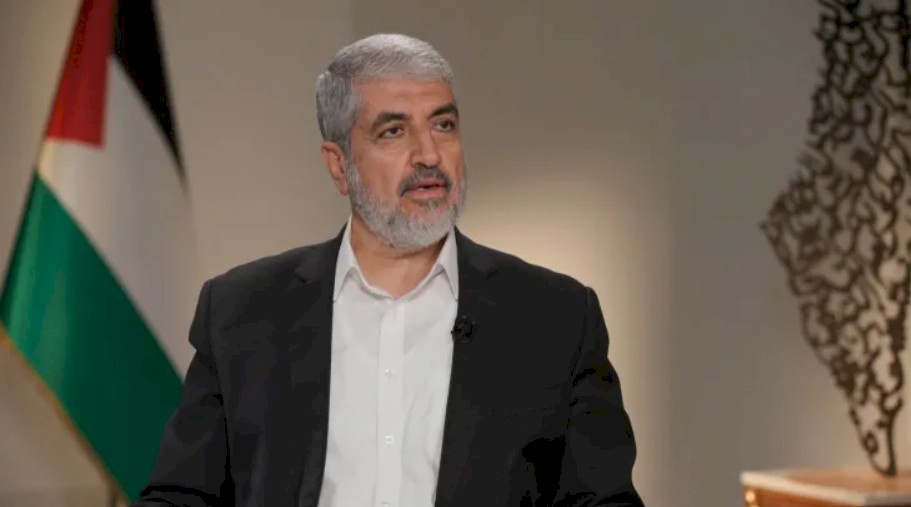
Meshaal: They Want to Disarm the Resistance and Legalize Chaos Militias
SadaNews: The head of Hamas's Political Bureau abroad, Khaled Meshaal, stated that there is a strange paradox, as there is a blatant and audacious attempt to disarm the Palestinian people who defend themselves, while the weapons of client militias such as "Abu Shabab" and others are being legitimized. These militias aim to create chaos to fill a void, while some think that the Palestinian people and resistance forces will leave the arena to them.
Meshaal added during his speech at the seventeenth Al Jazeera Forum held in the Qatari capital, Doha, titled (The Palestinian Cause and Regional Balances): "There is no doubt that we are facing a difficult reality after two years of genocidal war. The war has stopped, but the suffering has not. Forms of aggression and Zionist violations have not ceased in Gaza or the West Bank, and the Zionist bullying and attempts to dominate and subjugate the region continue."
He pointed out that Gaza's suffering continues today and that what is needed after opening the Rafah crossing is relief and enabling people with shelter and stopping the Zionist violations, addressing all the requirements of the first phase. He continued: "We are entering the second phase with all its significant questions related to disarmament, international forces, the peace council, the withdrawal of the occupation from the yellow line to outside Gaza, and other major questions."
Meshaal confirmed that Hamas, along with other partners in the Palestinian arena, is concerned with finding approaches and political movements based on a unified national vision to find practical solutions to major challenges and issues, restoring Gaza to its normal state and applying a similar approach in the West Bank.
He clarified that "the deluge and genocidal war on Gaza have disturbed the world, and there is now a question about a solution to the Palestinian issue, prompting the world to respond, resulting in conferences for the Palestinian state. But what comes next? For Israel, the US, and some parties want to deal with Gaza and the West Bank as scattered geography and a people without a bond or national identity."
Meshaal emphasized the necessity of capitalizing on the deluge and genocidal war and making the occupation pay a price for its crime, stating that the core issue is the existence of the occupation, and the Palestinian cause must find a solution. He added: "The recognition of 159 countries of the Palestinian state is good but not sufficient. The big question is how do we turn the Palestinian state into a reality on the ground?"
He indicated that the philosophy of resistance is based on that "as long as there is occupation, there is resistance, and it is a right of peoples under occupation, and part of international law and divine laws, as well as part of the memory of nations that take pride in it."
Meshaal reviewed historical milestones in the journey of Palestinian resistance, asserting that it is inappropriate to look at any milestone in isolation from its overall context, referencing the uprising of Izz al-Din al-Qassam in the late 1920s, the battle of al-Qastal led by Abdel Qader al-Husseini in 1948, the contemporary Palestinian uprising in 1965, the Battle of al-Karamah in 1968, the October War of 1973, and other milestones that uplifted the morale of the nation.
He stated that the occupation is waging wars against Gaza because it does not want there to be a spot with the infrastructure for resistance or free will, confirming that the Palestinian cause is based on constants and variables. "The constant is that as long as there is occupation, there is resistance, and the variable is the forms of resistance, from uprisings to armed resistance and others."
 Follow the latest Sada News via Google News
12 Martyrs in Gaza Strip since Dawn Today

A Series of Important Decisions Taken.. The Cabinet Discusses Developments in the Deterior...

Organizations of the Temple Prepare for the Largest Raid on Al-Aqsa on What is Called the...

Smotrich: Israel Has No Interest in Joining the War Against Iran

Occupation Issues Military Order to Seize 5 Dunams of Land in Jaba'

Axios: Proposal for a 10-day Ceasefire Between Washington and Tehran and Two Options for M...

In a Rapid Pace.. The Occupation Builds a Huge Earth Barrier Inside Gaza
