

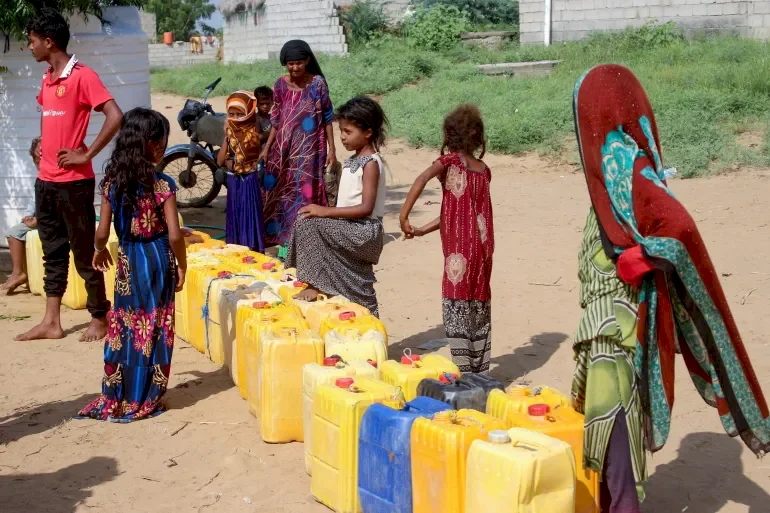
UN report warns of worsening food insecurity in Yemen
SadaNews - A UN report warned of the worsening food insecurity crisis in Yemen, amidst ongoing economic fragility and rising regional instability.
The report, published by the United Nations' "ReliefWeb" and the Humanitarian Coordination, explained that risk levels remain high across various governorates, with sharp challenges expected to continue until February 2026.
The report noted that recent measures taken by the Central Bank in areas under the control of the Yemeni government have temporarily helped strengthen the value of the rial and reduce food prices, but these improvements remain fragile and could reverse at any moment.
The report predicted a renewed deterioration of the currency and a return of inflation due to the fragile economic situation, the lack of comprehensive economic reforms to address trade deficits, depleting foreign currency reserves, and a dollar shortage.
The report highlighted that these risks are exacerbated by regional instability, rising global food prices, declining household incomes, and local restrictions on access, which limits families' ability to purchase basic food necessities.
Regarding the areas controlled by the Ansar Allah "Houthis" group, the report indicated that the outlook until February this year appears more concerning, as communities face decreased rainfall, cold waves, local conflicts, declining imports, reduced wages, and eroded purchasing power.
It added that the prospects for agricultural production are weak, while the resumption of widespread humanitarian food aid and other sectoral support for the population in those areas is unlikely.
The UN report noted that according to the latest analysis of the Integrated Food Security Phase Classification, more than 18 million people, nearly half of Yemen's population, will suffer from severe food insecurity until February 2026, with the possibility of this number continuing or increasing due to mounting pressures.
The United Nations also predicted last Thursday that the number of people in Yemen needing humanitarian assistance will exceed 22 million by 2026, under what it described as "extremely concerning" conditions.
The Yemeni government is facing an economic crisis exacerbated by the continued halt of oil exports since the end of 2022, following Houthi attacks on the export ports of "Al-Dabba" in Hadramout and "Al-Nashimiah" in Shabwa province in response to what they call the neglect of their demands regarding oil revenues.
The country is also suffering from a currency split between areas controlled by the government and those under Houthi control, while UN and international efforts to end this fragmentation, which aggravates the suffering of millions, have stalled.
Source: United Nations
 Follow the latest Sada News via Google News
Saudi Arabia condemns the Houthi threats to navigation and pledges to protect its ships

Houthi Movement Announces Ban on Maritime Navigation Against Saudi Arabia

Earthquake of 5.5 Magnitude Hits Western Iran

To Enhance His Support for "Increasing Children"... Vance Announces the Birth of His Fourt...

Death of a Mosque Imam in Armed Attack in Southeastern Iran

Rubio Reveals Circumstances Surrounding the Death of an American Soldier in Iraq

Reliable Threat.. US Embassy in Jordan: Evacuation of International Airport and Port in Aq...
