

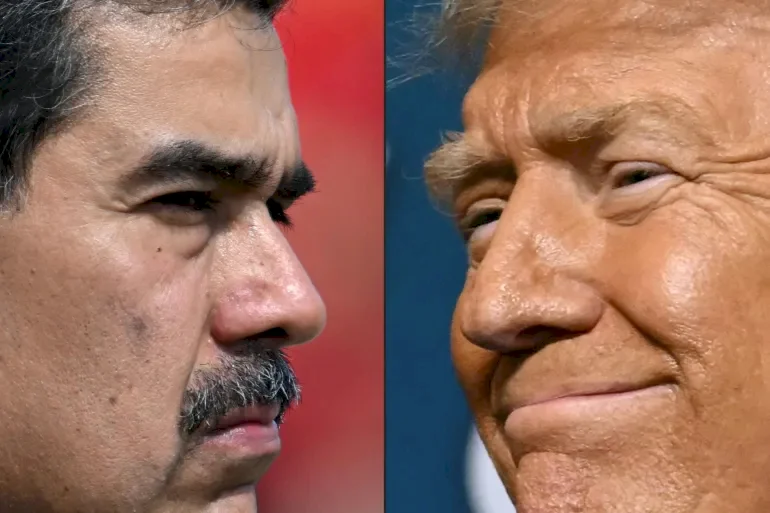
American Writer: How America's Confrontation with Venezuela Turned into Trump's Personal Battle
SadaNews - In a moment where geopolitical calculations intertwine with personal ambitions, Venezuela appears to U.S. President Donald Trump as more than just a troubled country in Latin America. It is a test of American influence, a battleground against international adversaries, and a final opportunity to settle an old score with a regime that has withstood the harshest pressures.
In an article in the conservative Washington Times, which is traditionally close to U.S. right-wing circles, writer Ben Wolfgang argues that the Trump administration's focus on Venezuela cannot be explained by a single factor but is the result of a complex interplay between geopolitical, economic, and personal considerations.
The writer, who is the newspaper's national security, foreign affairs, and military correspondent, notes that what becomes clearer day by day is that Venezuela is no longer a mere passing issue in U.S. foreign policy but has turned into a "strategic obsession" that blends personal grievances with ambitions for geopolitical dominance.
According to deep analyses and informed sources, the intense pressure campaign led by the White House against Nicolás Maduro's regime exceeds its stated goals of combating drug trafficking or protecting human rights, reaching a wild desire to reshape power balances in the Western Hemisphere and choke off the growing influence of Beijing and Moscow.
Apparently, the publication of this article coincided with, or followed, Trump's announcement yesterday (Tuesday) of a comprehensive maritime blockade on "sanctioned oil ships" departing from and heading to Venezuela. He stated in a post on his platform "Truth Social" that he also decided to designate the Venezuelan regime as a foreign terrorist organization, intensifying pressure on President Nicolás Maduro.
Wolfgang points out in his analytical piece that Trump views Venezuela as one of the most important pieces on a high-stakes global chessboard.
The U.S. administration seems to be operating under the hypothesis that Venezuela, through a series of military and geopolitical maneuvers, and perhaps with a bit of luck, could transform from a "hostile drug state" into a friendly democracy with vast reserves of gold, minerals, and heavy oil, according to the article.
Observers, including Christopher Sabatini, a researcher at the Chatham House, believe there is a "sense of unfinished business" that has haunted Trump since his first term when attempts to recognize the opposition as a legitimate alternative failed, causing diplomatic embarrassment for the administration at the time.
The writer notes that influential figures within the administration, most notably Secretary of State Marco Rubio, have convinced the president that Maduro's regime is weaker than ever, especially after the recent elections that were described as illegitimate.
However, this escalation, according to the article, places Trump in a political dilemma. After the rhetoric shifted from combating drugs to an explicit demand for regime change, the president is now required to deliver tangible results, or he risks appearing weak. "It has become a direct confrontation between Trump and Maduro," Sabatini says.
The article also touches on the internal division in Washington regarding this policy. Republican Senator Lindsey Graham warned that Maduro's continued hold on power would be a "deadly mistake for our standing in the world," adding that "this is the worst signal that can be sent to Russia, China, and Iran."
Maduro, holding the "Sword of Peru" belonging to Venezuelan independence hero Simón Bolívar during a military ceremony (AFP)
On the ground, this policy is embodied in repeated naval strikes on "drug boats" at sea and the seizure of oil tankers, with explicit threats to expand operations to land targets within Venezuela. However, legislators such as Democratic Senator Mark Warner express doubts about the efficacy of this course, urging the president to clearly define his goals before putting American soldiers at risk.
Wolfgang believes that these military maneuvers target the "gold mine" that Venezuela represents, as the country that holds the largest oil reserves in the world and whose mineral wealth is estimated at $1.36 trillion remains a strategic prize that Trump seeks to wrest from Chinese influence.
Moreover, he argues that seizing oil tankers not only tightens the noose around Caracas but could also affect China’s interests, which rely on imports from sanctioned countries.
Thus, Venezuela appears, in the view of the Washington Times, as a battleground where the struggle for global influence intersects with the calculations of a president seeking a decisive political victory.
Source: Washington Times
 Follow the latest Sada News via Google News
Panic Grips Israel Following Washington-Riyadh Nuclear Deal

Officially.. Saudi Arabia and America Announce Reaching Nuclear Cooperation Agreement

More than 900 settlers storm Al-Aqsa Mosque so far

Why Can't Zahran Mamdani Arrest Netanyahu in New York?

The 5,000 Plan: What Are the 'Temple' Groups Planning for Al-Aqsa?

The US Army Completes Latest Round of Strikes on Iran

Weather: Very Hot Conditions and New Rise in Temperatures
