

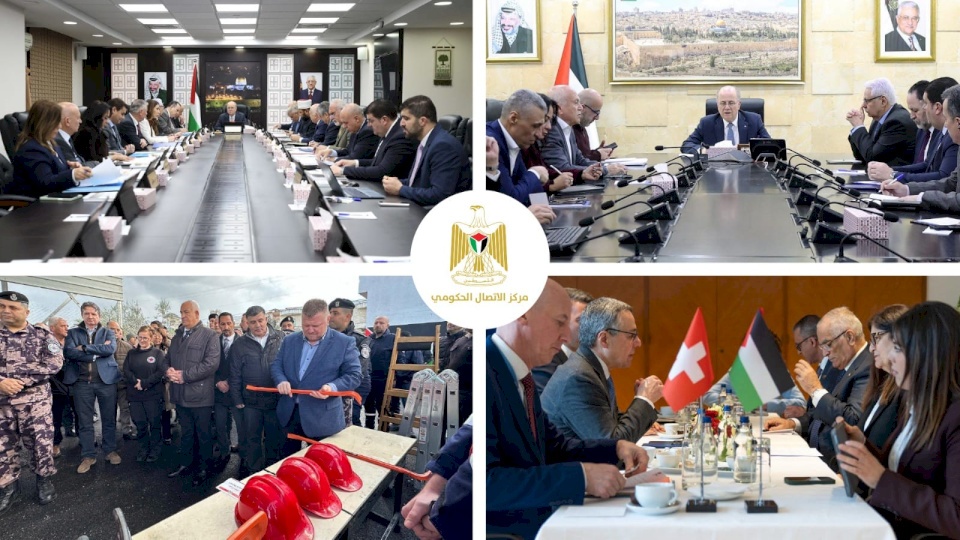
Government Communication Monitors Key Interventions Implemented by the Government Last Week
SadaNews - On Sunday, the Government Communication Center issued a report highlighting the most important developmental and reform interventions carried out by the Palestinian government during the past week (22/02/2026 - 28/02/2026), as follows:
During his chairing of the governmental emergency cell meeting on Saturday, in the presence of ministers and directors of vital sectors, the Prime Minister directed to raise the readiness of institutions, particularly medical facilities, civil defense, and security agencies, in compliance with the directives of President Mahmoud Abbas to ensure the continuity of services and enhance security, stability, and law enforcement.
The Ministry of Social Development implemented a series of integrated interventions in the West Bank and Gaza Strip, targeting vulnerable groups and families. These interventions included the distribution of food and non-food parcels and shopping vouchers, benefiting 2,668 individuals with a total value of approximately half a million shekels. Additionally, the ministry provided 537 health insurance services, 88 interventions for persons with disabilities, 79 interventions for the elderly, 186 for women, 161 for childhood, 131 for youth, 17 for nurseries, 35 in economic empowerment, and 4,337 for orphans, alongside support for volunteering, training, and charitable associations. The interventions also included the provision of relief and social support by distributing food and clothing parcels, in-kind donations, transfer of aid to partner associations, and humanitarian support for the patients of the Gaza Strip and their escorts through food and cash vouchers. Joint responses were implemented, including food vouchers and holiday clothing for children in partnership with international organizations. In the Gaza Strip, the ministry provided more than 379 food interventions that included vegetable and fruit baskets, baby milk, meals, and bread, distributing 1,240 cups of water, in addition to 5,300 non-food interventions that included health packages, mattresses, winter clothing, and dignity bags, 4,809 interventions for women's protection including psychological support and case follow-ups, 90 interventions for child protection, and 955 for orphans.
The Ministry of Public Works and Housing continued its projects in Gaza and the West Bank to enhance shelter and infrastructure, and to improve roads and construction services. In Gaza, the ministry completed the installation of tents in the Zaitoun camp and began leveling the land in Al-Toum area in Beit Lahia, covering an area of 11 dunams with support from the UN Development Program, in preparation for the establishment of a shelter center using "RHU" units. It also completed maintenance of 232 residential units in the Emirati and Japanese neighborhoods in Khan Younis governorate. In terms of rubble removal, the first local crusher was operated, and the Al-Rasheed street in Al-Zawida area was leveled by distributing 492 tons of rubble outputs. The ministry also conducted damage assessments in Gaza City through 28 field teams comprising 70 engineers. In the West Bank, the Central Tenders Directorate referred a bid for the expansion of the Dier Abu Deif Secondary School for Girls to the Ministry of Education and Higher Education, and opened a tender for wind energy generation for the Tubas water facility at an estimated cost of 3.5 million Euros. The ministry began implementing a project to rehabilitate the "Lacasa Mall - Al-Mazra'a Al-Gharbiya" intersection in Ramallah and Al-Bireh governorate, and completed the implementation of 30 projects for main and connecting roads in various governorates, including rehabilitation, repairs, and emergency projects funded by the public treasury and the Islamic Development Bank. The ministry's laboratory obtained the "ISO17025" accreditation for soil tests, and preparations are being made to be accredited in concrete and asphalt tests to become a standard central laboratory for providing structural testing for state institutions.
The Minister of Foreign Affairs and Expatriates held a series of intensive meetings in Geneva to discuss developments in the occupied Palestinian territories and ways to enhance international support. She met with the UN High Commissioner for Human Rights and emphasized the importance of his reports in documenting violations. She also discussed with the Deputy Minister of Human Rights and Citizenship ways to enhance bilateral cooperation, and met with the Secretary-General of the UN Conference on Trade and Development, praising efforts to document economic losses and support building Palestinian institutions. She met with the President of the International Federation of Red Cross and Red Crescent Societies, emphasizing the need to protect medical teams and secure humanitarian corridors to Gaza. Additionally, she met with a delegation from the World Council of Churches to discuss the role of churches in supporting justice and protecting holy sites. She held bilateral meetings with the foreign ministers of Angola, Iceland, Cuba, Venezuela, South Africa, Indonesia, Senegal, and Switzerland, focusing on strengthening bilateral relations and coordinating international positions supporting Palestinian rights, commending the supportive positions of South Africa for Palestine. In her speech before the Human Rights Council, she emphasized that impunity encourages ongoing violations, calling for measures to ensure accountability, and stressing that the two-state solution is the only way to achieve peace.
The Ministry of National Economy confirmed that stocks of basic materials are available and sufficient for 6 months, and called for avoiding rush purchasing and reporting violations in markets via 129 or the "Bohmana" platform.
The Ministry of Education and Higher Education implemented a series of interventions that included winning first places in the Arab Programming Week in its fifth edition, organizing the central Quran memorization competition in partnership with the Ministry of Awqaf and Religious Affairs, launching 31 environmental initiatives in schools, and following up on expanding turnout for face-to-face educational points in Gaza, alongside announcing the dates for the general secondary education exam and holding meetings to follow up on educational issues, most notably with the network of civil organizations, and reviving Palestinian Educator Day. In higher education, the ministry announced the names of candidates for the Thailand grants for 2026-2027 and issued a guidance newsletter for general secondary education students regarding studies in higher education institutions for the year 2025-2026.
The Ministry of Interior implemented a series of interventions that included the minister meeting with the "Halo Trust" organization to enhance partnership in demining and war debris clearance and support cleansing efforts in the West Bank and Gaza Strip. A new civil defense center was opened in Aqaba southeast of Nablus to serve more than 67,000 citizens. The Minister of Interior also chaired a meeting to follow up on Palestine's commitments to the Convention Against Torture and to ensure the alignment of legislation with international standards. On the ground, police apprehended 852 wanted individuals, executed 2,451 judicial warrants, conducted 48 drug control missions, and followed up on 222 criminal incidents. The civil defense executed 103 firefighting missions and 64 rescue tasks, issued 321 professional and industrial permits, inspected and licensed 279 elevators, and conducted 914 public safety tours. The customs police monitored 49 cases of tax and customs evasion and destroyed 24.3 tons of expired goods and those not meeting specifications.
The Minister of Transport and Communications inspected the workflow in the Tulkarm Directorate and discussed ways to develop and organize the sector, in the presence of the Tulkarm governor, and met with union representatives in the governorate to discuss proposed solutions to improve working conditions and enhance the level of services provided. As part of enhancing partnership and cooperation, a memorandum of understanding was signed with Palestine Technical University - Kadoorie, aimed at developing the transport sector and enhancing scientific and technical capabilities in this field, launching two new public transport routes in Tulkarm governorate.
Minister of Local Government and Chairman of the Higher Planning Board Dr. Sami Hajjawi chaired the council's public meeting on Thursday, in the presence of the council members from ministry deputies and representatives of relevant entities, and the council's Secretary Engineer Ruba Sobeh, during which several decisions were made.
The Civil Affairs Authority led a series of field interventions in several governorates; in Hebron, its staff continued to be present in the Ibrahimi Mosque to facilitate the entry of worshippers during Ramadan, coordinating maintenance works in the Old Town, Dura, and Raboud. In Jenin, five agricultural roads in Faqqua were reopened, arrangements were completed for a burial in Jenin refugee camp, medicines were brought into Barta'a, and maintenance of sewage lines in Al-Hadaf neighborhood was coordinated. In Nablus, the councils of Awarta, Burin, and Jorish were enabled to repair and rehabilitate the entrances to the villages in the contact areas. In Tulkarm, arrangements were made to reopen gates in Beit Lid and to remove obstacles from their entrances, coordinating the reception of a sick worker at the Jabara checkpoint. In Salfit, farmers were enabled to access their lands near the settlements of Netafim and Barkan.
The Energy and Natural Resources Authority launched a package of projects to enhance smart and sustainable energy, including launching the second phase of the revolving fund for solar energy with storage systems to support homes and small establishments, completing the transition to smart meters to increase network efficiency and reduce losses, and developing a unified "GIS" platform to support technical planning and update electricity networks and renewable energy projects. An agreement was signed under the emergency recovery program with Japanese funding of $27.3 million, of which $6.3 million is allocated to the energy sector to enhance the quality of electricity services and provide the Gaza Strip with solar energy systems with storage units.
The Environment Quality Authority conducted 41 monitoring and inspection rounds on industrial facilities, followed up on 6 environmental complaints, issued 15 permits for importing chemicals, granted two environmental approvals for a cellular broadcast station and renewing an industrial facility, while rejecting another request due to non-compliance with requirements. It also held a workshop to present the proposed framework for classifying development and environmental projects and activities within the project of integrating the environment and climate change into national policies, organized courses for women in recycling plastic and paper waste to enhance small projects, alongside awareness workshops on water conservation and sustainability.
The Ministry of Agriculture, in cooperation with the Agricultural Relief, participated in the integrated humanitarian support and early recovery project - Phase Two, distributing 40 tons of potato seeds in favor of 57 farmers in Gaza to cultivate 170 dunams. It launched the "My Initiative" project in partnership with UNDP to support the manufacture of alternative fodder in the northern Jordan Valley. The ministry also conducted field tours and visits to 37 grape farmers in Halhul north of Hebron as part of projects to enhance resilience and improve livelihoods, and signed an agreement with the village council of Naqoura to create a public park on government forest land in Nablus, in addition to concluding specialized training meetings in food processing in partnership with the Eastern Baqa Association in Tulkarm targeting women to develop their home production projects.
The Minister of Tourism and Antiquities launched the "Bethlehem Through the Ages" conference at the "Sapienza University in Rome," emphasizing the symbolic nature and historical depth of the city. The ministry reiterated its rejection of attempts to take control of the Sebastia site as it is an integral part of the national history. It opened specialized training on preparing archaeological excavation reports to develop scientific documentation, welcomed international tourist groups at the archaeological garden of Tell Blata in Nablus to stimulate tourism activity, and followed up on maintenance of the Jenin municipality library in the Old Town to preserve its heritage value, in addition to receiving a delegation from the Samaritan community to strengthen cooperation in protecting and developing the Samaritan museum on Mount Gerizim.
The Official Gazette issued number (235) of the Official Newspaper "Palestinian Facts," making published legislations available through the electronic reference of the official newspaper to facilitate citizens' access. It also launched, in collaboration with Palestine Ahlia University, a specialized legal training program for graduates of the Faculty of Law titled "Fundamentals of Legal Opinion on Legislative Drafts," and signed a memorandum of understanding and joint collaboration with Palestine Technical University Kadoorie.
The Ministry of Labor discussed with the business accelerator "Flow" and the "SPARK" Foundation the development of supportive policies to create quality job opportunities, and the minister chaired the final evaluation session for the "Be the Impact" project supporting cooperatives funded by Italian cooperation and supported by the International Labour Organization. It also expanded cooperation with the First Ramallah Company, the Palestinian Journalists’ Syndicate, and the Union of Women’s Committees for Social Work to empower youth and women and enhance sustainable economic models, affirming on the International Day of Social Justice that decent work is an inherent right and a legal and moral obligation. Regarding services, the General Directorate of Employment Services issued 1,240 unemployed certificates for free health insurance, benefiting 2,871 job seekers from employment services. In vocational training, 173 students were distributed for field training in Nablus, and 76 registered on the "Job Match" platform, conducting interviews for about 80 applicants in Tulkarm, and preparing to establish a nucleus for vocational training center in Al-Arroub camp, alongside implementing licensing and professional guidance campaigns. The inspection and occupational safety and health teams conducted workshops and awareness meetings benefiting dozens of workers and students, recording 8 violations that were taken action regarding them, and accredited 9 safety supervisors while monitoring work injuries and referring them to the relevant authorities.
The Ministry of Industry enhanced its national and international partnerships, signing a memorandum of understanding by the General Authority for Industrial Cities and Free Zones with the Civil Defense Agency to integrate safety and preventive standards in the planning and operation of industrial cities and through implementing specialized training programs. The minister discussed with FAO and UNIDO the development of food specifications and standards and improving the efficiency of food industries. He met with the British consul general in Jerusalem and the Moroccan ambassador to discuss enhancing cooperation and supporting the competitiveness of local products and the development of industrial zones and accessing new markets. In terms of field performance, 4 licenses were issued for establishing new industrial facilities, and 3 first operating licenses were issued with a capital of 273,700 Jordanian Dinars, providing 33 job opportunities, renewing 33 industrial licenses, executing 36 inspections and monitoring rounds, reviewing two quality files, and issuing two licenses for renewing quarry licenses, alongside holding a technical committee for accreditation.
The Ministry of Women's Affairs signed a strategic memorandum of understanding with UN Women in Palestine for 2026 to enhance cooperation in protection from gender-based violence, economic and political empowerment, and integrating a gender perspective in policies. It also discussed supporting women's initiatives with the First Ramallah Company and began preparations for International Women’s Day by preparing monitoring and documentation reports on the reality of women in support of advocacy and policy development.
The Ministry of Culture continued to enhance its presence in the governorates; the minister met with the "Bedouins Without Borders" organization to intensify activities in marginalized areas. Cultural events were held in Salfit focusing on folklore, contemporary media, and poetry, while in Tulkarm, storytelling, creative writing activities, lectures on heritage, and the launch of the novel "It Will Surely Pass" took place. In Bethlehem, a mosaic workshop for women was organized, and in Qalqilya, a seminar on heritage and a lecture about Jerusalem, as well as a closing meeting for the creative writing workshop were held.
 Follow the latest Sada News via Google News
Sheikh Offers Condolences for the Martyrdom of Citizens in Deir Jareer

Ministry of Labor Calls for Registration in Licensed Private Vocational Training Centers a...

Occupation Forces Storm the Home of Major General Bilal Al-Natsheh in Jerusalem

The Working Group on Palestine of the Permanent Independent Human Rights Commission Issues...

Arrests in Occupation Attacks in the West Bank and Jerusalem

Ramallah and Al-Bireh Forces Mourn Al-Mughayer Martyr and Emphasize Popular Solidarity to...

More than 38,000 travelers crossed through the Karama crossing last week
