

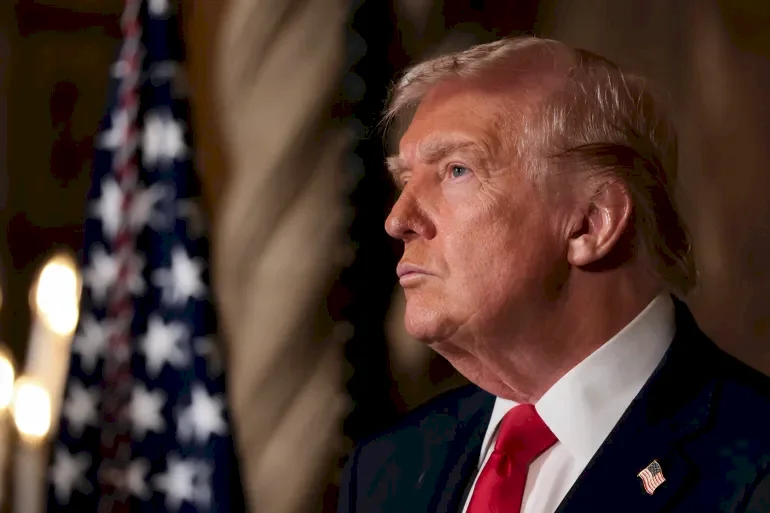
How Did Trump and His Team Decide to Attack Iran?
SadaNews - Donald Trump finished negotiating, and for weeks, he amassed a fleet of aircraft carriers and destroyers in Middle Eastern waters, supported by squadrons of "F-35" and "F-22" fighter jets sent to bases throughout the region. This was the largest American military buildup since the Iraq War in 2003, which toppled Saddam Hussein's regime.
Trump's goal was to pressure Iran's rulers to do what they had refused to do for decades, namely abandon their long-range nuclear and missile programs and stop supporting their armed proxies. He stated that he preferred a diplomatic solution with Tehran, but the military buildup continued.
However, even as his envoys to the Iran talks, his son-in-law Jared Kushner and Steve Wittekov, were preparing to travel to Geneva to meet their Iranian counterparts for further discussions, the balance of calculations was shifting toward conflict.
This report is based on interviews and briefings with several American officials and individuals familiar with how events unfolded last week, all of whom requested anonymity when discussing events that were not public.
In his State of the Union address on Tuesday, Trump warned that Iranian officials "are once again seeking to achieve their evil ambitions" to rebuild their nuclear program, following the devastating attacks launched by the U.S. and Israel last year.
The president said, "They want to make a deal, but we have not heard the secret pledge that they will never possess a nuclear weapon."
That evening, Secretary of State Marco Rubio met with senior congressional leaders to update them on the talks.
Intelligence Controversy and Differing Assessments
Time was running out, but behind the scenes, a debate was still ongoing. U.S. Defense Intelligence Agency assessments indicated that Iran's nuclear progress remained constrained, while Israeli intelligence painted a much more urgent picture. Some U.S. officials quietly warned Trump's senior envoys against overly relying on Israeli conclusions.
By Thursday evening, Kushner and Wittekov's talks in Geneva had yielded no breakthrough. However, there was enough ambiguity for them to agree to return later that day, after navigating the city for unrelated discussions with Ukrainian and Russian officials.
Iranian officials claimed they believed the second round of talks that day showed progress. But by the end of the evening, Kushner and Wittekov felt that all avenues had been exhausted.
In their view, Supreme Leader Ali Khamenei's vision of the world left little room for coexistence with Trump's vision for the Middle East. After 16 hours in Geneva, the Americans adhered to their self-imposed deadline and flew back to Washington.
And while there were announced plans for further talks the following week, Oman’s Foreign Minister Badr al-Busaidi, who was playing the role of mediator in the Geneva talks, was concerned, convinced that conflict was imminent.
On Friday morning, he traveled directly from Geneva to Washington and immediately headed to a meeting with Vice President J.D. Vance, who has long expressed skepticism about foreign interventions and may still have some sway over the president regarding Iran.
Trump 'Unhappy' with the State of Negotiations
This move angered some of Trump's hardline advisors, with some describing this communication as bordering on disloyalty and seeing it as an attempt to fracture the ranks within the president's inner circle at a critical moment.
On the same day at the White House, Trump was preparing to travel to Texas to engage in some internal political activities just days before the state held crucial primary elections. But his mood regarding Iran was worsening.
Officials who briefed him stated that although a short-term deal with Iran seemed within reach, it would not address core issues such as Tehran's missile program. At a campaign rally in Texas that day, Trump said he was "unhappy" with the state of negotiations.
Afterward, a light-hearted atmosphere prevailed. At a branch of the "Whataburger" in Corpus Christi, decorated with American flags and crowded with supporters, Trump declared, "Burgers for everyone!" He held up a take-out bag with the number 47, in reference to his position in the presidential order.
Yet, in a later recollection, that festive spirit hid a grim reality, that no further talks would take place.
Trump left Texas and headed to Florida for a weekend at his Mar-a-Lago resort. Vance met with government members in Washington. That night, Rubio informed senior U.S. lawmakers that military action against Iran was becoming likely.
In a video recorded without the presence of journalists and released at midnight U.S. time, Trump announced the attack, urging the Iranian people to overthrow their ruling regime, which he accused of fueling "widespread terrorism."
He said in the video, "No president has been willing to do what I am prepared to do tonight." War had begun.
The First Strikes and Tehran's Response
Explosions echoed across Iran. In response to hundreds of joint U.S. and Israeli strikes, Tehran launched volleys of missiles at Israel and American targets across the region.
Air defense systems engaged incoming projectiles over Riyadh, Doha, and Abu Dhabi, while residents reported hearing explosions and falling debris. In Bahrain, home to the U.S. Fifth Fleet, a base associated with the United States came under fire. In Abu Dhabi, at least one person was killed by shrapnel from an intercepted missile.
As in the 2003 U.S. invasion of Iraq, the early stages proved critical, as Trump and Israeli Prime Minister Benjamin Netanyahu announced the death of Khamenei, the second leader to govern Iran since the establishment of the regime in 1979. Iran later confirmed his death. Reports also indicated the deaths of other high-ranking leaders, including the defense minister and the head of the "Revolutionary Guard."
However, as the United States learned painfully in its interventions in Iraq and Afghanistan, the early hours rarely determine the course of conflict.
For now, at least, Trump is relying on air power, attempting to rally citizens of a country that lacks an organized opposition to advance the ground work he avoids.
In a social media post, Trump pledged to continue "heavy and precise bombing" without interruption "throughout the week or as long as necessary." But he also urged Iranians to seize the opportunity he said he was giving them.
Trump's Second Major Military Campaign
For Trump, this represents the second major military step against an adversary since the beginning of the year. Driven by his swift success in toppling Venezuela's leader and detaining him, Trump has once again shredded the "MAGA" (Make America Great Again) rules and launched a war by his own choosing. The president, who rose to prominence a decade ago by denouncing "America's endless wars," is now risking his biggest gamble yet, with consequences that may extend for years.
But the president does not seem worried. While at his resort in Florida, with Republicans rallying around him, White House spokesperson Caroline Leavitt stated that the president would proceed with his previously announced plans for the weekend.
She said, "President Trump still intends to stop for a fundraising event that will be held at Mar-a-Lago this evening for the Republican Party, which is more important than ever."
 Follow the latest Sada News via Google News
Trump: We will make great progress with Beirut.. Aoun: It is time for Lebanon to be stable

The Lebanese Army Deploys in the South and Comes Under Gunfire; Israel Clarifies

Bezhkian: Directives from the Leader to End the State of No War, No Peace

Saudi Arabia condemns the Houthi threats to navigation and pledges to protect its ships

Global Warning to Americans Due to Rising Tensions in the Middle East

Houthi Movement Announces Ban on Maritime Navigation Against Saudi Arabia

Earthquake of 5.5 Magnitude Hits Western Iran
