

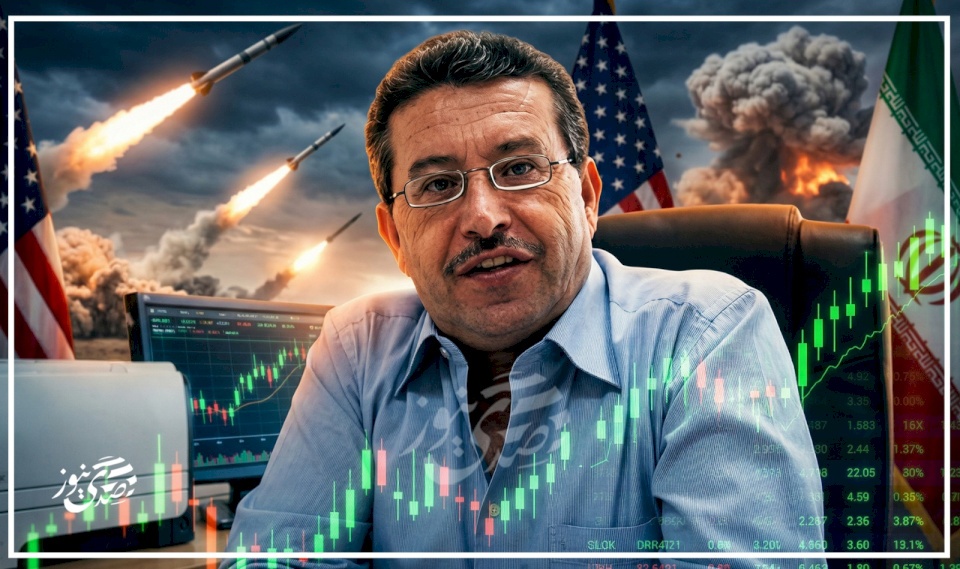
How will the financial markets and stock exchanges open the first session after the strike on Iran?
Economic Expert: Significant increases are expected in the prices of gold, dollar, and oil, and red will dominate the stock markets..
Dr. Abdul Karim: The exchange rate of the dollar against the shekel may reach 3:20 or 3:25 on Monday..
Exclusive to SadaNews: The United States and "Israel" chose Saturday to begin implementing the strike on Iran after the global financial markets and stock exchanges had closed their weekly sessions on Friday to enter an official holiday on Saturday and Sunday. As those markets return to work on Monday, anticipation will dominate the scene regarding price trends for currencies, stocks, gold, and oil, in the first session following the declaration of war.
Economic expert Dr. Nasr Abdul Karim predicted to "SadaNews" that gold, oil, and dollar prices will witness noticeable increases on the first day that global markets resume operations after the strike commenced. It is known that the markets had absorbed part of these economic repercussions in advance on the previous Thursday and Friday before the strike.
Dr. Abdul Karim stated, "Regarding gold, following the first strike, it began trading on digital platforms, rather than official ones, around $5500 per ounce, and thus saw a significant rise of about $250 per ounce, which is nearly 5%, and this is a substantial increase," indicating that the development of the military confrontation or its containment will determine the price of the precious metal.
He added: "On Monday, we will witness an increase in the trajectory of gold, and we might reach prices of $6000 to $6200 soon, contrary to the predictions of major investment institutions and financial analysis firms worldwide that anticipated reaching this price by the end of this year."
He continued: "Gold is likely to rise if the war expands, but if this confrontation takes a routine course and is contained by mediators, we will see gold returning to decline, possibly sharply."
Regarding oil, Abdul Karim clarified that the markets began to sense the strike during the Friday session, so prices rose in anticipation of this risk, predicting that prices will see further increases in Monday's session. This is due to expert analysis regarding Iran's ability to close the Strait of Hormuz, which is a vital energy passage, particularly for Southeast Asia. Therefore, the extent of price increases depends on how much shipping and insurance costs rise.
Abdul Karim noted that global demand for oil might decrease during the confrontation because the global economy may enter another slowdown phase due to disruptions that may occur in supply chains, leading to a reduction in import and export operations along with the restrictions imposed by the war. Additionally, there might be a decline in consumption and investment rates if the war lasts for an extended period.
He pointed out that there are two factors that might limit increases in oil prices: First, the increase in production by OPEC countries, and second, the slowdown in industrial and economic activity in central countries like China due to the war in the coming period, which reduces demand for oil.
Abdul Karim explained that the fastest impact of this war will be on the prices of basic commodities, currencies, stocks, and metals (unless signs of de-escalation or cooling of the military confrontation appear before the markets open), adding that the dollar will generally rise against most currencies, while cryptocurrencies will likely suffer severe losses. The stock markets will be deep red when they open on Sunday in our region and Monday in the rest of the world.
He confirmed that most commodity prices will rise, especially those shipped through our region, warning of the return of inflation to the global economy, especially if the confrontation extends for a long period and expands.
He confirmed that the war will cost tens of billions of dollars distributed among its parties, some of which are direct and others indirect.
Regarding the dollar, Dr. Abdul Karim predicted that it would rise against a basket of currencies, and it will also increase against the shekel, stating, "We may see it rise when the markets return to work on Monday, possibly reaching 3.20 or 3.25."
He indicated that the trajectory of the exchange rate may be determined later based on how the war develops.
Israeli experts outlined several scenarios for the exchange rate of the dollar against the shekel in the case of an attack on Iran, including the possibility of the dollar declining further to levels below 2:80 against the shekel if an Israeli victory emerges from this confrontation, and its rise to levels reaching 3.80 if the battle becomes complex and prolonged.
The dollar exchange rate reached 3.14 against the shekel after dropping to levels of 3.07 in previous days, while the gold ounce in spot trading on Friday recorded a price of $5175 per ounce, and U.S. gold futures for April delivery rose by 0.2% to $5201 per ounce.
Oil prices increased by more than 2% on Friday's session, thus recording gains on a monthly basis, with Brent crude reaching $72.48 per barrel, while U.S. West Texas Intermediate crude settled at $67.02 on Friday.
Barclays Bank stated before the strike that Brent crude could rise to around $80 per barrel in the event of significant disruptions in supplies; however, experts predicted it could rise higher if the confrontation prolonged and its conditions complicated.
 Follow the latest Sada News via Google News
Soaring Oil Prices Burn the Pockets of the Palestinian Citizen "The Poor"

Millions of Dollars in Losses.. "SadaNews" Reveals Shocking Figures for Traders from Pales...

The Problem of Shekel Overcrowding Worsens.. Fuel Station Owners Threatened with Closure o...

The Palestinian Economy at a Crossroads: 4 Files Awaiting Resolution

Exchange Rates of Currencies Against the Shekel on Tuesday (July 21)

Inflation Expectations in Israel Stabilize at 1.5%

Ministry of Economy Announces the Opening of Import Application Submissions for Commodity...
