

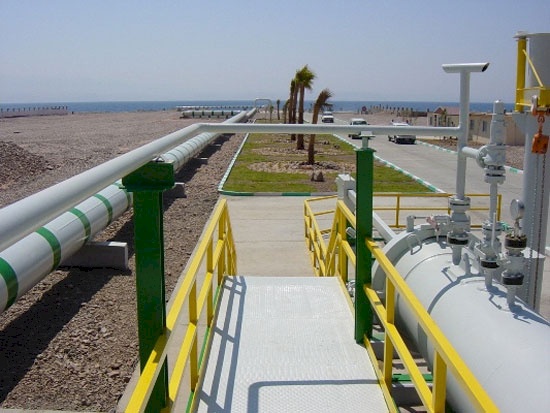
Egypt Establishes New Pipeline for Transporting Israeli Gas at $400 Million
SadaNews - Egypt is preparing to establish a new pipeline to transport the additional quantities of Israeli gas that were recently agreed upon, during the fourth quarter of this year, at an estimated cost of about $400 million.
One official clarified that the pipeline will be entirely built within Egyptian borders, aiming to accommodate the additional quantities of gas imported from Israel. Another official suggested that the Egyptian Natural Gas Company "GASCO" will take over the implementation after all engineering details are finalized.
This step follows Egypt's agreement with "New Med Energy", the partner in the Israeli Leviathan field earlier this month, on a significant amendment to the natural gas export agreement that includes adding about 4.6 trillion cubic feet (130 billion cubic meters) to the original agreement, distributed over two phases: the first involves exporting about 706 billion cubic feet (20 billion cubic meters) as soon as the amendment comes into effect.
The second phase stipulates exporting up to 3.9 trillion cubic feet (110 billion cubic meters), conditional on meeting investment requirements and expanding gas transport infrastructure, with the supply period extended until 2040 or until the additional agreed quantities are exhausted, whichever comes first, bringing the total quantities to 4.6 trillion cubic feet.
This deal is the largest among the energy agreements signed between Egypt and Israel, and comes at a time when Cairo seeks to enhance its gas supplies to meet local demand and support its export plans.
Egypt Bears the Cost
The two officials mentioned that the cost of the pipeline will be borne by Egypt, while "New Med Energy", the partner in the Leviathan field, will be responsible for extending the pipeline and connecting it inside Israel.
Egypt, which has shifted from being a net exporter to an importer of liquefied gas, aims to be a regional energy hub by importing gas from neighboring countries, liquefying it at its stations, and then reselling it in the global market for a profit margin.
However, this plan is currently nearly stalled, with Cairo opting to use imported gas from Israel and Cyprus to meet local demand after the country witnessed an unprecedented deficit in 2024 between production and consumption; consumption reached about 60 billion cubic meters versus production that did not exceed 47.5 billion cubic meters.
In this context, Egyptian Prime Minister Mostafa Madbouly stated that his country expects to resume exports by 2027 with local production rising again to a level of 6.6 billion cubic feet per day, compared to 4.1 billion cubic feet per day at present.
 Follow the latest Sada News via Google News
Decline in Oil Prices and Rise in Gold Prices Globally

Strait of Hormuz Approaches Maritime Paralysis After American and Iranian Strikes

Oil Prices Surge as US Airstrikes on Iran Renew

Gold Holds Steady Near $4080 Amid Middle East Escalation

The IMF Forecasts a Contraction in the Middle Eastern Economy This Year and a Faster Recov...

6000 Sailors Still Stranded in the Gulf

Floating Iranian Oil Faces Uncertain Fate After U.S. Exemption Cancellation
