

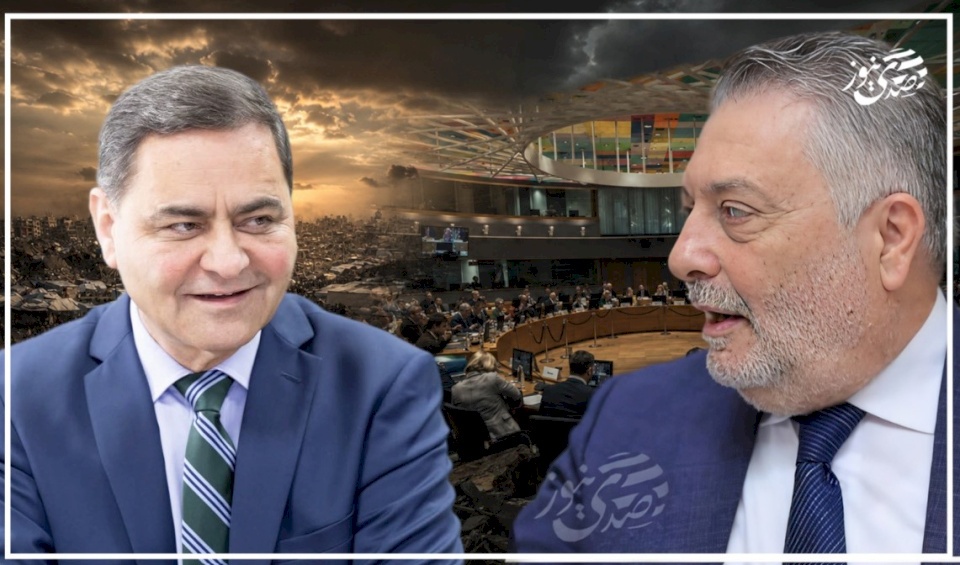
Brussels Meeting.. Promising Flows for Gaza but Scarce for Authority Drowning in Debt
Exclusive to "SadaNews Economy": Data from the Ministry of Finance and Planning shows that the public debt of the Palestinian Authority increased by the end of May to approximately 49 billion shekels.
The data revealed that the largest debt is owed to the Civil and Military Pension Authority with debts amounting to 15 billion shekels, while the salaries owed to public sector employees by the end of May reached about 9 billion shekels, and private sector dues amounted to approximately 8.4 billion shekels. Local borrowing reached 10.4 billion shekels, and external borrowing reached 3.8 billion shekels, while debts to other entities (mostly public funds and agencies) were around 2.4 billion shekels.
It is noted that the reason for the decrease in local and external borrowing is attributed to the recent decline in the exchange rate of the dollar.
These figures come at a time when the Palestinian Authority concluded its participation in the second ministerial meeting of the Donor Group for Palestine, held in Brussels, which provided political support to the Palestinian Authority, and announced an initial commitment to support Gaza amounting to 883 million euros (about one billion dollars), which may not cover the estimated needs that exceed 70 billion dollars, but it is seen as a step in the right direction by observers. On the other hand, the outputs of the meeting do not provide anything new for the budget of the Authority, which suffers from significant debt, and stands unable to meet its obligations to various sectors amid the continued Israeli detention of clearance funds for more than 15 months.
Political support lacking impactful budget support
In his comment on the outputs of Brussels for donors, economic expert Samir Halileh told "SadaNews Economy" that one of the most important outputs of this meeting is the support for the legitimacy of the Palestinian Authority in facing the legitimacy of the Peace Council, which is much more important than any direct financial support to cement Palestinian legitimacy and prevent the separation of Gaza from the West Bank. He also noted the positive aspect of providing financial support for humanitarian and relief work and starting the reconstruction process in Gaza worth around one billion dollars, while also indicating that this amount is much less than the needed scale, yet it represents an important first step to begin the relief and reconstruction process in the sector.
He added, "There is a political gain, and this is an opportunity for the Palestinian Authority to strengthen its role in Gaza not through its direct presence or at the invitation of Israel or the U.S., but by enhancing its relationship with the private sector and civil society, ensuring that it retains a role in the implementation of projects."
Paltry amount
Regarding the negatives of the conference outputs, Halileh believes that direct support to the Palestinian Authority's budget has been scant, as the amount of 41 million euros is not a significant figure even when added to the European amount announced in the Pegase mechanism, which is around 1.6 billion euros, of which nearly 620 million euros are allocated to support the general budget over three years. He adds, "This amount definitely does not meet the needs of the public treasury and what employees expect in terms of improving salary disbursement, especially in light of Israel's continued detention of clearance funds, which constitute 68% of public treasury revenues with no prospect of their release."
On the topic of reform, Halileh pointed out that although attendees spoke positively about the reforms and expressed satisfaction with the positive steps taken by the Palestinian Authority in this regard, there remains a need to involve local social and economic sectors in order for the Palestinian Authority to form community support for these reform steps.
He noted that the five points mentioned in the reform program with the European Union were not agreed upon nationally. The first point of the plan relates to financial matters and social care, specifically concerning the topic of salaries for the families of martyrs, prisoners, and the wounded. A recent report from an American audit firm confirms the Palestinian Authority's commitment to this point. The second point concerns democracy and freedom of opinion and expression, and holding elections, stating that there is a shortcoming in this area. However, the only aspect that has seen progress is the issuance of a decree from President Mahmoud Abbas announcing the date for legislative elections next November.
Need for community partnership in discussing the reform file
Halileh concludes that there is a lack of Palestinian discussion regarding the items included in the reform plan. For example, there is a point concerning the reform of infrastructure and educational curricula, but no one knows the progress in this regard. That is why there is a need for community partnership to discuss the reform items to launch from a community conviction, noting that direct support to the budget does not address the feelings and needs of employees, and what they expect in terms of improving their financial situation.
Palestinian Prime Minister Dr. Mohammad Mustafa stated in a speech at the Brussels conference, "Since October 2023, the Palestinian economy has contracted by 30%, and the unemployment rate has risen to 50%, resulting in more than 500,000 citizens losing their jobs. The financial deficit has reached unprecedented levels due to Israel's continued withholding of Palestinian clearance revenues and the constraints imposed on our financial and economic system."
Mustafa added, "Over the past fifteen months, Israel has completely suspended regular transfers of Palestinian clearance revenues, severely restricting the Palestinian government's ability to fulfill its obligations significantly. Despite these challenges, the Palestinian government has remained active, responsible, and committed to reform, stability, and building institutions."
In response to a question during the conference about the scarcity of financial support for the public treasury, Mustafa indicated that additional support comes within the framework of a programmed support from the European Union under the Pegase mechanism, emphasizing the importance of this support, but it does not replace the release of clearance funds, which constitute the main revenue for the National Authority.
Worrying figures..
Economist Dr. Said Sabri told "SadaNews Economy" that it is necessary to separate the political dimension from the financial aspect of the Brussels conference, pointing out that from a political perspective, the conference achieved an important gain by renewing international support for the Palestinian Authority and reaffirming its role in the recovery and reconstruction phase for Gaza. However, from a financial perspective, its outputs do not meet the size of the crisis facing Palestinian public finance.
He noted that the figures issued by the Palestinian Ministry of Finance and Planning are alarming, as the accumulated obligations and debts reaching about 49 billion shekels mean that the crisis has surpassed being a temporary liquidity crisis and has become a financial and structural crisis. The accumulation of employee dues, private sector dues, and pension fund debts are all indicators of significant pressures threatening economic activity and social stability.
He added, "While it is true that the European Union announced important funding to support Gaza, this funding is mostly allocated for relief and reconstruction, not for covering budget deficits or enabling the government to fulfill its financial obligations. Therefore, employees or the private sector will not feel any immediate improvement as a result of these commitments, nor will it achieve less than what is hoped for in terms of the government's obligations to employees."
He emphasized that the core of the crisis does not lie solely in the lack of aid but also in Israel's continued detention of clearance revenues, which constitute the main source of public revenue, noting that even with the continuing reforms being implemented by the government and receiving international praise, any financial reform will remain limited in impact if the government remains deprived of its essential resources.
Dr. Sabri confirmed that the coming phase is crucial as it requires working on three parallel tracks: first, international pressure to release clearance funds; second, the continuation of financial and administrative reforms to enhance donor and investor confidence; and third, directing a larger portion of international support toward strengthening public finance resilience, as the stability of state institutions is just as important as the reconstruction of Gaza.
 Follow the latest Sada News via Google News
Soaring Oil Prices Burn the Pockets of the Palestinian Citizen "The Poor"

Millions of Dollars in Losses.. "SadaNews" Reveals Shocking Figures for Traders from Pales...

The Problem of Shekel Overcrowding Worsens.. Fuel Station Owners Threatened with Closure o...

The Palestinian Economy at a Crossroads: 4 Files Awaiting Resolution

Brussels Meeting.. Promising Flows for Gaza but Scarce for Authority Drowning in Debt

Threat of Labor Dispute: Mercantile Bank Employees Committee Rejects Merger with Discount...

The Risk of Cancellation Looms over Tens of Thousands of Airline Tickets at Ben Gurion Air...
