

Between De-escalation and Bab el-Mandeb.. How Does Tehran View the Escalation in Yemen?
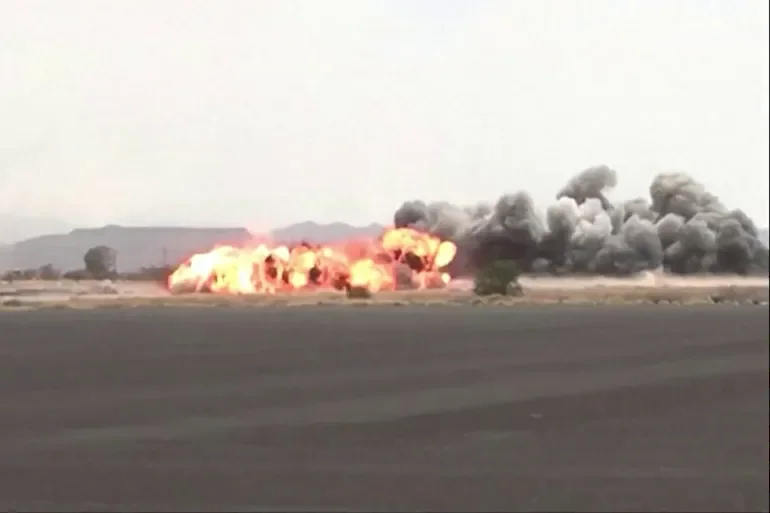
SadaNews - The announcement by the Yemeni Ministry of Defense regarding the bombing of the runway at Sanaa Airport has renewed tensions between the Houthis and Saudi Arabia, bringing it back to the forefront of the regional scene after a phase of relative calm.
The escalation came in the wake of an attempt by a plane belonging to the Iranian airline "Mahan" to reach areas under Houthi control, which Tehran and its allies framed as an effort to break the restrictions imposed on air traffic to Yemen.
After the plane was unable to land at Sanaa Airport due to the bombing of its runway as announced by the Yemeni Ministry of Defense, it headed to Hodeida Airport, which is under Houthi control, according to reports circulated by Iranian media.
This incident turned a flight into one of the focal points of regional escalation in a crisis where Tehran's relationship with the Houthis intersects with the path of Iranian-Saudi de-escalation, alongside the US-Iran confrontation and rising tensions in the Red Sea and Bab el-Mandeb.
It also raised questions about Tehran's priorities at this stage: Does it insist on controlling tensions to maintain its understanding with Riyadh, or does it consider breaking the restrictions on Houthi-controlled areas and supporting their position as a priority that outweighs the de-escalation efforts?
Iranian Caution
The official Iranian position was cautious in tone, as Foreign Ministry spokesman Ismail Bakayi condemned the attack on Sanaa Airport, describing it as a violation of international law and the United Nations Charter, as well as Yemen's sovereignty and territorial integrity.
Bakayi stated that targeting a civilian airport and threatening the safety of a passenger plane contradicts international aviation rules. He also considered the attack a violation of the ceasefire agreement of 2022 and subsequent understandings aimed at preventing escalation.
He warned that these actions jeopardize the political process and ongoing efforts to reach a peaceful solution in Yemen, announcing Iran's readiness to help advance the political process and implement the roadmap aimed at achieving sustainable peace and stability.
The Iranian statement did not include a direct threat to Saudi Arabia or an announcement of counter-military steps, reflecting the Iranian Foreign Ministry's adherence - so far - to a political and legal discourse that does not break from the path of de-escalation between Tehran and Riyadh.
In contrast, some Iranian media close to the conservative stream reflected a sharper tone, framing Iranian flights to Houthi-controlled areas as a step to break the air blockade, linking their continuation to the reconfiguration of the balance of power in Yemen.
Breaking the Blockade
Political researcher Hussein Bak argues that Iran was not surprised by the possibility of renewed confrontation between the Houthis and Saudi Arabia, as it was, in his estimation, part of the planning and movement aimed at breaking the blockade imposed on Yemen.
Bak says in an interview with Al Jazeera Net that information circulating among those concerned with the Yemeni file indicates that decision-makers in Tehran saw it as essential for the Mahan plane to land — regardless of the circumstances — at one of the airports in Houthi-controlled areas.
He believes that the failure of the plane to return — after the bombing of Sanaa Airport — and its landing at Hodeida Airport instead, which had sustained significant damage during previous rounds of fighting, reflect the seriousness of Iran and the Houthis in continuing the path of breaking the air blockade.
According to Bak, Iran's current priority is to break the blockade on Yemen and support the Houthis in their confrontation with the United States, more than maintaining the existing understanding between Tehran and Riyadh.
He adds that significant changes have occurred in the military and security structure in areas controlled by the Houthis due to the conditions of war, including the enlistment of a large number of individuals during the recent period.
He refers to information indicating the existence of approximately 1.1 million individuals in military service and believes that providing military and living capabilities and forms of general support for these forces represents a priority for Iran at this stage.
There are no independent sources to verify the number that Bak mentioned regarding the Yemeni forces, and his statements about Iran's involvement in planning to break the blockade reflect his political estimation, which has not been officially declared by Iranian authorities.
Bak believes that among Tehran's priorities is to equip the Houthis with the capabilities to enhance their control over the Bab el-Mandeb Strait, including the appropriate weapons to achieve that.
Calculated Support
For his part, international security researcher Aref Dehghandar believes that decision-making centers in Tehran view the recent developments as extending beyond the internal Yemeni crisis, placing them in the context of redefining the rules of engagement at the regional level.
Dehghandar says in a statement to Al Jazeera Net that Tehran interprets the attack on Sanaa Airport as part of what it considers American-Israeli arrangements aimed at exerting pressure on its regional allies and increasing indirect pressure on Iran.
In contrast to Bak, Dehghandar expects that Iranian support at this stage will remain within diplomatic and political levels, alongside strategic coordination at the leadership level.
This support, in his estimation, includes the official condemnation of the attack, sending a plane to break the air blockade imposed on Sanaa, in addition to continued coordination with the Houthis.
He believes that Tehran is not currently seeking to escalate tensions with Riyadh, but the continuation of this approach is linked to Saudi behavior in the coming phase and the extent of its involvement in any moves aimed at weakening the Houthis.
Dehghandar describes Yemen as a smart card that Iran could employ in major regional files, but it has not done so seriously since the last war.
He believes that Iran cannot remain idle in the face of continued attacks on the Houthis or attempts to weaken them, especially if they coincide with rising American pressure on Tehran in the southern region and the Strait of Hormuz.
He concludes that Iran might resort to activating the Bab el-Mandeb card if US actions against it continue, or if Saudi Arabia moves within the US policy aimed at weakening the Houthis.
Source: Al Jazeera
 Follow the latest Sada News via Google News
What Do Syrians Expect from the New People's Assembly?

Water and Food Shortages Threaten Displaced People in Southern Lebanon

Between De-escalation and Bab el-Mandeb.. How Does Tehran View the Escalation in Yemen?

Russia Bombs Kyiv Following Announcement of European Alliance to Enhance Support for Ukrai...

Britain Classifies the IRGC as a Threat to National Security

Airstrikes Target Sanaa Airport, Houthis Blame Saudi Arabia

Sudan.. Death Sentence Issued Against Hemetti and the Defense Council Welcomes Mediation E...
