

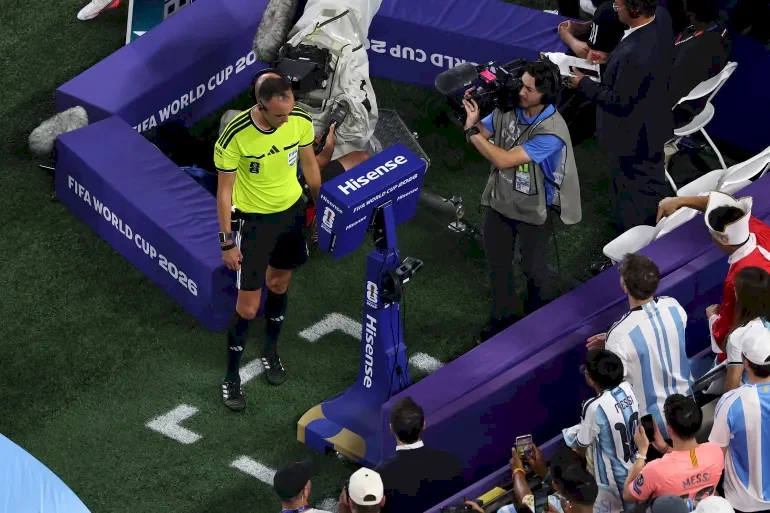
The "VAR-gentina" Theory: How Did Referee Decisions Ignite Allegations of Favoritism Towards Messi and His Teammates?
SadaNews - The brilliance of the legend Lionel Messi has played a key role in leading Argentina to the anticipated World Cup semi-final against England in Atlanta on Wednesday. However, the reigning champions' journey to the last four has been overshadowed by conspiracy theories circulating online, claiming, without evidence, that they were receiving assistance.
Social media is flooded with satirical videos and AI-generated images that bolster this narrative, whether showing FIFA President Gianni Infantino and Messi in a warm embrace aboard the "Titanic" in the style of Leonardo DiCaprio and Kate Winslet, or simply superimposing Infantino's face into the heart of the "Sun of May" in the middle of the Argentine flag.
Among the controversial refereeing decisions, we highlight the key incidents that fueled the conspiracy theories:
Messi Escapes a Red Card
During Argentina's victory over Algeria in the group stage, with the reigning champions leading 1-0, captain Lionel Messi slid his foot over the right calf and Achilles tendon of Algeria's captain Aissa Mandi in the 30th minute.
Polish referee Simon Marciniak awarded a free kick to Algeria, but Messi did not receive any further punishment and later ended the match with a hat-trick.
However, several analysts emphasized that Messi committed a foul deserving of a red card, and that, according to the law, he should have been shown a red card, which would have led to his suspension.
ESPN analyst and former Manchester City defender Nedum Onuoha stated: "In my opinion, it should have been a red card." He added: "Messi knew he had done something that could get him in trouble. Personally, I see it as a red card."
Former Bundesliga international referee Patrick Ittrich agreed, saying: "For me, that’s a red card. We have numerous examples from the Bundesliga where such an intervention was punished with a red card. According to the law, it is a red card. If I had seen it in that way on the field, I would have shown the red card."
The Algerian Football Federation later filed an official complaint with FIFA regarding the "refereeing injustice" in the match.
Egypt's Protests
Argentina staged one of the greatest comebacks in World Cup history to maintain their campaign, overturning a two-goal deficit to win 3-2 against Egypt in the Round of 16.
However, Egyptian players and coaching staff expressed their anger over several decisions made by French referee Francois Letexier that favored Argentina at crucial moments.
The most contentious point after the match was about a goal scored by the Egyptian team in the second half, which was disallowed after intervention from the Video Assistant Referee (VAR) who detected a foul on an Argentine player several plays prior to the goal scored by Mustafa Ziko on the other end of the field.
Analysts questioned whether VAR had overstepped its authority.
Former English international referee Mark Clattenburg stated: "VAR was looking too deeply for something that happened in the match to disallow the Egyptian goal."
Egypt's coach Hossam Hassan also believed his team deserved a penalty during the attack that preceded Enzo Fernandez's late winning goal for Argentina. Hassan said: "It seems there's pressure on the referee from the Argentine side that led to this result."
He added to "beIN Sports": "Perhaps they wanted to keep the champions of the world in the competition? Maybe they wanted Messi to stay in the race? In football, sometimes there are external factors that transcend the technical aspects."
In response, FIFA's chief referee Pierluigi Collina described the Egyptian claims as "baseless."
Crucial VAR Decision
A critical VAR intervention also helped shape Argentina's 3-1 victory after extra time against Switzerland in the quarter-finals in Kansas City on Saturday.
In the 70th minute, referee Joao Pinheiro issued a yellow card to Argentine Leandro Paredes for a foul on Breel Embolo, shortly after Switzerland equalized 1-1 and gained control.
However, a VAR review under FIFA's new "Mistaken Identity" rule concluded that Embolo was the one who committed the foul by simulating a fall, leading to the annulment of the initial decision. Since Embolo had already received a yellow card, he was shown a red card and sent off, leaving the Swiss team with ten players and halting their momentum. Argentina went on to seize victory in extra time.
Switzerland's coach Murat Yakin said after the match: "We were punished due to a rule, which I believe is completely unacceptable."
However, many commentators pointed out that Embolo was rightly punished for clear simulation.
Nancy Armour wrote in "USA Today": "If you want to say that FIFA is manipulating the World Cup in favor of Lionel Messi and Argentina, and some of you are determined to do so, you need to present a better argument than this."
Meanwhile, Kristina Unkel, a refereeing analyst on ITV who previously officiated international matches, stated: "I don’t think this protocol should have been applied in the first place, because its scope is overly broad."
She added: "What I find difficult to accept is that we're not just changing the identity of the player who received the card, but we're changing the original decision itself, from awarding a free kick in one direction to a completely contrary decision. We're effectively rewriting the basis of the decision."
She continued: "I believe this puts us officially in the area of re-refereeing, which the VAR system has been trying to avoid from the beginning."
Instead of calming the controversy, Argentina's benefit from this protocol, which prompted critics on social media to label it "VAR-gentina," has heightened fan tensions.
Unkel told Reuters: "This new expansion of the protocol without adequate testing, and without a real understanding of whether it achieves the intended purpose, is like a powder keg. I feel we’re only waiting for the last spark."
Source: Al Jazeera + Agencies
 Follow the latest Sada News via Google News
The "VAR-gentina" Theory: How Did Referee Decisions Ignite Allegations of Favoritism Towar...

What Happens to Your Brain When You Watch the Sunrise or Sunset? A Study Answers

As the Final Match Approaches.. How Can We Psychologically Benefit from Following the Worl...

Syria Qualifies for the U-18 Asian Basketball Cup... Is the World Cup Dream Coming Closer?

Why Does Spain’s Star Carry the Name "Lamine Jamal"? The Touching Story Behind the Name

Egypt Aims to Host Africa Cup of Nations 2028 Following Achievements in World Cup 2026

World Cup: Spain Advances to Semi-Finals with Late Victory over Belgium
