

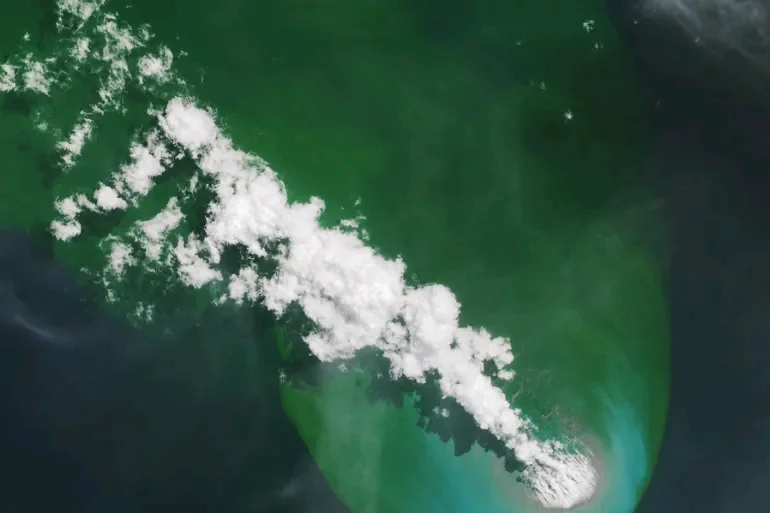
The Earth Gives Birth to an Island from Nothing.. Satellites Document "Volcanic Labor"
SadaNews - It is not new for satellites to observe a volcanic eruption, but what is new about the volcanic eruption occurring in the depths of the Bismarck Sea near Papua New Guinea (southwestern Pacific Ocean) is that it could result in the emergence of a new island above sea level.
The story began on May 8 when satellites captured unexpected indicators of underwater volcanic activity, and in the following weeks, satellite images showed columns of steam and ash rising above the sea surface, alongside a noticeable change in the color of the waters surrounding the eruption site, confirming the continued flow of volcanic materials from the ocean floor.
Although the volcano is hidden from view in the depths of the sea, its effects quickly reached coastal communities in the Louisiade Arcipelago of Papua New Guinea, as its eruption led to the production of massive quantities of pumice stone, a type of lightweight volcanic rock filled with air pockets, allowing it to float on the water's surface for extended periods.
With the movement of ocean currents, huge blocks of this rock began to drift toward nearby islands, and images captured by the Landsat 8 satellite on June 4 showed wide bands of pumice spreading across the sea surface.
A few days later, local reports indicated that some coastlines had become covered with thick layers of floating volcanic rock, reaching several meters in thickness in some areas, hindering residents' access to water and affecting fishing and maritime transport activities.
The islands of "Lou" and "Baluan" were among the most affected areas, and the impacts extended to the larger "Manus" Island, located about 125 kilometers from the volcano's site.
Will the volcano give birth to a new island?
Scientists see one of the most exciting aspects of this event to be the possibility of a new island forming.
When underwater volcanoes continue to eject lava, ash, and rocky materials, these materials gradually accumulate above the sea floor. If the process continues long enough, this accumulation may rise above sea level, creating new land that didn’t exist before.
However, researchers point out that such islands are often temporary, as they can be subject to rapid erosion from waves, storms, and ocean currents, leading to their disappearance shortly after their emergence.
Environmental Benefits and Risks
While the pumice blocks cause problems for local residents, they sometimes play an important environmental role, acting as floating platforms that carry various marine organisms, like algae, microbes, and some invertebrates, helping them to travel long distances across the ocean.
Conversely, researchers warn of potential negative environmental impacts, as the accumulation of pumice on the water surface may block sunlight from reaching seagrasses and coral reefs, limiting the photosynthesis necessary for their survival. Volcanic rocks can also cause direct damage to sensitive coral reefs.
Previous studies indicate that some fish and marine organisms may ingest small pieces of pumice thinking they are food, which could lead to their death or harm their health.
Source: Al Jazeera + Agencies
 Follow the latest Sada News via Google News
Samsung Asks Its Users to Share Their Data.. What's the Story?

The Earth Gives Birth to an Island from Nothing.. Satellites Document "Volcanic Labor"

How Does Colon Cancer Transform into a Version Capable of Invading the Liver?

The "VAR-gentina" Theory: How Did Referee Decisions Ignite Allegations of Favoritism Towar...

What Happens to Your Brain When You Watch the Sunrise or Sunset? A Study Answers

As the Final Match Approaches.. How Can We Psychologically Benefit from Following the Worl...

Syria Qualifies for the U-18 Asian Basketball Cup... Is the World Cup Dream Coming Closer?
