

Remarkable Academic Achievement for Student Susanna Bdeir in the Field of Neuroscience at An-Najah National University
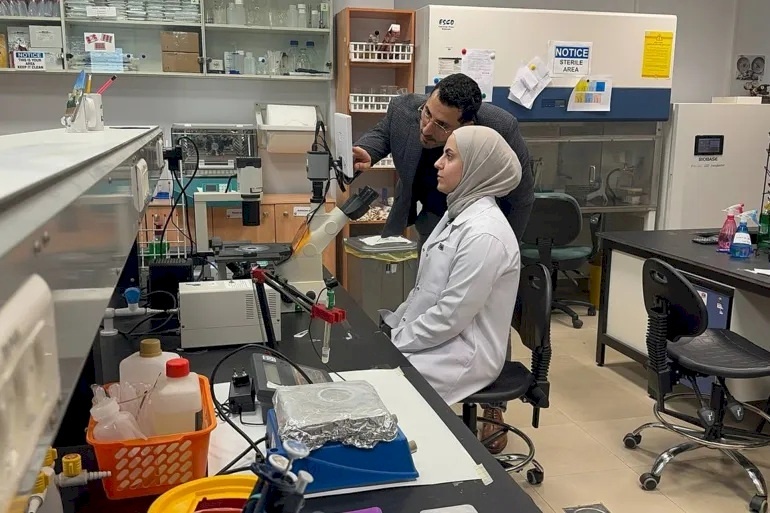
SadaNews - At the distinguished Neuroscience Lab of An-Najah National University, student Susanna Bdeir from the Faculty of Medicine and Health Sciences continues to achieve remarkable scientific accomplishments, balancing her academic journey with advanced research in the field of neuroscience.
Susanna started her first steps in scientific research six years ago, where the lab became an essential part of her university day, focusing on studying neural receptors in the brain, specifically the "AMPA" receptors responsible for transmitting neural signals.
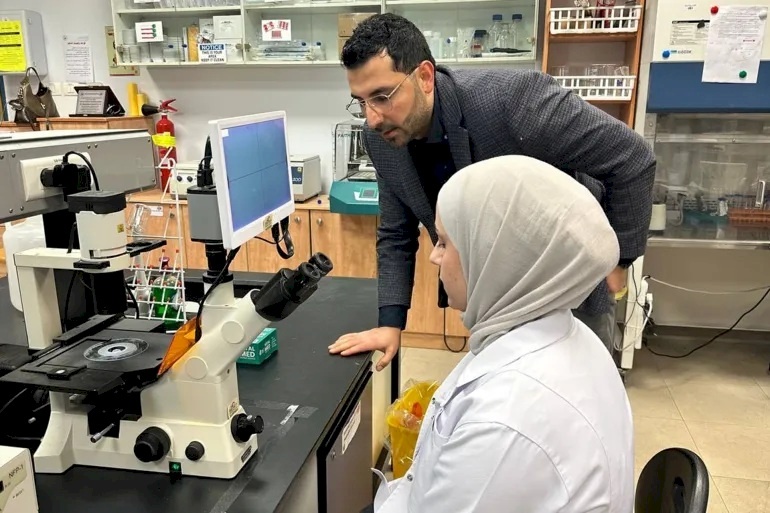
In this field, Bdeir explained that her research focuses on analyzing the motor activity of these receptors and their response to chemical and natural compounds, aiming to expand the understanding of their mechanisms and various effects.
Her most recent research, published last March titled
"Auxiliary TARP Subunits Define AMPA Receptor Pharmacology and Function,"
highlights the impact of new chemical compounds on the activity of these receptors, using precise electrophysiological techniques at the cellular level.
The study focused on testing eight chemical compounds, with results showing that these compounds act as regulatory inhibitors that reduce the intensity of neural signals and accelerate the closure of ion channels, opening the door for the development of potential drug treatments, especially for conditions related to neural hyperactivity such as epilepsy.
Bdeir joined the Faculty of Medicine at An-Najah National University after attaining a score of 99.1 in her high school diploma, and was able to engage early in a research team within the medical faculty, completing around 25 scientific research projects to date that explored neurons and their relationship with several diseases.
Bdeir confirms that her experience in scientific research, despite its initial difficulties, helped her develop time management skills and maintain a balance between studies and research projects. She has also participated in interdisciplinary research, including using artificial intelligence techniques for early detection of myocardial infarction via electrocardiography (ECG).
For his part, laboratory supervisor Dr. Mohammed Quneibi explained that the idea of creating a research lab that includes medical students from their first years has turned over eight years into a model to be emulated in medical faculties in the West Bank, and the lab has achieved global awards for its published research.
Quneibi noted that Susanna was among the first students to join the lab, asserting that her extensive scientific publications, along with the substantial engagement with her research, reflect the importance of early research work and its role in enhancing students' academic journeys.
He added that the belief in students' abilities from their early years was the cornerstone of this success, indicating that his support and confidence in the potential of students, including Susanna Bdeir, were a true driving force for them to engage in scientific research early on. He confirmed that this vision, which focuses on empowering first-year students and providing them the opportunity for creativity and scientific production, has contributed to breaking the traditional image of the limited role of students at the beginning of their university years, and has proven that students are capable of achieving advanced research accomplishments when provided with a supportive environment and effective supervision. He emphasized that his belief in Susanna and the other students was a pivotal factor in achieving these successive successes.
Additionally, Dr. Abdul Nasir Zaid, the university president, praised Susanna's achievement and affirmed that the university allocates all its resources to serve its students, hosting distinguished talents in all fields and supporting students and academics in their scientific and research endeavors. Regarding the neuroscience center, he noted that it is considered the first specialized laboratory for medical research in the universities of the West Bank.
 Follow the latest Sada News via Google News
Ooredoo Palestine Wins the Award for "Best Employer in the Telecommunications Sector" at T...

Palestinian Insurance Companies Union Achieves Qualitative Milestones and Enhances the Dev...

Two Palestinians Win Membership in the Inaugural Cohort of the Global "Azm" Fellowship for...

During a press conference.. An-Najah National University showcases its most significant ac...

"Jerusalem Electricity" Discusses Enhancing Cooperation with the Municipalities of Ramalla...

Jerusalem Governorate Water Utility Strengthens Partnership with Local Authorities to Miti...

The Higher Council for Public Procurement Policies Launches the First Phases of the Electr...
