
Mas Institute Launches This Year's Series of Round Tables with a Discussion on Economic and Social Rights in the Draft Temporary Constitution of the State of Palestine
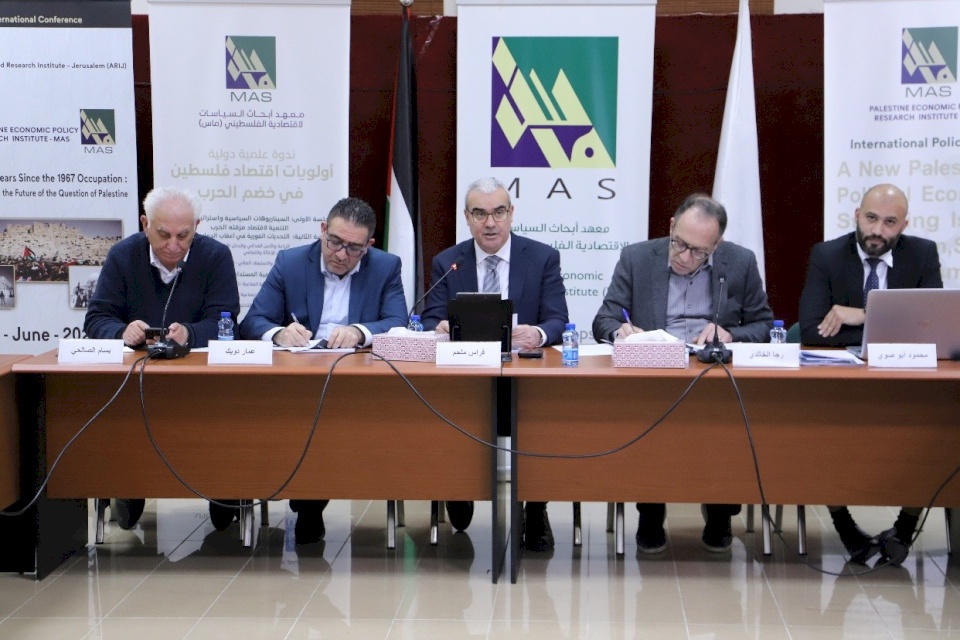
SadaNews - The Palestinian Economic Policy Research Institute (Mas) held its first round table meeting for the year 2026 to discuss "Economic and Social Rights in the Draft Temporary Constitution of the State of Palestine from a Comparative Perspective," both in-person at the institute's headquarters and via Zoom. The background paper was prepared by lawyer Dr. Mahmoud Abu Sway, a lecturer in constitutional law, while Mr. Raji al-Khalidi, a researcher in Palestinian economic development, Dr. Ammar Dweik, a member of the temporary constitution drafting committee, and Mr. Bassam al-Salhi, also a member of the committee, presented their contributions and comments on the paper.
At the beginning of the meeting, the general director of Mas Institute welcomed the participants, including experts and representatives from various sectors, emphasizing the significant importance of discussing the draft temporary constitution of the State of Palestine.
In his presentation of the paper, Abu Sway provided a comprehensive analysis of economic and social rights in the Palestinian constitution draft of 2026, noting that the draft adopts a more comprehensive and progressive approach to economic and social rights compared to the Basic Law of 2003, through the explicit recognition of these rights. He highlighted that the constitution guarantees a wide range of rights, most notably ensuring decent work opportunities with healthy conditions and fair and equal wages, the right to mandatory and free education, ensuring equal opportunities in higher education, alongside guaranteeing the independence of academic institutions and research freedoms, the right to physical and mental health and providing free treatment for low-income groups, the right to housing and a decent standard of living, the right to water and a healthy environment, along with protection for vulnerable groups such as children, people with disabilities, the elderly, and families in extreme need. He explained that this comprehensive rights system reflects a clear trend towards establishing a social state model that balances between economic freedoms and social justice.
The researcher highlighted the key transformations in addressing rights compared to the Basic Law:
He also pointed out the key transformations in addressing rights compared to the Basic Law. The draft reflects a practical trend by linking rights to executive commitments that obligate the state to take necessary measures to ensure their realization, sometimes gradually, through adopting fair social and economic policies. Additionally, the constitution expands the scope of rights to include new areas that were not previously directly stated, such as the right to water, mental health, and sports participation, along with the development of some existing rights. The constitution also emphasizes promoting the social dimension of the economic system, primarily by preventing monopolies on essential goods and services, and linking the economic system to principles of mixed economy and social justice. The constitution commits to a general trend of enhancing social justice and sustainable development by linking several economic and social rights to public policies.
The researcher also mentioned international standards and comparative experiences, especially the core standards in the International Covenant on Economic, Social, and Cultural Rights, and some national constitutions (South Africa, Egypt, Tunisia), which adopted the principle of gradual realization of rights according to available resources, paying special attention to protecting the most vulnerable groups, such as children, people with disabilities, and the elderly.
Among the challenges the researcher pointed out in the draft constitution are several substantive issues that may affect the effectiveness of these rights and their binding nature, mainly reflected in the weak judicial enforcement mechanisms and accountability, alongside the lack of clear specification of the financial obligations associated with economic and social rights. There is also limited linkage between rights and public policies, along with structural confusion and dispersion of rights, making it difficult to distinguish between economic freedoms and aspirations. Abu Sway emphasized the need for clearer definitions of institutional responsibilities and enhancing coordination mechanisms among different parties to ensure the effective implementation of these rights.
The researcher presented three main pathways to address these challenges, starting with maintaining the current texts while leaving implementation to ordinary legislation, alongside enhancing and reorganizing constitutional texts for freedoms and economic and social rights more clearly and logically, with clear obligations on the state, leading to linking economic and social rights with financial and developmental policies to ensure practical application.
The researcher concluded his presentation by offering a series of recommendations aimed at linking economic and social rights with developmental policies and national plans to achieve integration between constitutional recognition and practical implementation, alongside developing accountability and judicial enforcement mechanisms, and enhancing constitutional financial obligations. He stressed the need to separate economic freedoms from social rights and clarify their structural nature, and to clarify institutional and organizational responsibilities and coordination mechanisms between relevant entities to ensure practical application with follow-up mechanisms to evaluate the effectiveness of implementation through the competent authorities.
In his comments on the paper, Al-Khalidi emphasized the necessity of clearly distinguishing between economic freedoms and social rights, asserting that mixing them weakens the clarity of the draft constitution. He suggested in this context that Article 41 be dismantled and its contents redistributed, so that economic freedoms are listed separately from social rights. He also indicated that the constitution cannot define the nature of the market or legislate for it directly. He highlighted the importance of drafting a temporary constitution in an occupied state, citing that despite limited sovereignty, this constitution is a definition of the national project and can form a unifying vision.
Meanwhile, Dweik pointed to the importance of discussing the topic, noting that the draft constitution has not been previously discussed in such depth and analysis. He explained that the committee tasked with drafting the constitution has been given three months to complete it, assuring that they will study all the notes and proposals submitted. He considered that the South African model is the closest to the Palestinian case, especially regarding the measures that the state must take to guarantee rights. He clarified that Article 41 represents a principle or a public policy rather than a right in itself, and it should be included in the preamble of the constitution.
For his part, Al-Salhi emphasized the need to begin discussions from what already exists, stressing the importance of achieving greater clarity in distinguishing between economic freedoms and social rights within the constitutional text. He called for setting a clear and defined framework for these rights in the constitution, ensuring they are not subject to external interventions. He also pointed to the importance of a referendum, noting that the constitutional committee welcomes all notes and proposals.
Participants in the meeting emphasized that the role of the state is a fundamental element in defining rights and ensuring their enforcement, while they pointed out that the definitions provided are still vague and require further specification and precision. They also noted the absence or ambiguity of texts related to the right to litigation in the area of economic rights, emphasizing the importance of ensuring that the constitution adapts to the changing circumstances in Palestine, enhancing its flexibility and ability to respond to current and future challenges.
 Follow the latest Sada News via Google News
Soaring Oil Prices Burn the Pockets of the Palestinian Citizen "The Poor"

Millions of Dollars in Losses.. "SadaNews" Reveals Shocking Figures for Traders from Pales...

The Problem of Shekel Overcrowding Worsens.. Fuel Station Owners Threatened with Closure o...

The Palestinian Economy at a Crossroads: 4 Files Awaiting Resolution

بنك إسرائيل يخفض توقعات النمو ويحذر من ارتفاع العجز

Exchange Rates of Currencies Against the Shekel on Tuesday (July 21)

Inflation Expectations in Israel Stabilize at 1.5%
