

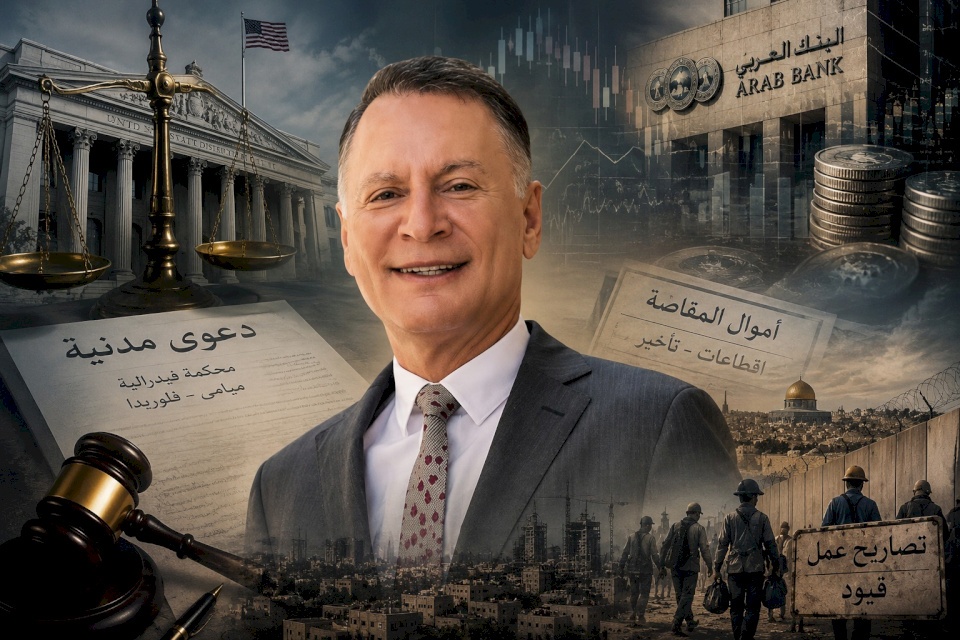
323 Plaintiffs in Miami… How Palestinian Investments Become a Legal File with Political Dimensions in Washington?
Investment in politically unstable environments has ceased to be merely a neutral economic activity; it has increasingly become part of a complex web wherein legal and political considerations intertwine, allowing a financial profile to quickly transform into a cross-border legal matter that reshapes the facts within contexts that extend beyond the economic act itself.
This is reflected in the lawsuit currently before a federal court in Miami, Florida, filed against Palestinian-American businessman Bashar al-Masri, a case that reignites the debate over the boundaries between investment and legal responsibility in conflict areas.
According to court documents, al-Masri and his affiliated Palestinian companies face a civil lawsuit brought by 323 American plaintiffs representing 80 families of victims and survivors from the events of October 7, 2023, based on the U.S. Anti-Terrorism Act, which allows for expansive compensatory civil claims.
This large number of plaintiffs, representing dozens of families, gives the case significant legal and humanitarian weight from the outset, turning it into a complex judicial trajectory where facts are reconstructed within extended legal narratives that intertwine responsibility with political and geographical contexts.
In response, al-Masri's defense team filed an official motion to dismiss the lawsuit, asserting that all the claims lack any legal basis or direct evidence, and fail to meet the required standard of proof in federal civil cases.
The defense emphasizes that there is no direct or indirect connection between Bashar al-Masri or his companies and any unlawful activity, and that the claims made in the lawsuit rely on inferences linking economic activity and the geographical environment in Gaza, without tangible evidence proving a causal relationship.
The legal team believes that this type of reasoning expands the concept of responsibility to include "context" rather than "action," which raises a fundamental legal issue regarding the limits of investment accountability in conflict areas, and whether it can become a suspect element simply due to its geographical and political ties.
Economically, Bashar al-Masri's presence in the Palestinian scene extends over 30 years of investment, including major projects such as the development of Rawabi city in the West Bank, along with investments in real estate, energy, and technology sectors, within a declared vision that aims at supporting the economic structure and generating job opportunities.
However, this investment trajectory finds itself today within an American judicial space that redefines the relationship between the economy and politics, raising deeper issues beyond the limits of this lawsuit: To what extent can economic action be separated from the political context in conflict environments, or have they become interlinked in a way that one automatically reproduces the other?
This case, in its broader dimension, reflects a recurring pattern in the American judicial system, where international civil lawsuits transform into open arenas for reshaping responsibility within intertwined legal and humanitarian narratives that often transcend direct action boundaries.
In the Palestinian situation, this complexity is exacerbated by the fragility of the economic structure and its reliance on foreign investments and funding networks, making any economic activity susceptible to reinterpretation within multiple political and legal contexts.
Despite this, the defense maintains that expanding the concept of responsibility in this manner sets a dangerous legal precedent, as it could open the door to holding any investment in conflict zones accountable without direct proof of wrongdoing, based solely on contextual connections.
Ultimately, this case reveals a deeper transition from being an individual legal dispute to a moment where the relationship between economics, law, and politics is redrawn, making the investment itself part of a sensitive international equation that is not settled solely within the courtroom, but extends to a wider realm of global political influence and interpretation.
 Follow the latest Sada News via Google News
Between Pragmatism and Survival Management: Where Does Hamas Go After the Election of Khal...

Khalil Al-Hayya as President of Hamas.. Continuation of the Founders' Approach

The Annihilation of Sportsmanship

Until When Will the Palestinian Citizen Pay the Price of an Endless Phase?

7-10 Billion Shekels.. The Bill for the Absent Worker from Brussels

Why Does Marwan Barghouti Remain the Key to Unity and Settlement?

The Joy That Passes Through Barriers
