

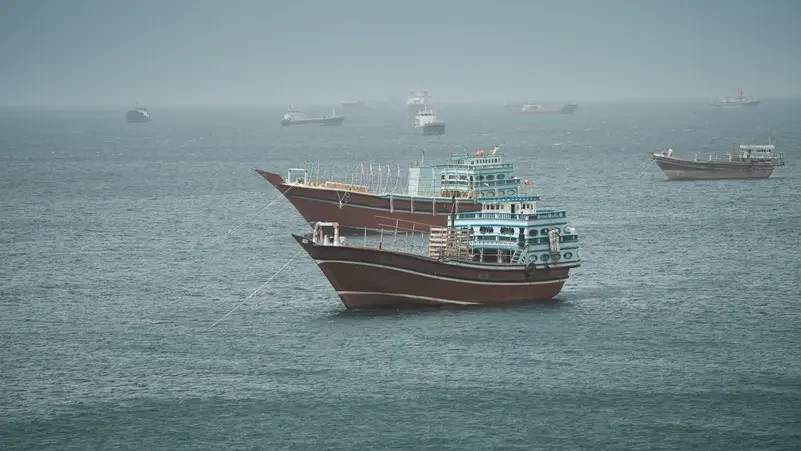
From Hormuz to the North Sea: How Do Seas Become Arenas for Global Wars?
SadaNews - The world seems to be heading towards a multi-front maritime war extending from the Strait of Hormuz to the North Sea, which may not only affect oil prices but also threaten the international system based on freedom of navigation and maritime law, amid the growing unipolarism of major powers.
British Guardian writer Simon Tisdall states that the U.S. military campaign to protect commercial ships in the Strait of Hormuz is not the first of its kind historically, as America had previously sent a fleet to the Mediterranean Sea in the 1820s to protect its trade from pirates.
Tisdall explains that the American goal at that time - as is the case today - was not to spread democracy or change regimes, but rather to protect economic and commercial interests. He notes that Washington has historically defended the principle of freedom of navigation, despite its failure to ratify the 1982 United Nations Convention on the Law of the Sea.
According to the writer, the Trump administration weakened this principle when it hinted at imposing tolls on passage through the Strait of Hormuz before partially retracting, whereas the memorandum of understanding signed with Iran accepted Tehran's and Oman’s right to collect revenues from transit traffic, which the writer sees as a precedent that may encourage other countries to take similar steps.
Maritime Tensions
Tisdall warns that this shift could drive countries controlling strategic maritime corridors - such as Indonesia in the Malacca Strait, Turkey in the Bosporus, or Spain in the Strait of Gibraltar - to impose fees on ships, potentially disrupting global trade and supply chains, especially as about 80% of the world's traded goods by volume pass through the sea.
The writer believes that maritime tensions are not limited to the Middle East, but extend to the Red Sea, where the Houthis - allied with Iran - have begun imposing a blockade on the Bab al-Mandab Strait and targeting oil tankers, in a move seen as an extension of the Hormuz crisis and a new threat to global energy markets.
In East Asia, Tisdall points to the escalating confrontation in the South China Sea and the Taiwan Strait, accusing Beijing of ignoring international law by constructing military islands and reinforcing its territorial claims, despite the Permanent Court of Arbitration's decision in 2016 rejecting most of its sovereignty claims.
He also highlights the rising tensions between China and Japan after a Chinese destroyer conducted live-fire drills within Japan's economic zone, amid fears of a confrontation over Taiwan.
Gray Zone Warfare
Tisdall adds that Russia represents another front in this maritime conflict, as it has expanded its military operations in the Baltic Sea, North Atlantic, and North Sea, intensifying its activities near European maritime infrastructure, including pipelines and communication cables, within what he calls a "Gray Zone War." He considers that recent Russian naval exercises near British shores reflect an escalating confrontation with NATO.
The writer reviews a series of other incidents that he believes confirm the decline in commitment to international law, such as the United States sinking an Iranian ship near Sri Lanka, clashes between China and the Philippines, President Trump's threats to annex Greenland, and tests of Chinese nuclear submarines, developments that fuel an accelerating maritime arms race and prompt other countries to increase defense spending and enhance their naval capabilities.
Tisdall concludes that the world is witnessing a gradual collapse of the rules of maritime cooperation that have developed over centuries, with a decline in respect for international law and common interests, as a policy of enforcing facts by force takes the place of international consensus, threatening freedom of navigation, trade, and global security.
Source: Guardian
 Follow the latest Sada News via Google News
For 80 million euros.. Barcelona settles its position on selling Raphinha to Al-Hilal

From Hormuz to the North Sea: How Do Seas Become Arenas for Global Wars?

Law to Restructure Egypt's Future Authority for Sustainable Development

Goodbye to Cavities.. A New Gel That Rebuilds Tooth Enamel

UNESCO Officially Lists the Tunisian Village of "Sidi Bou Said" as a World Heritage Site

Morning Chaos of Choosing Clothes.. Is the "Capsule Wardrobe" the Solution?

Joshua defeats Brinjar by knockout and approaches a fight with Fury
