

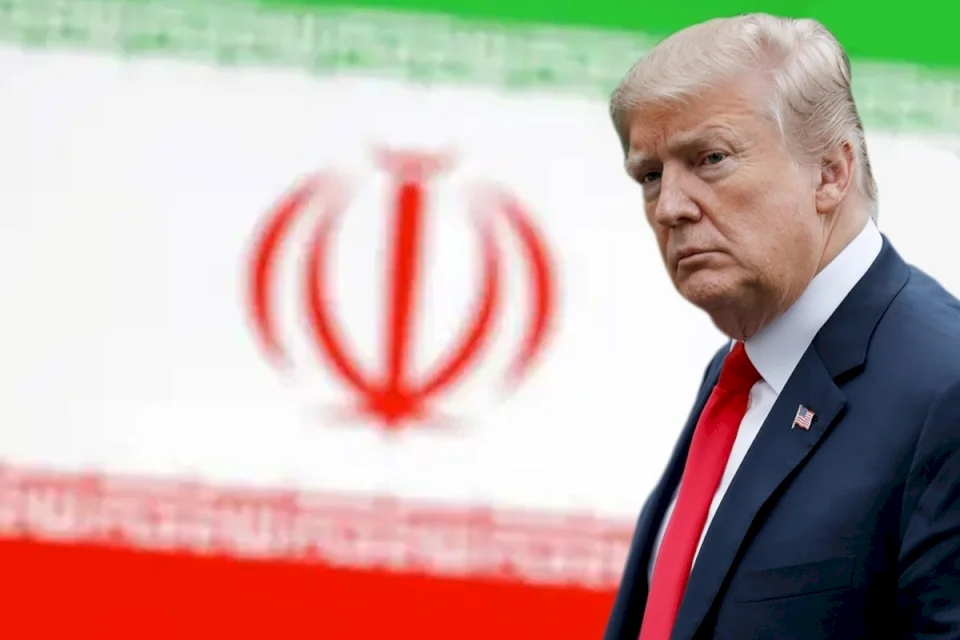
Amid Diplomatic Activity.. Trump Gives Iran the Choice Between Peace and Escalation as His Forces Halt Attacks
SadaNews - U.S. President Donald Trump stated that the Iranians are communicating with Washington, suggesting they are unlikely to reach an agreement. He touched on Iran's military capabilities, saying: "Iran does not have many drones left."
This statement came during his attendance at the White House Correspondents' Dinner, late Friday to Saturday night.
Prior to that, in remarks from the White House, Trump indicated the possibility of ramping up attacks on Iran due to their unwillingness to agree to any deal.
The U.S. president believed that Tehran was not ready to sign an agreement, pointing out that Washington has many options including intensifying military strikes and completely destroying them. Trump also confirmed that the U.S. administration is currently in talks with the Iranians.
In a series of statements, Trump noted that Iran's position is becoming more serious day by day, emphasizing that the U.S. military is in a state of maximum readiness.
Although the U.S. military had not reported any strikes on Iran for about two weeks, Reuters published images, citing eyewitness accounts, of American bombing targeting the city of Ahvaz in southwestern Iran.
In the past few days, Trump threatened to expand the list of targets in Iran to include energy facilities and bridges, and to send ground troops to seize Khark Island, Iran's oil export hub, in addition to bombing a deep underground site linked to the nuclear program known as "Pickaxe Mountain."
Trump stated yesterday, Friday, that he has not yet made a decision regarding the implementation of new major attacks.
In response to a question about an exit strategy from the Iran war, Trump said: "There is a military exit, which involves continuing what we are currently doing, and we could ramp up the strikes, which would lead to eliminating everything they have. There is a smarter strategy, which is to reach an agreement."
However, he concluded his remarks by saying: "We are on high alert and ready to move."
Halting the Attacks..
The U.S. military conducted airstrikes on Iran on Thursday night and early Friday for the thirteenth consecutive night, prompting Iran to launch missiles towards neighboring Arab countries hosting U.S. military bases.
For the first time in 13 nights, the U.S. military did not carry out any new strikes.
On Friday night, the U.S. military reported that it fired on another commercial vessel attempting to breach the blockade imposed on Iranian ports.
Captain Tim Hawkins, spokesman for U.S. Central Command, stated that American forces disabled the tanker "MT Lavin" in the Gulf of Oman on Friday after the ship attempted to breach the blockade at least four times.
Hawkins confirmed that the crew was warned, but they did not comply with orders, prompting the U.S. military to fire on the engine room.
This is the second commercial vessel to be disabled since the U.S. military reimposed its blockade on Iran.
U.S. Central Command "CENTCOM" announced that it had redirected 12 other ships attempting to breach the blockade imposed on Iran.
The United States resumed its maritime blockade against Iran on July 14, due to Tehran's closure of the Strait of Hormuz.
On Thursday, the Iranian Revolutionary Guard announced it had prevented three oil tankers from passing through the Strait of Hormuz. The U.S. response to Iran's ban on maritime traffic in this passage has been to impose a maritime blockade on Iranian ports.
Diplomatic Movement..
Meanwhile, three Pakistani sources indicated that Islamabad is exploring a pathway to resume stalled talks between the U.S. and Iran aimed at ending the war, which has lasted for nearly five months, in a diplomatic initiative backed by China, while Oman has intensified its communications with Tehran regarding maritime security and organizing shipping traffic in the Strait of Hormuz.
The diplomatic moves come at a time when the Wall Street Journal reported that U.S. President Donald Trump has grown increasingly impatient with the continued war and is becoming more skeptical about the possibility of achieving a permanent diplomatic settlement, amid rising military casualties and economic and political pressures within the United States.
Chinese Movement via Pakistan
Reuters reported from Pakistani sources that exploratory discussions took place during the visit of Iranian Interior Minister Iskandar Momeni to Islamabad this week, his second visit in ten days.
Data released by the Pakistani government showed that Momeni, a former commander in the "Revolutionary Guard," met this week with officials from the Pakistani government and Army Chief Asim Munir.
The three sources emphasized that the obstacles hindering the resumption of any talks with the United States remain significant.
Pakistan finds itself in an increasingly complex position as a potential mediator in the upcoming phase, amid continued Iranian attacks on Gulf states and disruptions affecting maritime traffic in the Strait of Hormuz.
Islamabad relies heavily on Beijing, which is a major financial supporter for Islamabad and has direct economic interests in reaching a diplomatic solution that allows for the reopening of key trade routes in the Middle East.
The three Pakistani sources stated that Foreign Minister Ishaq Dar also discussed the new movement related to the Middle East with Chinese officials during his visit to China last week. The sources requested anonymity as they are not authorized to speak publicly on the matter.
A Pakistani government official stated, "The Chinese are discontented because Iran's attacks on other Gulf states and the closure of the Strait of Hormuz harm their interests." He added that disturbances in the Red Sea will also affect another key trade route on which Beijing relies.
Neither Ishaq Dar nor the media wing of the Pakistani army responded to requests for comment.
The Chinese Foreign Ministry stated in a statement that "China supports the mediation efforts being made by Pakistan and other parties."
It added that Beijing will continue to "play a proactive role in restoring peace and stability in the Gulf and the Middle East as soon as possible."
 Follow the latest Sada News via Google News
اعتقالات ومداهمات وتشييع بلا مشيعين.. بلدة تل تحت الحصار الإسرائيلي

Occupation Launches Wide Campaign of Raids and Arrests in the West Bank

Amid Diplomatic Activity.. Trump Gives Iran the Choice Between Peace and Escalation as His...

Occupation Continues Violations of Ceasefire in Gaza Strip

U.S. Intelligence: Iran's New Leader More Inclined Towards Nuclear Weapons

Washington warns its citizens in Israel and the Middle East of possible flight cancellatio...

The Presidency Condemns the Terrorism of Settlers and Holds the Occupation Government Resp...
