

"Backrooms": From Digital Legend to Cinematic Phenomenon
SadaNews - "Backrooms" has proven to be one of the most intriguing films of 2026, not only due to its commercial and critical success but also because of the unconventional way the project was born.
The film is directed by young filmmaker Kane Parsons, who started his journey in the world of "Backrooms" through a series of short videos on YouTube, before the idea transformed into a major film production with support from A24 studio. The film features a number of prominent names, including Chiwetel Ejiofor, Renate Reinsve, and Mark Duplass.
How did Kane Parsons turn an internet nightmare into a cinematic phenomenon?
To understand the significance of "Backrooms", it must be viewed more broadly than merely a successful film with a modest budget; in reality, it is one of the most successful film projects in translating internet content into cinema.
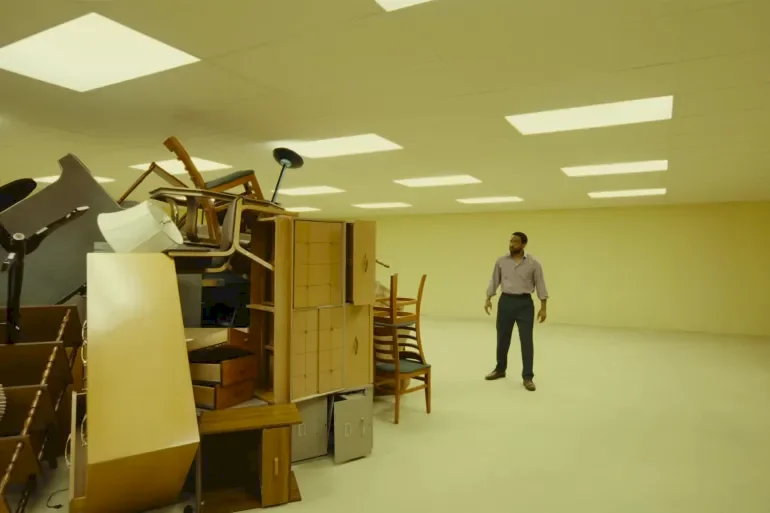
The story begins with an uncredited image that circulated in 2019 on internet forums, depicting an empty yellow room with disturbing lighting. This image quickly morphed into what is known as "Backrooms", a digital legend based on the idea of falling out of reality and entering an infinite maze of similar rooms and corridors.
On the other hand, Kane Parsons, also known online as "Kane Pixels", emerged in 2022 when he posted a short film on YouTube titled "The Backrooms: Found Footage". At the time, Parsons was merely a teenager passionate about visual effects, yet he succeeded in transforming the abstract internet concept into a complete visual experience, blending found footage style with the architectural emptiness that became the hallmark of the "Backrooms" world.
The video achieved massive popularity, followed by numerous clips that expanded the legend and added backgrounds and characters.
Interestingly, Parsons didn't reach Hollywood through short films or festivals but directly through YouTube. A24 noticed the unprecedented success of the series and quickly moved to develop a feature film while retaining Parsons as the project's director, a rare step reflecting the studio's confidence in his artistic vision.
The film "Backrooms" revolves around a psychologist named Mary (Renate Reinsve), who attempts to find one of her patients after they disappear into a mysterious dimension or "Backrooms". Throughout her journey, she discovers an enormous network of rooms and corridors that defy the laws of space and reality, while gradually revealing the connection of this world to feelings of loss, obsession, and escape from pain. As the story progresses, the search for the missing person transforms into a confrontation with a maze that seems to draw its power from human memories and psychological traumas.
"Backrooms" represents a complete transition from online horror to cinema, drawing from a modern legend that has affected millions of internet users, while simultaneously conveying the visual language born on YouTube, retaining many characteristics of "internet horror" based on mystery, emptiness, and existential anxiety. This makes it a pivotal moment in the history of contemporary horror, demonstrating that internet culture can produce cinematic phenomena without the need for a story, video game, or previous film series to build upon.
"Backrooms" and the Maze with No Exit
"Backrooms" does not rely on traditional monsters or chases, but rather on the horror of the place itself. From the moment of entering the first backrooms, a sense of danger and threat begins, with the similar corridors, empty yellow rooms, and the sound of fluorescent lighting; these details become the core horror elements, making the film's visual and sound design among its best attributes. They create a consistent feeling of suffocation and disorientation, even during moments without any direct threat.
This idea indirectly brings the film closer to "Being John Malkovich". In both works, everything starts by crossing a door or a corridor leading to a different reality; however, while Charlie Kaufman uses this world to pose questions about identity and the desire to live the lives of others, "Backrooms" utilizes the maze to ask a different question: What happens when a person loses their sense of place and meaning simultaneously?
This is evident in several scenes where characters pass through the same corridors despite attempts to escape, or when similar rooms become spaces where it is impossible to distinguish the beginning from the end. The film also successfully capitalizes on long silences, tight shots, and the absence of any clear time markers, providing viewers with the same feeling experienced by the characters, where they cannot tell if minutes or days have passed.
"Backrooms" can also be read as a film about alienation. The familiar yet meaninglessly empty maze reflects the state of modern man, who finds himself surrounded by people while being in complete isolation at the same time. The film's universe visually embodies psychological trauma, colored according to the character’s experiences. What the psychologist endures differs from what her patient perceives. The characters do not face a single monster as much as they confront the impossibility of escaping a closed loop, where some individuals find themselves trapped within their memories or fears.
However, at the same time, it is noted that the strength of the visual world comes at the expense of the characters, and that the maze itself is more captivating than the dramatic journey undertaken by the characters.
Nevertheless, the film's true success lies in its ability to transform a simple digital idea into a cinematic experience that raises questions about fear, identity, and existence, as much as it stirs terror itself.
Source: Al Jazeera
 Follow the latest Sada News via Google News
The Egyptian Federation Files Official Complaint Against Referee Letexier

Do You Know How to Comfort Someone Who is Crying? Here's What to Say and Do in Tough Momen...

"Backrooms": From Digital Legend to Cinematic Phenomenon

Prediabetes.. The Silent Bomb Carried by Millions Without Their Knowledge

From Sweden 1958 to the Epic of Egypt 2026.. Argentina's History with World Cup Comebacks

After the South Africa Precedent.. Nigeria Investigates the Encroachment of Technology Com...

Argentine Admission and Global Consensus on the Referee's Injustice to Egypt's National Te...
