

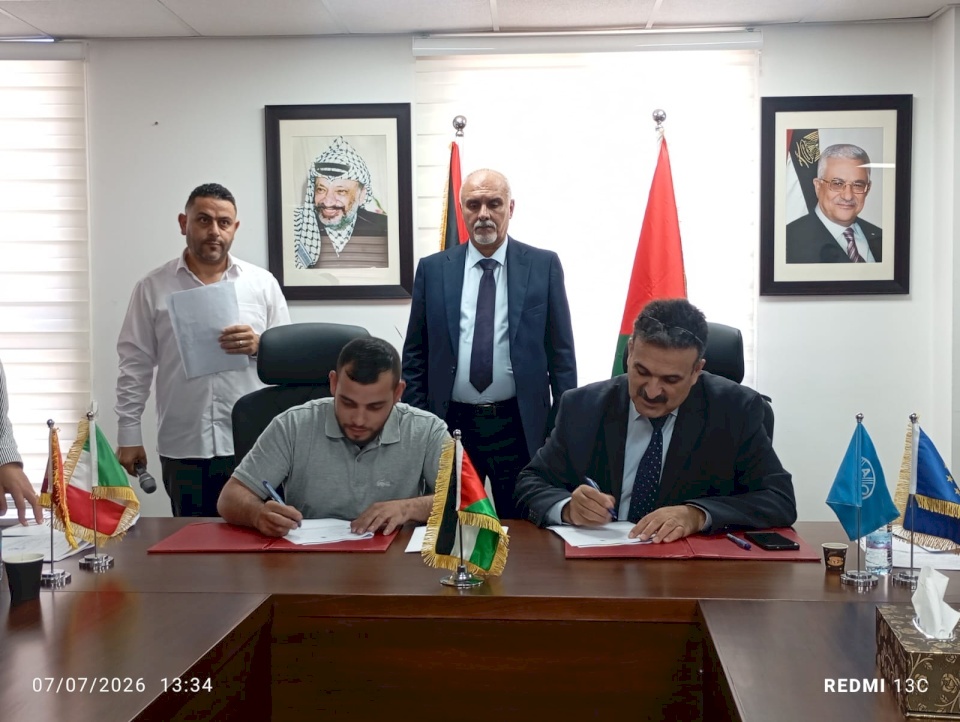
Ministry of Agriculture and FAO Sign New Batch of Investment Support Agreements Worth 8 Million Shekels
SadaNews - The Ministry of Agriculture, in collaboration with the Food and Agriculture Organization of the United Nations (FAO), has signed a new batch of investment support agreements under the MAP II program, aimed at enhancing investments and market-oriented innovations for the development of a sustainable agricultural and food system, implemented in the West Bank governorates.
This batch continues the program's support for quality agricultural investments, including 23 investment agreements distributed across eight governorates: Jenin (5), Nablus (4), Salfit (4), Qalqilya (3), Tulkarem (3), Tubas (2), Ramallah (1), and Hebron (1), with a total investment volume exceeding 8 million shekels, while the MAPII program contributed about half (51%) of the total investments.
The new batch is characterized by the diversity of its investment projects, which include plant production, animal production, and food manufacturing, enhancing agricultural value chains and increasing the added value of Palestinian products. This batch includes projects for establishing cooling rooms, stone fruit farms, avocado, dragon fruit, developing sheep, poultry, and fish farms, units for producing and processing dairy and pickles, olive mills, and a workshop for manufacturing beehive boxes, alongside projects for developing the beekeeping sector, contributing to improving the quality of agricultural production and enhancing its competitiveness.
The Minister of Agriculture, Professor Rizq Salimieh, confirmed that reaching the new batch of agreements under the MAP II program reflects the success of the strategic partnership between the Ministry of Agriculture, FAO, and the donor countries, and affirms the program's continuity in supporting quality agricultural investments, enabling farmers, associations, and cooperatives to develop sustainable productive projects that enhance their resilience and increase the agricultural sector's contribution to the national economy.
Salimieh added that the ministry views these agreements as an investment in the future of the Palestinian agricultural sector, not just as financial grants, pointing out that the funded projects contribute to developing agricultural value chains, improving production, manufacturing, and marketing efficiency, and enhancing the competitiveness of Palestinian products, in line with the ministry's vision for building a more sustainable agricultural sector capable of facing challenges.
The minister stressed that the role of the Ministry of Agriculture is not limited to providing funding and signing agreements, but extends to technical and administrative follow-up of the projects, overseeing their implementation, to ensure achieving the desired objectives and maximizing the developmental and economic impact of these investments. He affirmed that the ministry will continue to work with its partners to attract more quality investments, building on the successes achieved by previous batches of the MAP II program, contributing to developing agricultural value chains, improving farmers' income, enhancing food security, and reinforcing sustainable agricultural development in Palestine.
The investment support agreements are implemented within the project "Enhancing Market-Oriented Investments and Innovations for Developing a Sustainable Agricultural and Food System," which is carried out by the FAO in collaboration with the Palestinian Ministry of Agriculture, funded by the governments of Denmark, Switzerland, Spain, the European Union, in addition to parallel funding from the Government of Italy.
The new batch confirms the continued successes achieved by the MAP II program, following a series of previous batches that contributed to financing dozens of quality agricultural projects in various West Bank governorates, reflecting the success of the partnership between the Ministry of Agriculture, FAO, and donor countries in expanding the volume of agricultural investments, supporting farmers, associations, and cooperatives, and enhancing economic development in the Palestinian countryside, towards building a more sustainable agricultural and food system, enhancing food security, and solidifying the resilience of the Palestinian agricultural sector.
The agreements were signed at the Ministry of Agriculture headquarters in Ramallah, in the presence of the Minister of Agriculture Professor Rizq Salimieh, the ministry's deputy engineer Bader Al-Hawamdeh, several deputy ministers and assistant deputies, and teams from the ministry supervising the implementation of the program, in addition to representatives from the FAO and beneficiaries.
 Follow the latest Sada News via Google News
Soaring Oil Prices Burn the Pockets of the Palestinian Citizen "The Poor"

Millions of Dollars in Losses.. "SadaNews" Reveals Shocking Figures for Traders from Pales...

The Problem of Shekel Overcrowding Worsens.. Fuel Station Owners Threatened with Closure o...

The Palestinian Economy at a Crossroads: 4 Files Awaiting Resolution

Ministry of Agriculture and FAO Sign New Batch of Investment Support Agreements Worth 8 Mi...

Israel's Bank Buys One Billion Dollars in a New Intervention to Weaken the Shekel

Exchange Rates of Currencies Against the Shekel on Tuesday (July 7)
