

Why Does Israel Fear Turkey Acquiring F-35 Fighters?
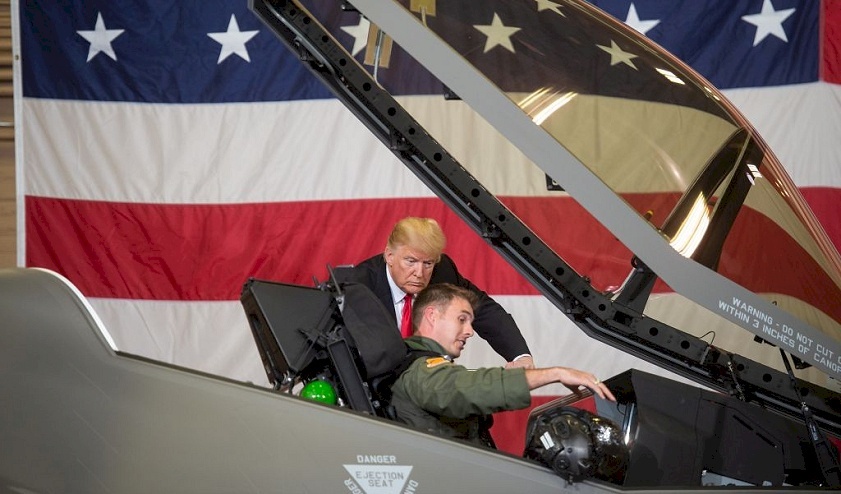
SadaNews - Concerns are rising in Israel over the possibility that U.S. President Donald Trump may agree to reinstate Turkey in the F-35 fighter jet program, particularly after he stated during his meeting with Turkish President Recep Tayyip Erdogan in Ankara that Washington would consider selling these aircraft to Ankara, on the sidelines of the NATO summit hosted by Turkey.
According to a report by Channel 12 in Israel, security agencies warn that Turkey's possession of advanced American stealth fighter jets could undermine what Tel Aviv describes as the "qualitative edge" of the Israeli Air Force and limit its operational capabilities in theaters that Israel considers central, including Iran, Syria, Lebanon, and the eastern Mediterranean.
During his meeting with Erdogan on the sidelines of the NATO summit hosted by Turkey on Tuesday and Wednesday, Trump remarked that selling F-35 fighters to Ankara is a "decision we will make," adding, "It’s a great aircraft, the best aircraft by a long shot, and it’s definitely something we will consider."
Turkey is seeking to acquire American-made F110 engines for a stealth fighter it is developing locally, alongside its efforts to return to the F-35 program from which it was removed following its purchase of the Russian S-400 air defense system.
Trump also pointed to the possibility of lifting sanctions imposed on Ankara in this context, stating, "We will lift the sanctions," and added, "We don’t want to impose sanctions on friends." Erdogan, for his part, indicated that Trump had given him his "promise" regarding this matter, stating, "In this issue, Mr. Trump always fulfills his promise. Here too, God willing, I believe a positive decision regarding the F-35 aircraft will emerge from this summit."
Trump’s public statements heighten concerns in Tel Aviv, as Israel views Turkey’s reinstatement in the F-35 program, or its supply with advanced engines for its domestic fighter "Kaan," as a significant shift in the military balance of power in the region.
"A Direct Threat to Israel’s Security Interests"
According to the report, Turkey is attempting to revive the previously suspended F-35 deal while simultaneously seeking to purchase F110 engines from the American company General Electric to use in its Turkish fighter project. In contrast, Israel is quietly working with Washington to maintain the freeze on the deal, based on its assessment that the arrival of a stealth fighter in Turkey would pose a direct threat to its security interests.
The Israeli concerns, as presented in the report, are based on the sharp deterioration in relations between Israel and Turkey in light of the genocide against Gaza and the war on Iran, and the "rising rhetoric from Erdogan against Israel." Israeli entities argue that a country that labels Israel as a "hostile state" should not possess military systems of such a level.
Areas of "Confrontation" with Turkey
The report suggests that friction between Israel and Turkey is no longer limited to political disagreements or rhetoric, but extends to four main theaters that concern the Israeli security establishment. The first theater involves negotiations with Iran, where Israel perceives Turkey’s role as an attempt to prevent Tehran from being defeated, which would lead to broader Israeli dominance in the region.
The second theater relates to the Gaza Strip, with the report indicating Turkey’s support for Hamas, claiming that a Hamas arm operates from within Turkey and conducts activities against Israel from there. The third theater is Syria, where Israel is increasingly worried about Turkey’s attempts to expand its influence following the changes in the country.
According to Channel 12, the Israeli Air Force is working to prevent the establishment of a Turkish foothold in Syria, including through repeated attacks on the T4 airbase, while Israel seeks to prevent Ankara from arming the Syrian army with drones and air defense systems.
The fourth theater, which the report states is taking shape, is the maritime area in the eastern Mediterranean, where Israel fears the expansion of Turkish presence in a region that Tel Aviv considers vital for its military and economic movements and its relations with Greece and Cyprus.
According to the report, Turkey is already developing advanced military industries that include defensive systems and ballistic missiles, and is seeking to build its own stealth fighter named "Kaan." However, the project faces significant difficulties, particularly in the area of engines, as Turkey currently lacks an independent capacity to develop a suitable engine for this type of aircraft, prompting it to seek American F110 engines.
The report indicates that Turkey's NATO membership has not previously prevented Washington from freezing its participation in the F-35 program after the U.S. deemed that it violated alliance rules by purchasing the Russian S-400 air defense system. Israel now fears that Trump will decide to reinstate Turkey in the program despite this past dispute.
The Israeli Air Superiority
According to the report, the essence of Israeli concern is not merely Turkey obtaining an advanced weapon, but what it could mean for the Israeli Air Force’s operational freedom. Israeli air superiority relies on remaining "one step ahead of everyone" and maintaining the ability to operate deep in the region without exposure or obstruction.
The F-35 is not just a fighter for dropping bombs, but an advanced platform for gathering intelligence, spotting ground targets, and sharing data with other aircraft. According to the report, these fighters have demonstrated their capabilities in the recent war against Iran, managing to penetrate Iranian air defense systems and operate within their depths.
Hence, Israel fears that Turkey’s possession of these fighters may enable Ankara to assess the strengths and weaknesses of the American aircraft, potentially complicating the Israeli Air Force's ability to conduct covert or long-range operations in areas where Turkey holds influence or along flight paths near regions under its sway.
The report presents an Israeli estimate suggesting that Turkey may use the capabilities of the F-35 to influence the operational freedom of the Israeli Air Force in Syria and Lebanon or along flight routes to Iran. It also highlights that countries operating this aircraft belong to a restricted club that exchanges information according to American requirements, raising concerns in Israel about the transfer of operational or technical knowledge to Turkey.
"A Threat That Must Be Prevented"
While the report clarifies that Israel possesses unique capabilities on its F-35 fighters that other countries do not have, it conveys sentiments from figures within the Israeli security apparatus indicating that Turkey merely possessing a basic version of the aircraft, amid current tensions, "constitutes a threat that must be prevented."
In response to this possibility, Israel is working to strengthen its alliance with Greece and Cyprus, in what the report describes as a counter-axis against Turkish influence in the eastern Mediterranean. This collaboration includes offensive and defensive arms deals, joint exercises, and broader security coordination in the air and maritime domains.
The report noted that the Israeli Air Force resumed training with the Greek Air Force yesterday after a long hiatus during which joint exercises were halted due to the war. Footage released by the Greek Air Force showed Israeli refueling planes supplying fuel to Greek F-16 fighters during flights over the Aegean Sea.
Channel 12 perceives that resuming these exercises is not only an operational step but also a political and military message within the context of the alliance that Israel is strengthening in the eastern Mediterranean against Turkey. The report concluded that if Israel fails to prevent the fighter jet deal with the U.S. administration, it will be considered in Tel Aviv a strategic failure.
 Follow the latest Sada News via Google News
The Prosecution and Police Begin Investigation Procedures into the Murder of a Young Man i...

Attack on tanker in Hormuz.. the third of its kind in 24 hours

Journalists' Syndicate: The Occupation Army Escalates Violations Against Journalists Durin...

Why Does Israel Fear Turkey Acquiring F-35 Fighters?

Trump "Frustrated with NATO and Meloni".. and Finalizes Sale of "F-35" to Turkey

Court Sentences Marine Le Pen to 3 Years in European Funds Embezzlement Case

Prime Minister Calls for Intensifying Field Visits and Interventions in Various Villages a...
