

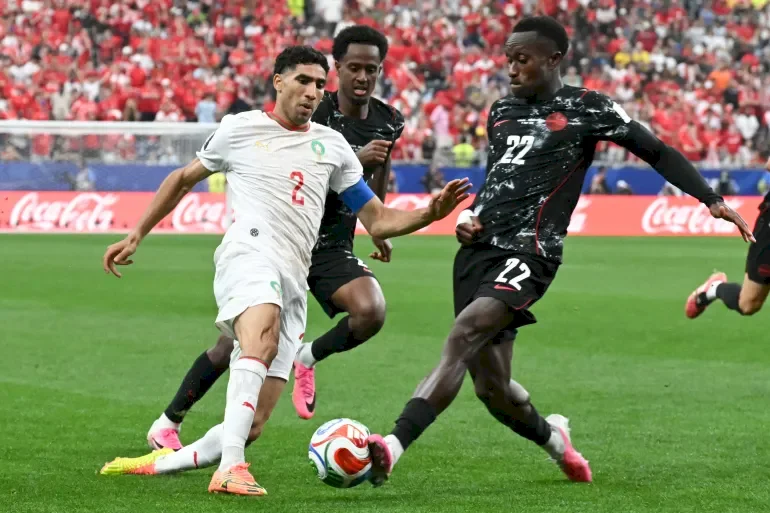
The Danger From the Right: French Media Highlights Morocco's Key Weapons
SadaNews - The Moroccan national team enters its anticipated match against France in the quarter-finals of the 2026 World Cup as one of the most entertaining teams technically in the tournament, alongside the French team, after showing a clear evolution in its playing style compared to the 2022 Qatar edition.
The "Atlas Lions" no longer solely rely on defense and counter-attacks; instead, they have transformed into a more flexible team that focuses on ball possession, with varied movements and continuous position exchanges, making them one of the most tactically prominent teams in the tournament.
The newspaper "L'Equipe" elaborated on the points of danger from the Atlas Lions from an offensive standpoint, emphasizing the signs of development compared to the 2022 edition, where Morocco achieved fourth place, the best achievement for an African and Arab team in history.
Significant Development Compared to the 2022 World Cup
One of the most notable changes in Morocco's performance is its style of ball possession; in the Qatar 2022 World Cup, their average possession was 38.4%, while in the 2026 edition, it has risen to 60.4%, indicating a clear shift towards a game relying on control and playmaking.
During the current tournament, the Moroccan national team lost control of the game only in two halves: the first against Brazil in the group stage and the second against Canada in the Round of 16.
Why Does Morocco Place the Burden on the Right Side?
Morocco's offensive system notably depends on the right flank, building nearly 50% of its attacks through this side.
This is not merely due to a preference for playing on the right; rather, it represents the main launch point for attacks by gathering as many players as possible in a tight space to lure the opponent to this side.
This positioning aims to create a numerical advantage on the flank, forcing the opponent's defense to slide toward the right, opening spaces in other parts of the field that can later be exploited, according to the newspaper.
Position Exchanges and Continuous Movements
Coach Mohamed Wabi relies on constant movements among his players, with midfielders and forwards continuously swapping positions with defenders, providing the Moroccan team with great flexibility in building attacks and complicating the opponent's marking tasks.
These movements help provide multiple options for the ball carrier, either through short passes or quickly changing the direction of play to the opposite side after pulling the opponent to the right flank.
Hakimi: The Key to the System
Right-back Achraf Hakimi forms one of the most crucial keys to this style, thanks to his speed and ability to advance and contribute to playmaking, along with the movements of Ibrahim Diaz and nearby players, granting Morocco a clear offensive density on this side.
The role of the right flank extends beyond creating opportunities; it becomes a tactical means to create spaces in other areas of the field, providing the Moroccan team with significant diversity in offensive solutions.
A Tough Test Against France
This style will present the French team with a complex tactical test in the quarter-finals, as they will need to limit the numerical advantage Morocco creates on the right side while being cautious of the spaces the "Atlas Lions" generate when switching play to the opposite side.
Indicators suggest that the clash will not merely be an individual battle among stars but a tactical battle between two teams offering some of the most developed and convincing styles in the 2026 World Cup.
Source: French Press
 Follow the latest Sada News via Google News
Argentine Admission and Global Consensus on the Referee's Injustice to Egypt's National Te...

The Danger From the Right: French Media Highlights Morocco's Key Weapons

Illness Strikes Norway's Camp Ahead of England Match in World Cup 2026

It Can Catch a Whale.. 111,000 Spiders Build the Largest Web Known to the World

A Decision to Evacuate the Casa Árabe in Madrid.. Bahira Abdul Latif: They are taking the...

Arab Praise and Israeli Discontent.. Hossam Hassan's Statements on Gaza Ignite Platforms

From Omar Ibn Al-Khattab to the Syrian Revolution.. The Omari Mosque on UNESCO's Lists
