

Selling in Front of the Speed Bumps: The Innovation of the Children of Yemen for Survival
SadaNews - Just as adults devise their own ways to survive, children in Yemen are inventing their own methods to overcome hunger.
In the exhausted streets of Taiz and Ibb, the "speed bumps" or potholes resulting from the decaying infrastructure have turned, out of necessity, into forced work platforms for children. There, where the wheels are forced to slow down, the children begin their daily run to speed up their quest for a meal dipped in the sweat of wasted childhood.
In the midst of complex living conditions, millions of children in Yemen face existential challenges that have forced them to abandon their classrooms and replace their school bags with water coolers and sidewalk stalls.
A Search for a Livelihood Under the Sun
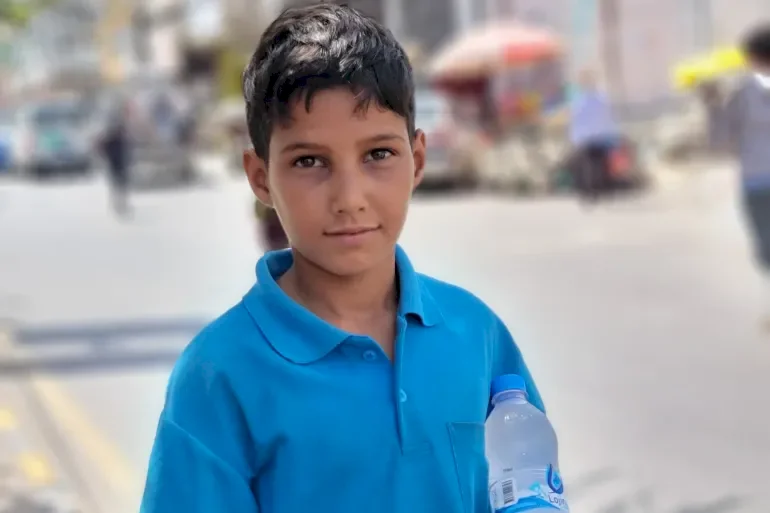
Every morning, 11-year-old child Issa Hassan Ahmed wakes up to wage his daily battle selling cold water in the city of Taiz. His journey begins with the first light of dawn and does not end until sunset, extracting from his tender body energy that his young age cannot bear: "I leave early in the morning to sell water so I can provide a living for my mother and siblings." With these spontaneous words that encapsulate a stolen childhood, Issa began his conversation with Al Jazeera Net.
He explains how he divides his time between his schoolbag and the sales sidewalk, saying: "On school days, I go to school but I am forced to leave before the last classes end so I can catch up with my father and help him sell. On holiday days, I am stationed here from dawn till dusk."
Issa no longer looks at life through a child's eyes waiting to play; rather, he sees it through the eyes of a man responsible for a family: "I have been begging in the street for a year and a half, and thank God, the most important thing is that we cover the household expenses. The market is weak, and the income is low."
Issa roams the crowded streets, tracking cars that slow down at corners and speed bumps, calling to drivers and passersby: "Do you want water?" Reflecting on the trials of this long day, he says: "The sun and fatigue exhaust me greatly, and when exhaustion overwhelms me, I sit on the water cooler to rest a little, then I continue working until I finish the bottles I have and return to sleep to start the struggle the next morning."
Two Dollars from Wasted Childhood Sweat
Issa's daily earnings alone range between 2,000 and 3,000 Yemeni riyals (about $1.5 to $2 depending on local exchange rates), while the overall total of his suffering alongside his brother and sixty-year-old father reaches 8,000 to 9,000 Yemeni riyals daily.
This meager amount, which diminishes every morning before the specter of inflation and rising prices, goes directly to cover the family’s food gap; Issa explains to Al Jazeera Net with innocent materiality imposed by reality, saying: "All the money we gather is immediately spent on household expenses. We buy flour, sugar, and some essential necessities."
Despite this daily siege, Issa still has room to dream: "I dream of being an engineer or a doctor; I just want a stable job that builds a future for me and protects my family from the humiliation of need."
From the Hell of Tehama to the Sidewalks of Taiz
Just a few meters away from Issa, in the same bustling area, stands his father Hassan Ahmed (60 years old) with a head turned gray and a back bent in front of the vicissitudes of time.
The father speaks with tears held back in the wrinkles of his face: "We are here not by choice. We are displaced people who fled the hell of war in Al Hudaydah (Tehama). We came to Taiz and we own nothing in this world; we settled in a random camp near the roundabout, and selling water was the only means of survival we found."
The father looks at his child Issa as he runs between the large transport busses, and continues, choked with emotion: "Issa helps me as soon as he leaves school... Some days we find sustenance and other days we find nothing, and we carry on with what God has written for us."
He adds: "Issa earns between 2,000 and 3,000 riyals alone... God knows that I do not want to throw a child of this age onto the roadside under the mercy of car tires, but what choice do we have? How do we cover the expenses of the rent, the camp, and food if my children do not help me?"
A Repeating Scene
Issa’s story and his choice of speed bumps is not an isolated case; rather, it is a daily "catalog" applied by thousands of children in Yemen who have come to study the geography of the sidewalk precisely; where is a hole? Where is there traffic? There you will find them catching passersby.
In the "Displaced People’s Street" in the Shar'ab Ar-Rounah district, the child Asim Radwan stands behind a modest wooden stall, selling pens, notebooks, and simple school supplies instead of being a consumer of them inside the classroom.
And in the streets of Ibb city, and regions like "Al-'Adain," "Hidbah," and "Nijd Al-Jama'i," the scene repeats with the same features: children of tender age standing amid the exhaust and dust, selling tissues, water, and snacks.
On Jamal Street in Taiz, we met 8-year-old child Rabee' Muhammad sitting on the rough asphalt selling small toothpicks to passersby. Rabee' says with pained innocence: "I sell a bag of toothpicks for 200 riyals to help my father buy bread for the house." He adds sadly: "There are few people buying from me, and the sun has burned me."
Recent data from the United Nations Children's Fund (UNICEF) indicates that there are more than 2.4 million Yemeni school-aged children who are currently out of school, while about 8.5 million other children face the risk of dropping out due to the destruction of school infrastructure and the stoppage of teachers' salaries for years.
Child labor has shifted from being merely a "temporary familial assistance" to a "survival strategy" for more than 35% of displaced and impoverished families who can no longer find a source of income, forcing them to push their children into the streets and strenuous work such as construction, collecting plastic, and selling on the sidewalks.
 Follow the latest Sada News via Google News
Lebanese President: I Value the Memorandum of Understanding and Look Forward to Turning It...

Selling in Front of the Speed Bumps: The Innovation of the Children of Yemen for Survival

Al-Shaybani and Barrack Discuss Bilateral and Regional Issues in Istanbul

الطريق لا يزال طويلا.. الاتحاد الأوروبي يطلق مفاوضات انضمام أوكرانيا

Houthi: We Will Stand Guard Against Israel and Its Ambitions in Somalia

Albanian Authorities Pursue 20 Individuals Suspected of Links to the Trump Family

North Korea: Our Nuclear Weapons Are Irreversible
