

Instead of Turning Into a Black Hole.. A Dying Star May Create a New Universe
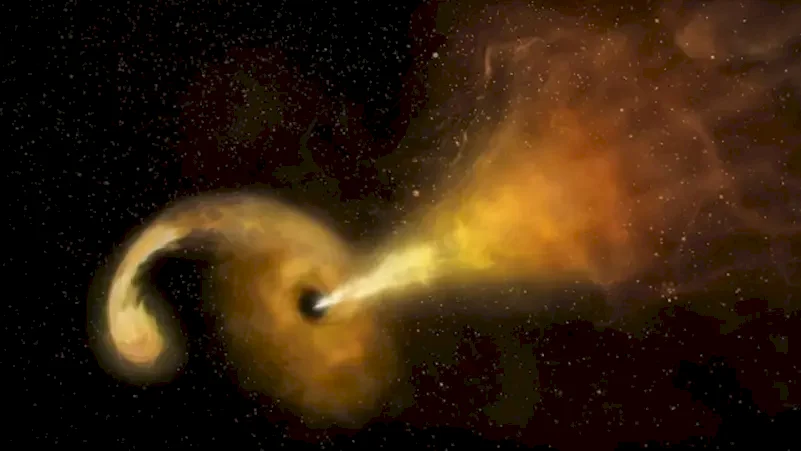
SadaNews - A massive star in its final stages may be able to avoid its traditional fate as a black hole by forming a "small new universe" within its collapsed material, according to a new theoretical proposal that could open unprecedented horizons for understanding the nature of black holes and the end of giant stars.
Massive stars produce light and heat through nuclear fusion in their cores, a process that releases vast amounts of energy that create a pressure opposing gravitational force. However, this balance does not last forever, as nuclear fuel runs out at the end of the star's life, gradually weakening the outward pressure from radiation, allowing gravity to prevail.
When this happens, the star begins to collapse under its immense mass, a collapse that is theoretically assumed to continue until the material is compressed to a minuscule, high-density point known as a "singularity," a state associated with the formation of black holes.
However, black holes, while widely accepted in the scientific community, still raise fundamental questions that modern physics has not definitively answered, according to Science Daily. How can a mass equivalent to billions of suns be compressed into a minuscule point? How can spacetime curve infinitely at a singularity?
Additionally, black holes pose an extra challenge represented by the event horizon, the boundary beyond which no matter, radiation or information can escape, including light itself, making it nearly impossible to study what occurs inside them.
Due to these lingering questions, some researchers have turned to studying alternative hypotheses suggesting that some objects classified as black holes may actually be a different kind of cosmic body known as "gravitational stars."
Gravitational stars resemble black holes in terms of their immense mass and density, making it extremely difficult to distinguish between them observationally. However, they differ in a crucial point, as they do not contain a singularity or event horizon. Instead, the theory proposes that they contain dark energy beneath their outer layers composed of ordinary matter.
This dark energy is believed to generate an outward-directed pressure that opposes gravitational force and prevents the complete collapse of the star. For this reason, several physicists see gravitational stars as an attractive theoretical alternative to black holes, as they avoid many of the conceptual issues associated with them.
Nevertheless, a fundamental question has been posed for decades: How can gravitational stars form in the first place?
In an attempt to answer this question, theoretical physicists Daniel Gambolsky and Professor Luciano Risola presented what they describe as the first dynamic solution to Albert Einstein's general relativity equations explaining how a gravitational star can form from the collapse of a massive star.
According to the study, stellar collapse could lead to the birth of a miniature universe inside the collapsing material itself. The researchers indicate that this emerging universe would not differ much from the early stages of the known universe, as it would form through a process similar to the Big Bang, while dark energy drives its expansion.
As this internal universe expands, an outward-directed pressure force arises, countering the gravity pushing matter inward. This opposing pressure can halt the collapse process before it reaches the black hole formation stage.
This results in a stable equilibrium between the collapsing stellar material and the expanding internal universe, which leads, according to the new model, to the emergence of the gravitational star.
A Question Discussed by Scientists for 25 Years
The researchers emphasize that this solution provides the first comprehensive explanation for a question that scientists have discussed for about 25 years regarding how gravitational stars might arise from the collapse of ordinary matter.
Daniel Gambolsky, who developed this model while preparing his master’s thesis under Luciano Risola's supervision, stated, "The Big Bang of the emerging universe can occur just as the star collapses almost to the verge of turning into a black hole."
He also added that the behavior of matter at these immense densities is still not fully understood, paving the way for the discovery of new physical phenomena. He explained, saying, "It is easier to conceive that the Big Bang does not occur until a very late stage, when the matter has already been compressed to an extreme degree, which may lead to the emergence of new physical effects."
For his part, Risola, a theoretical astrophysics professor at Goethe University, stressed that studying theoretical alternatives does not mean doubting the existence of black holes, asserting that they still represent the simplest and most natural explanation for the gravitational collapse fate of massive stars.
He added that it is essential to maintain an open scientific approach towards unresolved issues by exploring both traditional explanations and unconventional hypotheses, indicating that the history of science repeatedly shows that some ideas that initially seemed strange later turned into widely accepted theories.
 Follow the latest Sada News via Google News
Oak Trees Outsmart Caterpillars with a Clever Spring Maneuver

9 عادات صباحية يستلهمها الأذكياء والسعداء من جداتهم

Britain Bans Social Media for Those Under 16 Years Old

وائل حمدي عن "ورد على فل وياسمين": أحب الشخصيات التي تحمل جروحاً صامتة

Instead of Turning Into a Black Hole.. A Dying Star May Create a New Universe

Not Just for Hydration: Watermelon May Contribute to Heart Health

Rice Water for Hair: Between Korean Trends and Scientific Truth
