

Bloomberg: Trump Still Strongly Influencing Oil Market
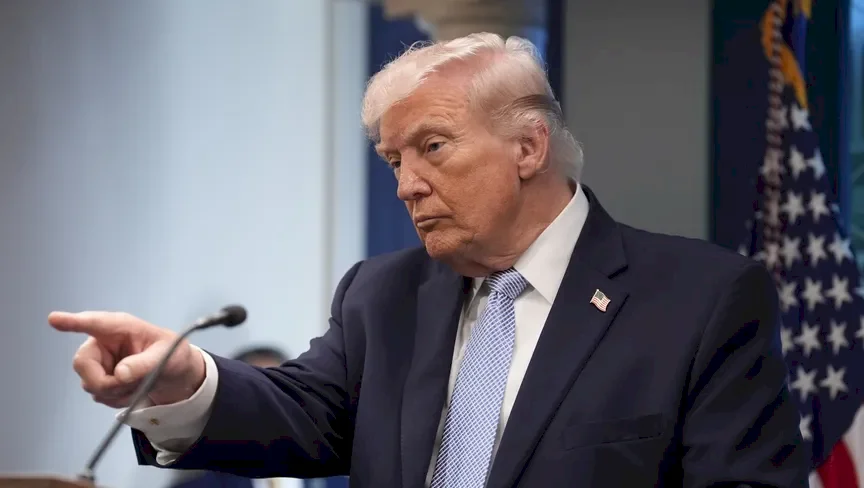
SadaNews - U.S. President Donald Trump still retains his full ability to influence oil markets. Any indicators suggesting that traders have become less affected by his statements are simply illusions.
Even considering the decrease in market volatility since the ceasefire with Iran went into effect, the impact of news from the White House on crude oil prices remains capable of moving the market with the same force as witnessed in the early days of the war.
Even if the statements seem repetitive, traders do not have the luxury of missing that declaration where threats of strikes or claims of reaching an agreement could turn into tangible reality.
Trump's Words Retain Weight in the Oil Market
The developments on May 18 reaffirm that Trump's words are still influential in the market. The president announced that he had directed Secretary of Defense, Pete Hegseth, to postpone a military strike scheduled against Iran the following day, a military operation that had not been publicly disclosed before. Within an hour, the price of West Texas Intermediate crude fell by 2.4%, while Brent crude dropped by 2.9%.
This aligns perfectly with the market's expected response of around 2.3% that our model anticipates in the event of a prominent statement, should the conflict escalate again toward direct military confrontation.
Bloomberg Economics analyzed 9,933 urgent news headlines related to the conflict with Iran, based on direct or attributed statements to Trump or White House officials.
By integrating the flows of news headlines from a specific speech or press conference into one event, we condensed this data into 576 news cases, measuring the oil price reaction within one hour of each.
The crude price response per news headline dropped by 34% between the direct military confrontation phase of the war (February 28 - March 23) and the subsequent strike halt and ceasefire period, a decline likely attributable to market fatigue.
When neutralizing the impact of local volatilities which fell by about 40% with the decrease in fighting intensity and the announcement of the ceasefire, this gap entirely disappears.
When issuing equally severe headlines, the price of West Texas Intermediate crude moved by 0.52 standard deviations during the military confrontation phase, and by about 0.54 during the following stages, which are nearly identical statistically.
If a new round of direct military confrontations begins, the response of oil prices to circulating news is expected to approximately double, rising from about 1.1% to 2.3% if any prominent market-moving statement is issued.
Traders Compelled to Follow Trump
The bottom line is that oil market participants do not overlook White House data, contrary to the common assumptions held by some.
The markets have dispelled fears of strategic certainty concerning the limits and scope of the war, but they remain incapable of resolving tactical doubts around the commitment of parties to any announcement or its sustainability.
The decline in the magnitude of price responses to news completely fades once considering the stability that has dominated the market following the decrease in fighting intensity and the ceasefire announcement on April 7.
The underlying market volatility, measured by the standard deviation of returns calculated every five minutes during the 24 hours preceding each news announcement, dropped by about 40% as the course of the war shifted from military strikes to diplomatic efforts.
The average volatility of West Texas Intermediate crude during the five-minute period fell from 0.52% during active fighting to 0.32% in the current phase. When dividing the immediate price movements by the local volatility ratio, it becomes clear that the market's reaction rate remained constant without change.
Unified Relative Weight for Similar News
News with comparable significance moved oil prices by nearly half a standard deviation, regardless of the phase of the war.
This applies to news indicating escalation or de-escalation alike, meaning the markets did not ignore one type of news over another.
Indeed, news indicating de-escalation prompted a stronger reaction after adjusting for volatility during the ceasefire talks in late March and early April, when every sign of peace carried the potential of reopening the Strait of Hormuz.
The price change adjusted for volatility, per unit of news significance, reached 0.78 standard deviations during that period, which is about 50% above the normal level for oil markets. The markets responded intensively to de-escalation signals when a resolution appeared on the horizon. The market does not ignore the White House; rather, the overall level of volatility has simply decreased.
Why Can't Traders Ignore Statements?
The structure of gains and losses makes ignoring news illogical. Ignoring a genuine announcement of reopening Hormuz or signing an agreement could lead to losses ranging from 10% to 15% in long positions on crude oil.
Conversely, the cost of temporarily repricing based on a transient statement being retracted remains a limited movement that can be mitigated.
This variance forces handling each headline with its full weight, regardless of the previous misleading signals' repetition.
This variance also pushes the market towards excessive optimism for any signs of peace, as the potential returns from taking long positions in anticipation of a resolution are so high that traders chase de-escalation news more than fundamentals justify. Additionally, the hypothesis that markets have priced in these announcements in advance does not apply here, as the situation is dynamic and unstable.
Geographic Limitation of the Conflict in Market Awareness
By mid-March, markets had settled the strategic issue; the conflict between the U.S. and Israel on one side and Iran on the other remains largely confined, with the Strait of Hormuz remaining the main pressure tool rather than a total regional war.
Despite Iranian attacks targeting some neighboring Gulf states, direct military engagement by these countries has remained limited. This hypothesis has stabilized in market pricing, without altering with any new news.
The tactical issue of how resilient the ceasefire is or the parties' withdrawal from the agreement remains undetermined since every announcement overshadows a fluctuating military and diplomatic scene. The collapse of the ceasefire for the eleventh time does not make the twelfth piece of news any less significant, as the fundamental conditions may change each time.
When applying the interaction rate adjusted for measuring volatility to the high volatility levels associated with combat operations, any major news concerning West Texas Intermediate crude could move prices by about 2.3%, compared to 1.1% at present.
This scenario is not hypothetical. The sharp volatilities associated with the war continue. Talks are ongoing, but both sides exchanged fire in recent days. We estimate that the likelihood of returning to direct military strikes has become increasingly probable.
Scenarios for the Return of the Iran War
Markets are currently pricing a limited conflict scenario, with the strait effectively remaining closed and only a limited number of ships passing in coordination with Iran.
Any escalation path could compel markets to reprice this hypothesis, in addition to doubling the intensity of price reactions with news by a factor of two according to our baseline scenario.
In summary: The markets continue to treat every news headline from the White House with the same significance as observed in March, as the limited price movements reflect a prevailing calmness and stability dominating the market, rather than a decline in sensitivity to developments.
If war ignites again, the return of high volatility and the continuation of strategic ambiguity could push market reactions to news to levels much greater than our baseline scenario anticipates.
 Follow the latest Sada News via Google News
Dollar Steadies Near One-Week High Amid War Developments

Trump Imposes Tariffs on Canadian Imports... Ottawa Vows to Respond

Oil Prices Drop After Reports of Mediation Efforts Between the U.S. and Iran

Gold Price Rises Supported by Increased Buying Amid Lower Prices

Due to "Hazardous and Counterfeit Products".. Europe Fines "AliExpress" $627 Million

Gasoline Prices Exceed $4 Again in America Amid Resumed War

What was the financial reward for Spain after winning the World Cup?
