

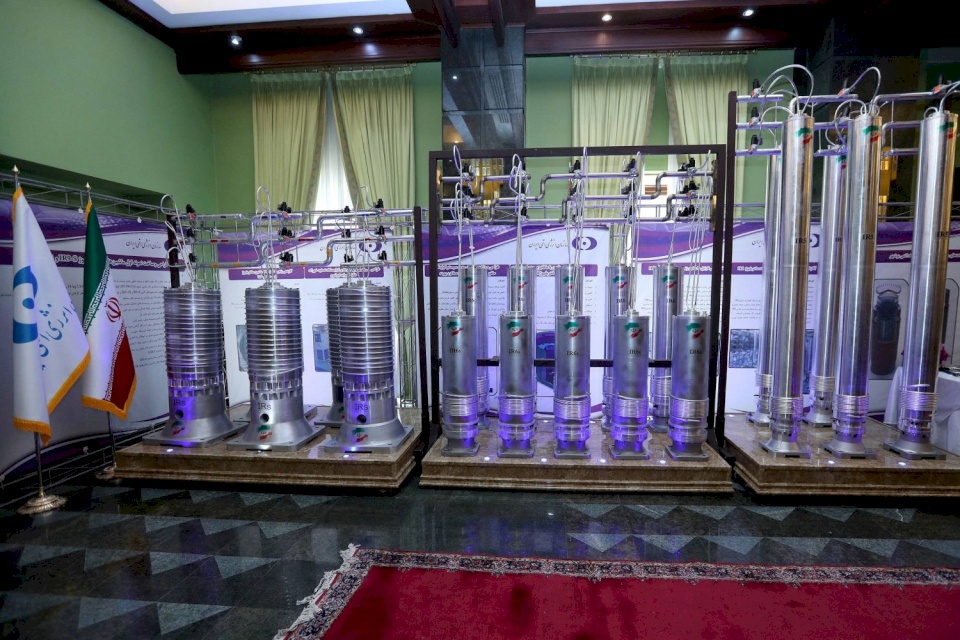
Highly Enriched Uranium... Iran's Most Important Negotiating Cards
SadaNews - Iran and the United States are engaged in talks to continue the ceasefire between them with the aim of starting negotiations regarding issues including Tehran's nuclear program, while Washington insists that Tehran must not be allowed to develop a nuclear weapon.
Despite the destruction of a large part of Iran's uranium enrichment infrastructure or severe damage to it when it was bombed by Israel and the United States last June, it is believed that a significant amount of highly enriched uranium in Iran remains unaffected by the attacks, which is a major concern for the United States ahead of the nuclear talks.
U.S. President Donald Trump stated on Friday in a post via social media that Iran must agree to allow the United States to "extract" the enriched uranium that was buried underground following previous U.S. strikes, and to destroy it in coordination with Iran and the United Nations' International Atomic Energy Agency.
* What is highly enriched uranium?
It is one of two fissile materials, along with plutonium, that can be used to make the core of a nuclear bomb.
While plutonium is typically extracted from spent fuel in nuclear reactors, which requires massive infrastructure that cannot be concealed, uranium can be enriched using centrifuges that occupy much smaller space.
Two of the three known enrichment sites in Iran were underground when Israel and the United States launched their attack in June. The above-ground site was clearly destroyed.
Highly enriched uranium is defined as uranium that has a purity level of 20 percent, and it is deemed suitable for use in weapons when it reaches levels of around 90 percent.
Modern reactors generally use fuel enriched to about five percent, though some use fuel enriched to higher levels. Reports indicate that the reactors powering U.S. nuclear submarines use fuel enriched to over 90 percent.
* What quantities does Iran possess?
Iran has not reported to the International Atomic Energy Agency (IAEA) about the status of its enriched uranium since the June attacks, nor has it allowed its inspectors to return to the sites where it was stored.
IAEA estimates indicate that Iran possessed the following quantities when the Israeli bombs first fell on June 13:
- 440.9 kilograms enriched to 60 percent
- 184.1 kilograms enriched to 20 percent
- 6024.4 kilograms enriched to five percent
- 2391.1 kilograms enriched to two percent.
The IAEA states that the quantity enriched to 60 percent is sufficient, should its enrichment level increase, to produce 10 nuclear weapons. The stock enriched to 20 percent would be enough to produce one weapon, while the inventory enriched to five percent could yield 12 weapons.
It is unclear what quantities survived the attacks. Rafael Mariano Grossi, the IAEA Director General, has mentioned that he believes "a little over 200 kilograms" of the 60 percent enriched stock is stored in an underground complex in Isfahan, which reportedly has not been much affected by the June attacks. He added that part of it was also present at the Natanz nuclear site.
* Why the concern?
The United States' concern is focused on the materials enriched to 60 percent; as they would be easier and quicker to convert into a bomb. Washington wants to eliminate these materials despite Tehran's denial of seeking nuclear weapons.
As the level of uranium enrichment increases, additional enrichment becomes much easier; transitioning from 60 percent to 90 percent is simpler than transitioning from non-enriched uranium to five percent enriched.
It is worth noting that Trump withdrew the United States from the nuclear deal between Iran and major powers during his first term, which kept Tehran far further away from the capability to produce a nuclear bomb than it is now. The U.S. withdrawal in 2018 led to the collapse of the agreement, and Iran quickly expanded its nuclear program.
Under the 2015 agreement, Iran's uranium enrichment level was not to exceed 3.67 percent.
However, even at a 90 percent enrichment level, additional steps are required to produce a bomb core. When enriching uranium, it is in a gaseous state, and it must then be converted to metal for use in weapon production.
* Can enriched uranium be transported?
Yes; Iran has transferred enriched materials between sites under the supervision of the IAEA prior to the June attacks.
Under the 2015 agreement and prior arrangements, Iran's stocks of uranium enriched to 20 percent or less were either reduced or converted into fuel plates for reactors and shipped out of the country.
Transporting nuclear materials such as highly enriched uranium from one country to another is a sensitive procedure, but it is relatively routine.
Grossi told PBS in March when asked about the materials enriched to 60 percent: "It requires some precautions, but it can be transported."
* Will Iran abandon it?
Two senior Iranian sources stated days ago that Supreme Leader Ali Khamenei has issued directives not to send 60 percent enriched materials abroad.
Iranian sources say Tehran may agree to send half of its stock of materials to a third country, in exchange for receiving 5 percent enriched uranium, while mitigating the other half within Iran.
 Follow the latest Sada News via Google News
In a Rapid Pace.. The Occupation Builds a Huge Earth Barrier Inside Gaza

Meeting Between Aoun and Trump Expected Alongside 'Experimental Areas'

Gaza Health Warns of Collapse of Oncology Services Due to Depletion of Treatments and Susp...

The Occupation Demolishes a House in the Town of Sa'ir near Hebron

Israel Reveals Details of Secret Iranian Nuclear Facility in Mount Fas

A Mother, Her Child, and Her Three Daughters Martyred in Israeli Shelling on Gaza City

US Military Ends Latest Round of Strikes on Iran
