

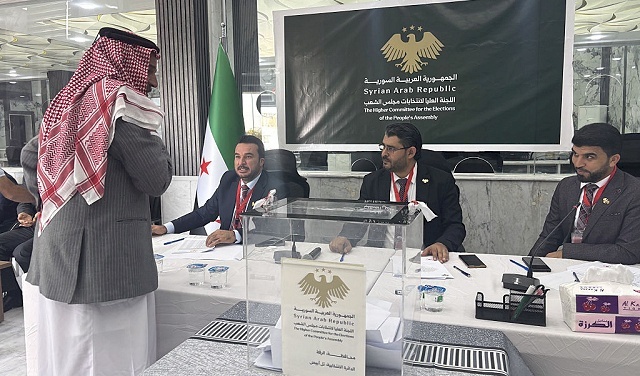
Elections in Northeastern Syria to Represent Kurdish Areas in the People's Assembly
SadaNews - Syrian authorities began organizing elections on Sunday in predominantly Kurdish areas in the northeast of the country to select representatives for the People's Assembly, while the province of Suwayda remains outside the electoral process.
According to the Syrian Arab News Agency (SANA), the voting includes the districts of Hasakah and Qamishli in Hasakah province, in addition to the Ayn al-Arab district in Aleppo countryside, to elect nine members to the People's Assembly, while two seats in the Malikiya district were filled by acclamation after only two candidates were nominated for the two designated seats.
The elections come after an agreement reached between Damascus and the "Syrian Democratic Forces" (SDF) last January, which stipulated the integration of civilian, military, and security institutions in northeastern Syria into the Syrian state institutions.
The electoral process has faced criticism from Kurdish parties and movements, which considered that the mechanism for forming the council "is nothing but an appointment process" and does not reflect the "free Kurdish will," according to a statement issued by them.
Kurdish forces also criticized the allocation of only four seats for Kurds out of a total of 210 seats in the People's Assembly, demanding representation of at least 40 seats, based on their claims that Kurds make up at least 20% of the population of Syria.
The Higher Election Commission had announced last October the names of 119 members of the new People's Assembly, out of 140 members that were supposed to be elected through regional bodies, according to an indirect mechanism stipulated by the constitutional declaration for the transitional phase.
At that time, 21 seats remained vacant from the provinces of Hasakah, Raqqa, and Suwayda, for reasons described by the commission as "security-related."
The People's Assembly consists of 210 members, two-thirds of whom are elected through electoral bodies formed by a High Committee appointed by Syrian President Ahmad al-Shara, while Shara appoints the remaining third, which amounts to 70 members, a process that has not been completed so far.
After filling the seats allocated for northern and northeastern Syria, three seats designated for Suwayda province remain vacant, amid the continued boycott of the electoral process in the province.
These developments come after months of violence that took place in Suwayda last July, and amid ongoing disputes between Damascus and local authorities, most notably Sheikh Hikmat al-Hajri, who renewed his commitment last week to the separatist path in Suwayda with support from Israel.
 Follow the latest Sada News via Google News
Among them 1,600 in 24 hours.. Ukraine announces the death and injury of 1.4 million Russi...

Data: Shipping Traffic in the Red Sea Declines After Houthi Attack on Saudi Arabia

Two killed and 5 injured due to gunfire in Seattle, USA

Iran Announces Suspension of Attacks After Halt of US Strikes

Does the liberation of 5 areas in Kordofan open the way to Darfur?

Berri: Lebanon Needs a Tripartite Guarantee Involving Saudi Arabia, the United States, and...

Raging Fires and a Hurricane.. Simultaneous Disasters Displace Hundreds of Thousands Acros...
