

Resistance through Light: Efforts to Revive Yemeni Cinema from the Rubble and Siege
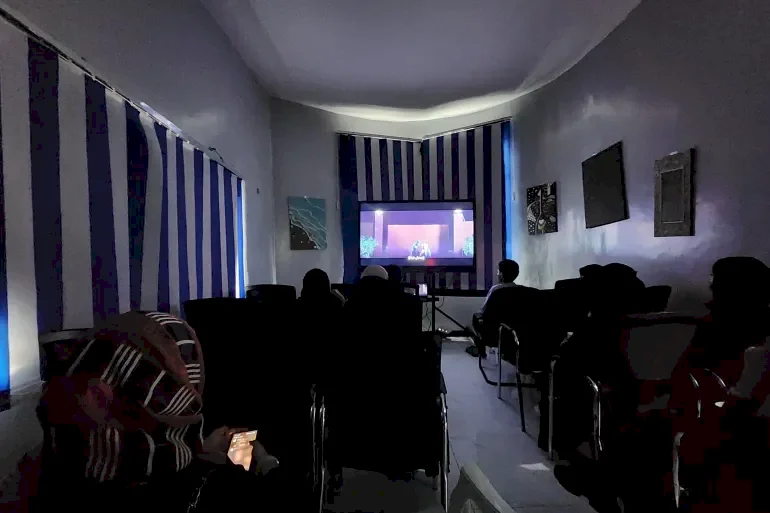
SadaNews - In a small hall in the city of Taiz, in central Yemen, the lights suddenly go out, and silence envelops the room before a rare screen lights up in a country where cinemas have been absent for years.
There are no tickets at the box office nor regular screening rooms, but an audience gathers every week to re-experience a nearly forgotten tradition: watching a film collectively in a city worn down by war and isolated by small screens. In the absence of cinemas in Yemen for years, limited initiatives have emerged trying to revive the experience of communal viewing.
Among these initiatives is the "Wednesday Cinema" project, which organizes weekly screenings at the headquarters of the "House of Press" and "Arniyada" institutions in Taiz, aiming to create an open space for viewing and discussion before the audience, especially in a city that has endured the ravages of war for 11 years.
The Screen: The Modern Diwan of Humanity
The organizers of the project connect the development of the arts with their role in preserving collective memory. This is emphasized by Adam Al-Hosami, the head of the "Arniyada" Foundation for Cultural Development, who states, "Just as the famous genres of literature and arts in ancient times served as diwan for the knowledge of peoples and the memory of their sentiments, cinema and its performing arts brethren have become a diwan for human civilization in the modern era. In every home screen or personal laptop, there is a principal space for these works, even in war-torn countries and those suffering economic crises."
Al-Hosami explained that digital evolution has removed authoritarian barriers, "but there remains a pang and a negative implication regarding the fear of society from art—a lingering pang for two decades that is represented in the absence of communal viewing or cinemas."
A Long Path to Darkness
The disappearance of cinemas in Yemen is part of a long trajectory of social and economic transformations that gradually led to the closing of screening rooms until they disappeared entirely.
Adam Al-Hosami notes that this created an antagonistic atmosphere towards freedom, the arts, aesthetic values, and openness to the world. Moreover, the use of personal devices for viewing does not contribute to a collective effect, which is confirmed by the sparse production statistics of cinema in Yemen. Despite the availability of means and digital cameras, the absence of the right climate remains the biggest obstacle.
In contrast to this reality, the Wednesday Cinema project seeks to reintroduce film screenings as a collective experience that opens the door for discussion and interaction between the audience and content creators.
Al-Hosami asserts that the project is a direct response to this void, explaining: "The idea of Wednesday Cinema came as an exceptional cultural activity in Yemen that provides what is available to all people in cities around the world." The project includes film screenings and a discussion space attended by a mixed audience of both genders, as well as young filmmakers, intellectuals, critics, and professionals in performing arts in television and theater, "who also dream of having cinematic experiences."
According to Al-Hosami, the weekly screenings, which began in February 2025, represented a direct testing ground between the audience and those dreaming of filmmaking on one side and the crews of the "Arniyada" and "House of Press" institutions on the other, "as we ended the forced limitation to seasonal and occasional activities with a weekly commitment that does not stop under any circumstances."
Specialized Screenings
The biggest challenge facing this project was the anticipated social reactions and rejection campaigns, according to Adam Al-Hosami. "How can we revive what has remained closed for decades while distorting it and perpetuating a negative image of this art? The idea came to link cinema with knowledge and professional fields, and we started by dedicating a month to each professional or knowledge area, beginning with a month of journalism films. We invited media students and graduates and did not anticipate such success and positive feedback."
Cinema: A Living Lesson
Al-Hosami recounts how the cinema audience in its first month, most of whom were journalists and media students, viewed the films that tell the stories of journalists and famous investigations as deeply impactful lessons that they could not receive in university. This prompted the "House of Press" and "Arniyada" to move to other fields such as legal and health-related films, arts, and environment, diversifying the audience from specialists and the general public.
The writer and theater director Ahmad Jabara notes that individual viewing diminished the impact and yield of these arts, because cinema is an art, industry, and collective production. Attending cinema or theater in the past was a popular ritual requiring an interactive audience.
He pointed out that initiatives like "Wednesday Cinema," despite their importance, cannot replace the absence of institutional roles. He hopes that cinema and theater can return to life and that their presence will be daily rather than occasional, stating "Taiz, as the capital of Yemeni culture, cannot be a cultural capital without cinema."
For her part, Nour Al-Sama'i, who studies media at Taiz University, adds that "Wednesday Cinema" provides "a rare opportunity to experience cinematic screenings in a country where there are no cinemas. More beautifully, it offers specialized films, allowing us to enjoy watching a cinematic movie while also benefiting from films that discuss qualitative cognitive and social issues."
A New Audience Takes Shape
The "Wednesday Cinema" project recorded significant figures from its launch on February 5, 2025, to May 2026, successfully organizing 61 screenings by the end of April 2026, with attendance ranging from 20 to 25 people, mostly women, at every screening. In terms of qualitative impact, the project's annual report noted a 70% improvement in the depth of audience engagement, with a shift from passive viewing to critical participation in discussions. The screenings covered various specialized areas, including journalism, law, and education, in addition to producing journalistic materials documenting the lives of rural women and dedicating months to issues such as health, climate, music, and human rights.
Al-Hosami clarifies that "after a year of specialized screenings, we transitioned to a classification that studies the experiences of each country or region separately, exploring the marginalized cinematic schools overshadowed by Hollywood. The beginning was with the few Yemeni cinematic experiences, then the Saudi films month as a neighboring country that suffered like us from the absence of this art and the rise of its production in recent years." He reaffirms their intention to move on to experiences from other countries and regions, engaging in an open dialogue between nations through various cinematic forums.
A Forgotten Memory... Will It Return to Life?
As part of the interests of the "House of Press" and "Arniyada Foundation" in cinema, representatives of the "Wednesday Cinema" project participated in a reconnaissance visit conducted by the Culture Office in Taiz Governorate (and Al Jazeera was present during the visit) to assess the status of "Sabaa Cinema" after years of closure, as part of efforts to reactivate cinemas and cultural spaces in the governorate. Sabaa Cinema in Taiz is one of the most prominent cultural and historical entertainment landmarks in the city, historically known for showcasing Indian films.
In Aden, southern Yemen, the "Aroha Cinema" in the Crater district is undergoing renovation and rehabilitation; it is one of the oldest theaters, historically known as "Bravine" during the British presence. This project is funded by the European Union through UNESCO, under the supervision of the local authority in the Sirah district.
On March 30, 2026, the European Union Ambassador (Patrick Simony) visited the "Tourist Dock" and "Aroha Cinema" in Aden to oversee the progress of the renovation works. A statement from the mission indicated that these projects aim to preserve the cultural heritage of the city of Aden, in parallel with creating job opportunities for local communities and supporting paths for economic recovery and sustainable development.
Source: Al Jazeera
 Follow the latest Sada News via Google News
The Egyptian Federation Files Official Complaint Against Referee Letexier

Do You Know How to Comfort Someone Who is Crying? Here's What to Say and Do in Tough Momen...

"Backrooms": From Digital Legend to Cinematic Phenomenon

Prediabetes.. The Silent Bomb Carried by Millions Without Their Knowledge

From Sweden 1958 to the Epic of Egypt 2026.. Argentina's History with World Cup Comebacks

After the South Africa Precedent.. Nigeria Investigates the Encroachment of Technology Com...

Argentine Admission and Global Consensus on the Referee's Injustice to Egypt's National Te...
