

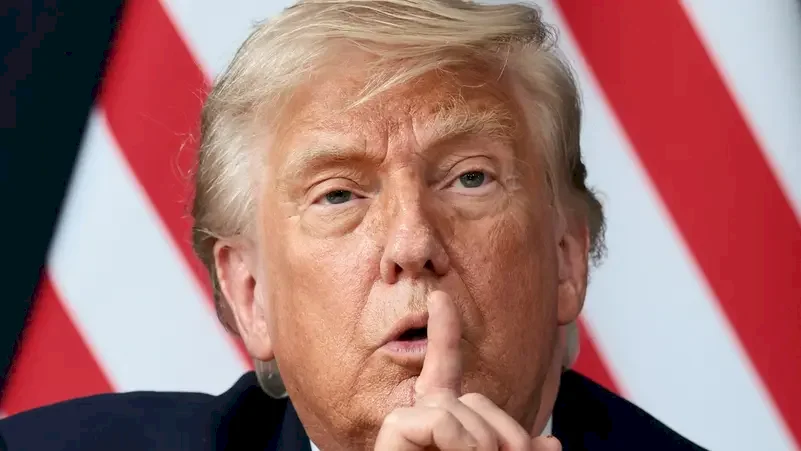
Trump Signals New Strikes on Iran and Announces End of Understanding
SadaNews - On Wednesday, U.S. President Donald Trump stated that the temporary memorandum of understanding with Iran "has ended," hinting at new strikes just hours after U.S. airstrikes targeted more than 80 Iranian sites. This escalation shook a fragile ceasefire and pushed the confrontation over the Strait of Hormuz into a more dangerous phase. Meanwhile, Tehran warned that any landing of hostile troops on its shores would lead to a "hell with no way out."
Trump's comments came hours after the U.S. Central Command (Centcom) announced a wide range of strikes on Iranian targets in response to attacks on three oil and gas tankers in the Strait of Hormuz.
Iran retaliated by targeting U.S. military sites in Bahrain and Kuwait, while Washington revoked a license that had allowed Tehran to sell oil under the temporary agreement.
The mutual attacks undermined the fragile ceasefire and diminished hopes of transforming the memorandum signed on June 17 into a permanent agreement to end a war that began with U.S.-Israeli strikes on Iran on February 28, which then escalated into a regional confrontation over the Strait of Hormuz and Iranian attacks on neighboring countries.
When asked in Ankara, just before the NATO summit, whether the memorandum of understanding had collapsed, Trump said: "That’s a very interesting question. For me, I think it’s over. I don’t want to deal with them." He added: "They are scum. They are sick. Sick people lead them... For me, dealing with them is just a waste of time."
Trump indicated potential new U.S. strikes on Iran late Wednesday, saying that Washington "will strike them hard tonight." He warned Tehran in front of journalists at the NATO summit in Turkey, before meeting with Ukrainian President Volodymyr Zelensky: "I’ll give a simple warning: We will hit them hard tonight."
While he did not completely close the door on diplomacy, Trump expressed skepticism about its effectiveness, stating that American representatives "can talk" but he believes they are "wasting their time."
His comments led to a spike in oil prices and raised concerns that the memorandum signed on June 17 would shift from a framework to stop the war to a document on the verge of collapse.
The temporary truce was supposed to open a 60-day window for negotiating a permanent agreement addressing the most complex outstanding issues, primarily regarding freedom of navigation in the Strait of Hormuz, shipping transit arrangements, and the future of Iran's nuclear program.
However, the mutual strikes returned the conflict to a moment of extreme fragility, without either Washington or Tehran officially declaring their exit from the negotiating table.
U.S. Strike Targets
Hours before Trump’s announcement, U.S. Central Command in the Middle East (Centcom) stated it had completed a new round of attacks on Iran, hitting more than 80 targets. It reported that U.S. forces targeted Iranian air defense systems, command and control networks, coastal radar sites, anti-ship missile capabilities, and more than 60 small boats belonging to the "Revolutionary Guard" in and near the Strait of Hormuz.
Centcom stated that the strikes aimed to weaken Iran's ability to continue attacking international trade passing through the shipping lane. It added that "the unprovoked aggression by Iranian forces constitutes a blatant and serious violation of the ceasefire and undermines freedom of navigation." It emphasized that its forces "remain poised to hold Iran accountable if it does not adhere to the agreement or comply with its terms," noting that the latest round of attacks had concluded.
An American official indicated that the strikes also hit surface-to-air missiles, anti-ship cruise missiles, and drone launch sites. Centcom did not mention Kharg Island among the targets, despite Iranian reports of hearing explosions in the southern part of the island, which is a major center for Iranian oil exports.
Coast Under Fire
Early on Wednesday, Iranian media reported explosions on Kharg Island, Qeshm Island, Sirik, Bandar Abbas, Bushehr, and the port of Mahshahr.
Iran’s state television said that the U.S. military launched an attack on coastal areas in Hormozgan, Bushehr, and Ahvaz, and that at least 10 explosions occurred in Bandar Abbas, targeting what was described as civilian targets, including port infrastructure, fishing facilities, and coastal monitoring centers.
In southern Iran, the director of ports and maritime navigation in the Bahran and East Hormozgan port, Hamid Reza Mohammad Hosseini Takhti, stated that the Sirik port suffered two strikes at 00:35 and 01:35 am, causing significant damage to one of the floating docks inside the port basin, according to the government agency "ISNA."
The Iranian official explained that specialized experts are conducting a technical assessment to determine the extent of the losses and damage, ensuring that no fatalities were recorded. He mentioned that one person was injured and transported to a medical center, while three others received outpatient treatment. He stressed that the rest of the ports managed by Bahner and East Hormozgan were not targeted during the attacks and that the ports of Bahner, Tiab, Sirik, and Jask, along with the Shahid Haqani passenger port in Bandar Abbas and the Shahid Fatemeh Nik port on Kharg Island, continue their daily activities while adhering to defense procedures.
Iranian Response
Iran retaliated by targeting U.S. military sites in Bahrain and Kuwait. The "Revolutionary Guard" claimed it had carried out a joint operation using missiles and drones against 85 U.S. military sites, including positions in Bandar Salman and the "Fifth Maritime Zone" in Bahrain, and Ali Al-Salem Air Base in Kuwait.
The "Revolutionary Guard" added that it downed a U.S. MQ-9 drone that it said tried to intervene in the operation. Sirens were heard in both Bahrain and Kuwait while the Kuwaiti army reported that air defenses thwarted "hostile" attacks by missiles and drones.
Iranian media reported that Tehran targeted a U.S. base in Bahrain and vowed to intensify attacks if the United States continued its strikes on Iran. Official media also reported that the revolutionary guard’s naval forces announced the death of one of its members in an attack by "enemy drones."
In Tehran, the Iranian armed forces’ joint chiefs of staff condemned the U.S. strikes, labeling them a "blatant act of aggression" and threatened a "crushing response." They warned that Tehran would not allow U.S. interference in the management of the Strait of Hormuz.
Official media reported that Iran considers any place supporting U.S. strikes against it to be a "legitimate target," in an implicit warning to countries hosting U.S. forces or facilities in the region.
For its part, the Iranian Foreign Ministry accused the United States of violating the United Nations Charter and the memorandum of understanding to stop the war. In a statement, it said that the "U.S. military" carried out an -"aggressive military act" against monitoring centers in southern Iran early on Wednesday, considering that these strikes represent a violation of Article 2, Paragraph 4 of the UN Charter, and a "blatant violation" of the first clause of the memorandum, which is based on ceasing military operations.
The ministry added that the U.S. strikes, the Treasury Department’s decision to revoke the license for Iranian oil sales, "violating Iranian arrangements in the Strait of Hormuz," and the continued Israeli attacks against Lebanon have "emptied significant and essential parts of the ceasefire understanding of its substance."
Washington was held responsible for the "serious repercussions" of the escalation. It stated that Iran's armed forces would defend territorial integrity, national sovereignty, and national security, targeting "the origin and source" of any aggression.
On June 22, the U.S. Treasury had issued a general license allowing the sale of Iranian crude oil and petrochemical and petroleum products until August 21. Upon its cancellation, Washington granted Iran a grace period until July 17 to cease any transactions.
This license represented one of the most significant concessions in the temporary agreement, as it permitted Iran to sell oil publicly in U.S. dollars for the first time in years. Tehran regarded its cancellation as a violation of the framework agreement and stated that it would take all necessary measures to safeguard its interests and national security.
Iranian "Arrangements"
The Iranian parliament speaker and chief negotiator with the U.S., Mohammad Baqer Qalibaf, entered the escalation arena, accusing the U.S. of committing "grave violations" of the memorandum of understanding. Qalibaf, a former leader in the "Revolutionary Guard," pointed to the U.S. strikes, the re-imposition of oil restrictions, threats of continued attacks, violations of Iranian "arrangements" in the Strait of Hormuz, and ongoing Israeli attacks on Lebanon.
Qalibaf wrote on Platform "X": "The era of bullying and extortion is over... We do not yield." He stated in another form that "the time of American thuggery is over," and that Iran will not be among those who concede to pressure.
Admiral Habibollah Sayyari, Chief of Staff and Deputy Coordinator of the Iranian Army, delivered a more direct military message, stating that "the enemy knows that if it lands troops on Iranian shores, it will enter a hell from which there is no escape."
For his part, Ali Akbar Velayati, advisor to the Iranian Supreme Leader, said that Tehran had previously warned that "the region is not a scene for political gambling," adding in a post on Platform X that it has "repeatedly proven that adventures are met with an immediate response." Velayati added that "stirring up new tensions, and the verbal acknowledgment of the cancellation of the memorandum, by the notorious and criminal politician linked to Epstein, after it has been practically violated several times, pushes the region once again towards fire."
 Follow the latest Sada News via Google News
Trump Signals New Strikes on Iran and Announces End of Understanding

"Peace Council" Plans to Establish a Humanitarian Pilot Zone in Southern Gaza

UN Committee Calls for Release of Gaza Doctor Detained by Israel

حكم قضائي بالحبس المؤبد في قضية مقتل طفل على يد والده بعد تحقيق أنجزته النيابة العامة خلال...

Lapid Accuses Russia and Iran of Trying to Influence Israeli Elections

Health Ministry in Gaza: 8 Martyrs in the Last 24 Hours

Trump: The Ceasefire Between the United States and Iran Has Ended