

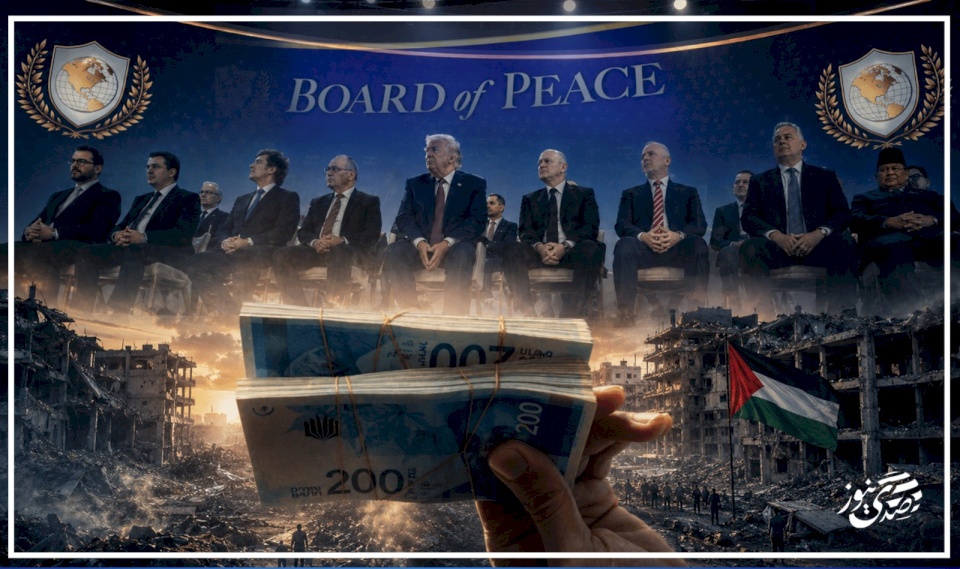
Analysts: The Transfer of Customs Funds to the "Peace Council" is a Dangerous Development Aimed at Undermining the Palestinian Entity
Exclusive to SadaNews: Economic analysts have confirmed that the announced Israeli intention to transfer part of the customs funds to the "Peace Council" in the Gaza Strip represents a dangerous precedent aimed at undermining the Palestinian entity.
The analysts told "SadaNews" that a step of this kind, if implemented, will create further financial pressure on the Palestinian Authority, emphasizing that this money is the right of the Palestinian people and that no party, whether it be Israel or the United States, has the right to dispose of it under any circumstances.
Economist Dr. Thabit Abu al-Roos confirms that transferring the customs funds held by the occupation to the "Peace Council" will have significant repercussions if carried out, pointing out that the formation of the "Peace Council" was sponsored by the U.S. with the intention of securing international funding worth $10 billion. However, the Israeli talk about transferring customs funds to the Gaza Strip will contribute to further weakening the Palestinian Authority financially. He clarified that the Authority is primarily responsible for paying salaries of employees in the education, health, and several service sectors in Gaza from the general revenues, including customs revenues, which constitute two-thirds of those revenues. Thus, if this step is implemented, it would impose a new financial burden on the Palestinian Authority by transferring most of its revenues to the Gaza Strip while still maintaining the responsibilities it bears in paying employee salaries in both the West Bank and Gaza Strip.
Abu al-Roos believes that this trend represents a dangerous precedent, as "Israel" manipulates the funds of the Palestinian people; transferring them to the Gaza Strip means it has freed itself from the Palestinian Authority's demands to release those funds.
He confirms that if this trend is implemented, it will create significant confusion for the Palestinian Authority regarding budget preparation and implementation, both for this year and for the coming years, noting that the ambiguity surrounding customs funds will complicate the task of Palestinian lawmakers in building budgets due to the uncertainty surrounding the value of funds that will reach the public treasury, which will create confusion and distortion in the financial data projected for the coming years already based on the expected revenues from customs.
Abu al-Roos points out that this step, if implemented, would allow "Israel" to extricate itself from a tight financial situation regarding the Palestinian Authority.
For his part, Moayad Afana, a researcher and expert in public finance, states that the news circulating regarding talks between the United States and Israel to transfer part of the customs funds withheld by Israel to the "Peace Council" in the Gaza Strip is very dangerous. Should it be realized, it represents a dramatic and perilous development in the piracy of the financial rights of the Palestinian people, given that customs revenues are the main component of the general budget in Palestine. They are not a grant from the United States, Israel, or any other party but are purely Palestinian funds that belong to the public treasury, taxes paid by Palestinian citizens on imported goods and services from Israel or through it. He adds: "No party, whether Israel or the United States, has the right to dispose of these funds under any circumstances."
Afana pointed out that United Nations Security Council Resolution 2803 regarding Gaza and ending the war clearly called on the World Bank and all financial institutions to facilitate and provide financial resources to support the reconstruction and development of Gaza, including the establishment of a trust fund dedicated to this purpose managed by donor parties. It does not include customs revenues.
In this context, Afana clarified that customs revenues are the right of the public treasury, accumulated from Palestinian taxpayers, and are not a grant or donation from anyone; no one has the right to dispose of them except the Palestinians themselves. Israel collects them under the Paris Economic Protocol, in exchange for an estimated administrative commission of 3%, and it holds no right over those revenues.
He pointed out that the Palestinian Authority, despite the Israeli "Cabinet's" decision to withhold allocations for the Gaza Strip from customs revenues since October 2023, amounting to 275 million shekels monthly, continued to pay allocations for the Gaza Strip, especially salaries for employees and possible basic services. Thus, the withheld money is from the revenues of the Palestinian people and not amounts intended for Gaza.
He also noted that the "Peace Council" has not done anything tangible since its establishment concerning reconstruction or alleviating the burden on our people in Gaza, and it has not paid salaries for employees. The future obligations remain ambiguous; therefore, transferring any amounts to it from customs revenues is meaningless.
According to Afana's assessments, these news are not unexpected in light of two main contexts: the first is the financing of the "Peace Council," and the second, which is more crucial, is increasing economic pressure on the Palestinians to undermine the Palestinian entity and deprive the Palestinian people of their financial rights, ultimately pushing for acceptance of any forthcoming solutions, especially since customs revenues constitute about 68% of general revenues. This makes its loss or disposal outside the framework of the Palestinian Authority a direct threat to its capacity to fulfill its obligations, whether towards employees, the private sector, or the banking sector. The more dangerous aspect lies in the potential for parts of revenues to be transferred in the future, meaning the treasury could lose two-thirds of its resources, leading to a state of paralysis for public finances.
Afana emphasized the necessity of not waiting, forging a comprehensive national strategy to defend our financial rights, led by the government in partnership with the private sector, the banking sector, and civil institutions, to counter the piracy of customs funds, and by mobilizing international support, especially from friendly countries and the European Union, to stop any actions targeting these funds.
Recently, Reuters revealed that the United States is considering requesting Israel to transfer part of the tax revenues it withholds from the Palestinian Authority to the "Peace Council" established by President Donald Trump, in order to finance its post-war plans in Gaza.
The agency clarified that the Trump administration has not yet made a decision regarding whether to submit an official request to Israel.
The agency reported that the proposal stipulates allocating part of the tax revenues to a U.S.-backed transitional government in Gaza and another part to the Palestinian Authority if it undertakes reforms.
The Palestinian Authority estimates the value of the withheld taxes at about $5 billion.
Economist Dr. Said Sabri believes that transferring customs funds to what is referred to as the "Peace Council" cannot be viewed as a normal financial procedure but as a dangerous political and economic shift that touches on the essence of Palestinian sovereignty. Customs funds are not merely money transferred monthly; they represent the primary source of funding for the Palestinian Authority and account for about 60-70% of its public revenues. Thus, any attempt to redirect them effectively means reshaping the balance of power and decision-making within the Palestinian system.
He adds: "At the immediate level, any deduction or transfer of these funds will lead to a severe financial crisis, starting from the inability of the government to pay salaries regularly, through to a decline in essential services such as health and education, leading to a real liquidity crisis within the Palestinian banking sector. This will immediately reflect on local markets, with declining purchasing power, reduced economic activity, and rising rates of recession and unemployment."
However, Dr. Sabri believes that the more dangerous aspect is the political dimension behind this step. When customs funds are transferred to an administrative entity outside the framework of the Palestinian Authority, this effectively means bypassing Palestinian official institutions and attempting to create new financial and administrative alternatives, undermining the unity of Palestinian political and economic decision-making and opening the door to deepening institutional division between the West Bank and Gaza Strip.
He noted that this step comes at a time when the Palestinian economy already suffers from unprecedented pressures; ranging from declining growth and rising poverty to liquidity crises and weak investment. Therefore, any additional shock may push the economy into a more fragile and complex phase.
He emphasizes that under these circumstances, dealing with the crisis with a "time management" mentality is no longer sufficient; it is now necessary to swiftly move towards a national economic rescue plan that enhances local production, protects the banking sector, reduces excessive reliance on customs, and builds Arab and international financial safety nets capable of supporting the resilience of the Palestinian economy against any future attempts to exploit the economy as a political pressure tool.
 Follow the latest Sada News via Google News
High-level sources reveal to SadaNews: Washington seeks to hold a Gaza Reconstruction Conf...

"Mistreatment After Death".. 104 Palestinians Died or Were Killed While in Custody in Isra...

Report: Israeli Prisons Have Turned into a 'Grave' for the Living

Under the Guise of Crime Fighting: The Occupation Cuts Half a Billion Shekels from Arab Co...

SadaNews Report: Who Will Manage Gaza After the Government Follow-Up Committee's Self- Dis...

Report: The American War on Iran Has Reduced Interest in the Fate of Gaza

من سلوان إلى كفر عقب: كيف يعيد الاحتلال تشكيل خريطة القدس السكانية؟
