

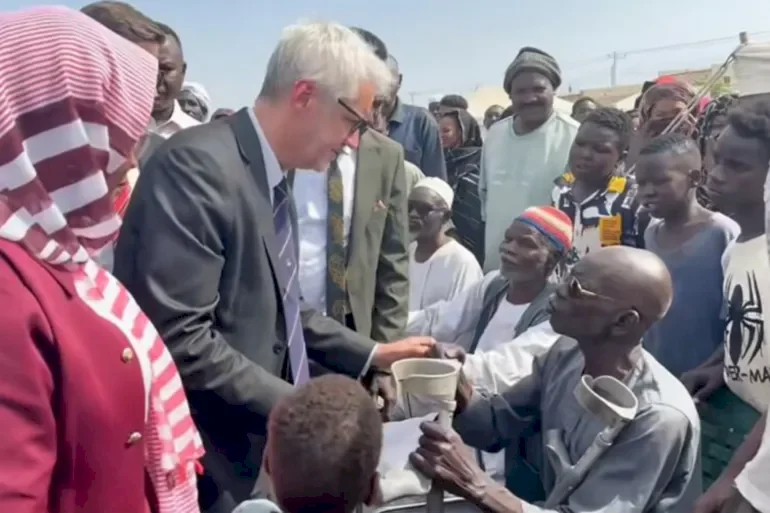
In Front of French Legislators, War Victims in Sudan Narrate Their Tragedies
SadaNews - In a hotel in the southeast of the Sudanese capital Khartoum, surrounded by buildings ravaged by war, a French parliamentary delegation held a "solidarity meeting" that included governmental, political, tribal, and community leaders, as well as war victims from the Darfur region.
During the meeting, the director of Al-Fasher Southern Hospital, Azal al-Din Ahmed, stated that the hospital conducted 12,000 surgeries during the city’s siege, where the Rapid Support Forces fired 140 shells at them daily, before committing a massacre at the Saudi hospital that left 469 dead, including patients and their companions.
Several victims from Al-Fasher, the capital of North Darfur, recounted the atrocities they faced during the siege, the massacres against the residents, and the horrors they witnessed while fleeing after the Rapid Support Forces took over in October of last year.
In a Displacement Center
During the visit, which was the first of its kind since the outbreak of war over three years ago, the French parliamentary delegation visited Khartoum and pledged a decisive European stance against those who committed crimes and violations against Sudanese people.
The visit, led by Christopher Marion along with several members of the French National Assembly and the Sudanese-French Friendship Association, lasted four days at the invitation of the governor of Darfur region, Mini Arko Minawi.
In Port Sudan, the French delegation visited a center for housing displaced persons and also checked on those fleeing from Al-Fasher in camps in the Northern State, listening to several victims about the crimes and systematic violations of starvation and siege that had lasted over 500 days in their city, perpetrated by the Rapid Support Forces.
The delegation met with a selection of political leaders, writers, and playwrights, and also held discussions with the Chair of the Sovereignty Council and Commander of the Army, Abdel Fattah al-Burhan, focusing on the humanitarian situation and the crimes of the Rapid Support Forces against civilians and state institutions, according to the Sovereignty Council's media.
Proposal
For his part, French parliamentary member Christophe Marion announced his intention to submit a proposal to the National Assembly (the House of Representatives) to ensure that Europe classifies the Rapid Support Forces as a terrorist organization.
Marion expressed hope that the French foreign minister would fulfill a promise made to visit Khartoum during the Berlin conference on Sudan last April, "so he can hear the cry of the Sudanese who have suffered oppression, see the destruction caused by the Rapid Support Forces in the capital, and witness France's solidarity with all Sudanese people."
He added: "I wanted to come here to see with my own eyes the tragedy that Khartoum has faced and to connect with those who suffered from the tyranny of the Rapid Support Forces, especially in Darfur."
"No to Amnesty"
As for the governor of Darfur, Mini Arko Minawi, he told Al Jazeera Net that he invited the parliamentary delegation after a tour in March that took him to France and Germany, where he held meetings with parliamentarians, officials, and actors, during which he explained the nature of the war "and the real practices of the Rapid Support Forces and the entities behind them, after they had distorted concepts and an unrealistic image of the situation in Sudan."
Minawi stated that stopping the war requires the withdrawal of the Rapid Support Forces from the cities and confining them to specific locations, as well as handing over their weapons and releasing captives and abductees.
He emphasized that there is no peace without justice and that there will be no amnesty for the Rapid Support Forces regarding the massacres and violations they committed against the residents of Darfur, criticizing the international community's silence regarding the massacres in the region.
European Approach
Commenting on the visit of the French delegation, international relations expert and former Deputy Head of the Sudan Mission in New York, Ambassador Muwawia Al-Toum, stated that the French move can be viewed as an attempt to reposition politically and diplomatically in the Sudanese file, after other regional and international roles have become more present and influential in the crisis's pathways.
Ambassador Al-Toum believes that the visit carries political significance and reflects a French desire to build multiple channels of communication with Sudanese forces and to directly understand the complexities of the humanitarian, political, and security crisis. He sees this step as a potential precursor to a broader European approach towards Sudan, following the growing international concerns about the expansion of the war and its dangerous regional repercussions.
Meanwhile, political writer and analyst Abdul Malik Al-Na’im believes that France has influence in the European Union and has the leverage to persuade many African countries, with which it has historical ties, to refrain from siding with the Rapid Support Forces.
The parliamentary delegation could also pressure the French government to adopt a supportive role for Sudan after the "negative" stances of President Emmanuel Macron's government and the deterioration of Sudanese-French relations, which were once at their best during the 1970s and 1980s.
Source: Al Jazeera
 Follow the latest Sada News via Google News
The General Secretariat of the Organization of Islamic Cooperation Affirms the Role of UNR...

Paul's Initiative in Libya: A Real Settlement or a New Division of Influence and Resources...

The Ghost of El Fasher Haunts El Obeid.. A Funding Gap Threatens the Lives of 20 Million H...

Dozens Dead and Injured in Russian Missile and Drone Attack on Kyiv

8 Dead and Injured.. Russia Launches Deadly Attacks on Kyiv

Aoun calls on those opposed to the "framework agreement" to present an alternative

The Organization of Islamic Cooperation Welcomes the UN Report on Occupation Against Child...
