

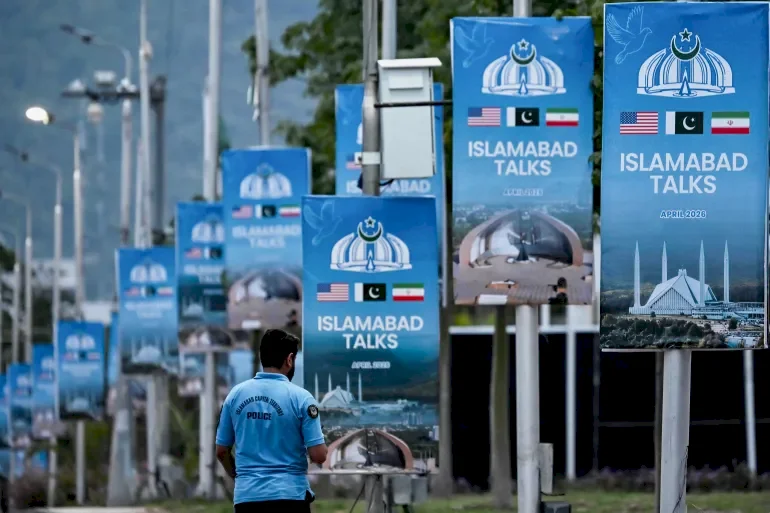
Last Chance Negotiations.. Anticipation and Questions Before US-Iran Talks in Pakistan
SadaNews - U.S. President Donald Trump stated on Sunday that American officials will head to the Pakistani capital, Islamabad, tomorrow to continue negotiations with Iran, while hinting at the destruction of infrastructure and power stations in Iran if they do not accept his terms.
Observers view the upcoming round of negotiations as "last chance negotiations," especially since the U.S. President preceded it by threatening Iran with destruction if it does not accept the U.S. offer. In contrast, Iran has hinted at not participating in the negotiations, accusing the United States of violating the ceasefire and imposing an illegal blockade.
The first round of negotiations between Iran and the United States, which took place last weekend in Islamabad, ended without achieving tangible results on the main contentious points, primarily regarding Iran's nuclear and missile ambitions and the navigation in the Strait of Hormuz.
These disputes cast a shadow over the second round of negotiations, which are being mediated by Pakistan, amid doubts about the possibility of reaching an agreement that ends the war started by the United States and Israel on February 28, before the current ceasefire ends next Wednesday.
The following report aims to explain the possible questions accompanying the negotiations in Pakistan.
Will the American and Iranian delegations attend?
Iran's Tasnim news agency confirmed ongoing exchanges of messages between Iran and the United States through a Pakistani intermediary in recent days. However, ambiguity still overshadowed the participation of the delegations as of Sunday.
On the American side
President Donald Trump confirmed, in a social media post, that the American delegation will head to Islamabad tomorrow, but reports conflicted regarding the participation of Vice President J.D. Vance in the negotiating team.
On Sunday, Pakistani sources reported the arrival of two planes in Islamabad carrying the "preliminary delegation" from Washington, while the Pakistani police declared they would adopt strict security measures in the capital ahead of the highly anticipated second round tomorrow.
On the Iranian side
The official Islamic Republic News Agency (IRNA) stated that "the U.S. demand exaggeration, the presentation of unreasonable and unrealistic demands, frequent changes in its positions, continued contradictions in its statements, and the ongoing so-called maritime blockade, which constitutes a violation of the ceasefire agreement, along with threatening speeches, have all thus far prevented any progress in negotiations, and under these circumstances, there appears to be no clear prospect for fruitful negotiations."
Also, Iranian official media, including Tasnim and Fars news agencies, reported that Tehran has not yet made its decision about sending a negotiating delegation to Islamabad as long as Trump's statements regarding the continuation of the maritime blockade against Iran remain in effect.
However, the American network "CNN" anticipated the participation of Iranian Foreign Minister Abbas Araghchi and Parliament Speaker Mohammad Baqer Qalibaf in the negotiations, and suggested that both the American and Iranian presidents might attend in Islamabad if an agreement is reached.
Tehran has not confirmed the arrival of its negotiating delegation in Islamabad in response to Trump's statements about the continued maritime blockade against it (Reuters)
Are there preconditions or anticipatory statements?
The Pakistani mediation is racing against time to bridge the views of American and Iranian officials in preparation for the second round of negotiations.
On the eve of the summit, Pakistani Deputy Prime Minister and Foreign Minister, Muhammad Ishaq Dar, emphasized in a phone conversation with Iranian Foreign Minister Abbas Araghchi the necessity of continuing dialogue and communication to resolve current issues as quickly as possible, thereby enhancing peace and stability in the region and beyond.
The Pakistani Foreign Ministry indicated that talks are expected to continue today, Sunday, between Pakistani Prime Minister Shahbaz Sharif and Iranian President Masoud Bezhikyan.
Iranian President Bezhikyan focused in his statements on the following points:
Iran does not seek to expand the war.
Continuous conflicts do not serve the interests of any party.
Solving issues does not lie in escalating tensions, but in rationality, dialogue, and avoiding further destruction.
The need to enhance rapprochement, collaboration, and cooperation among the countries of the region.
On the other hand, U.S. President Trump included in his statements on the eve of the negotiations:
Accusations against Iran of committing a "complete violation" of the ceasefire between the two countries.
Accusing Tehran of firing at vessels near the Strait of Hormuz.
Threatening to strike Iranian infrastructure if negotiations fail to reach an agreement based on his terms.
Trump said in a post on his Truth Social platform: "We are offering a very fair and reasonable deal, and I hope they accept, because if they don't, the U.S. will destroy every power station and every bridge in Iran."
U.S. Apache helicopters are flying over the Strait of Hormuz amid accusations against Tehran of violating the ceasefire agreement (AFP)
What are the proposals regarding the nuclear file?
Diplomats on the eve of the negotiations stated that reaching a framework agreement may be possible, based on a nuclear and another economic package, but they warned that the nuclear file remains the most contentious issue.
The discussions focus on Iran's stockpile of about 440 kilograms of 60% enriched uranium, a material that can be used to make several nuclear weapons if further enriched.
The options proposed at this point are:
The preferred option is "dilution of concentration" within Iran under the supervision of the International Atomic Energy Agency.
Another option is a hybrid approach, where some uranium is sent abroad, with Turkey and France being proposed as potential destinations.
Another option, which would be politically difficult for Iran to accept, is shipping the uranium to the United States, while Washington does not favor sending materials to Russia.
Iran has also suggested the idea of storing materials abroad for a specified period.
In addition to the stockpiles, the deeper dispute centers around Iran's right to the enrichment process itself.
A senior Trump administration official stated that Washington's red lines include stopping uranium enrichment operations, dismantling major enrichment facilities, obtaining high-enriched uranium, and accepting a broader framework for calming that includes allies in the region.
What about sanctions and security guarantees?
The economic track in the negotiations focuses on lifting sanctions and freezing Iranian assets while providing security guarantees to the countries in the region.
Iran wants, in the short term, access to limited frozen funds abroad.
The most crucial demand for Tehran is a guarantee that it will not be subjected to attacks again after having been attacked by the U.S. and Israel while previous diplomatic efforts were underway.
In return, regional countries are pressuring for addressing issues such as Iranian ballistic missiles and the activities of pro-Iranian armed groups in the Middle East, while Israel is pushing for imposing the strictest possible constraints on Iran.
Diplomats believe that Iran's demand for a complete abandonment of ballistic missiles would be unrealistic without broader security guarantees.
 Follow the latest Sada News via Google News
Report: Houthis Prepare to Resume Targeting Ships Near Bab al-Mandab Strait

The World Heritage Committee Approves Four Decisions Regarding the State of Palestine by C...

The Smallest Island Nation in the World Prepares to Open Its Embassy in Occupied Jerusalem

Friedman: 3 Leaders Driven by Hubris into Wars with No Exit

Occupation Forces Begin Demolition of Two Houses in Nahalin and Za'tara in Bethlehem

Mamdani Acknowledges: New York Does Not Have Authority to Arrest Netanyahu (Video)

Uranium on Saudi Soil: Details of the Nuclear Agreement Between Trump and Riyadh
