

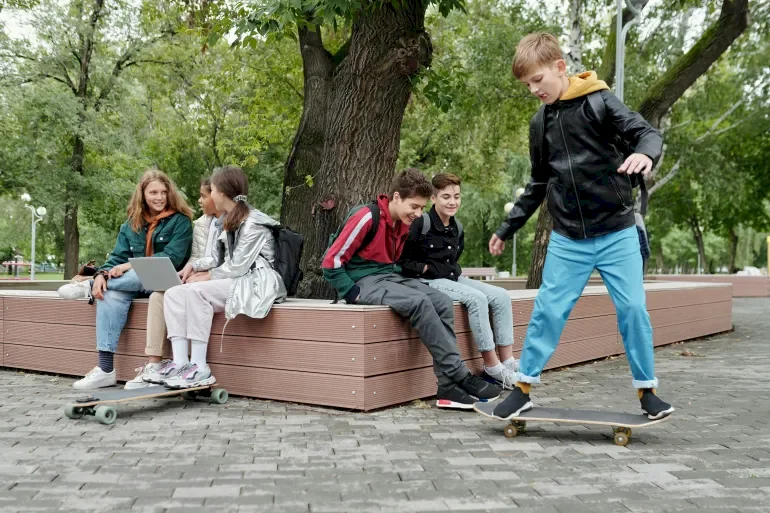
When You Dislike Your Child's Friend.. How to Act Without Losing Them?
SadaNews - This problem often arises at the onset of adolescence, when parents feel uncomfortable with one of their child's friends. Some reasons for this feeling are indeed valid, while others are linked to a parent's sense of losing control over their child's world, who is about to bid farewell to childhood and gain independence. So how do we deal with a new friendship that does not sit well with us?
Don't prohibit them.. Observe and stay calm
Until the age of ten or eleven, parents are the primary reference points, and then the power of influence begins to shift to friends, and perhaps to teachers or sports coaches. If you have prepared your child before this age to think independently, have their own values, and can say "no," the task will be easier. Remember that you are not protecting your child from all the dangers of life but rather equipping them to face it and supporting them.
Teenagers have an urgent need for belonging and social acceptance, which drives them to mimic to be part of a group and form their own identities. Mimicking is their way of discovering themselves and what they love and hate, according to ABC.
A study published in the journal Developmental Science in 2012 indicates that the presence of peers increases the likelihood of teenagers engaging in risky behaviors, as the brain shows greater activity in the areas associated with reward when they feel their friends are watching them, prompting them to make reckless decisions to obtain that social "reward."
According to The Guardian, a fleeting friendship that you dislike can turn into a "Romeo and Juliet" relationship if you show your rejection of it, and your excessive enthusiasm for a friend you see as positive can be the "kiss of death" for that friendship.
Thus, experts recommend silence and observation first, as teenage rebellion changes, and a friend you are uncomfortable with today may later become a supporter of your child.
Reflect on your feelings first.. What truly bothers you?
Many parents struggle to accept their children’s friends because they feel that the friends hold an important key in their children’s lives: identity and belonging. Sometimes, the source of discomfort is not the friend themselves, but what they provoke in the parent in terms of fear for their position and influence.
According to BBC, you should first ask yourself: Is the reason for your rejection of this friend based on clear and dangerous behavior — such as bullying or engaging in destructive behaviors — or does it simply not match the image you wish to see for your child's friend? Before you judge, ensure you are not exaggerating and not conflating real danger with differences in tastes or backgrounds.
When the reasons are valid.. How do you act?
If this friend indeed exhibits concerning behaviors, the basic recommendations are as follows:
Befriend them instead of fighting against them:
Be friendly with them and engage in a simple activity, such as baking a cake or organizing a room or moving some items. This opens a door for dialogue and getting to know each other, and your child may discover new aspects of their friend, and you may also find that things are not as bad as you thought.
Avoid direct prohibition:
Preventing your child from seeing their friend may increase rebellion, and every time you tell them that their friends are not likable to you, you are practically saying that you don't trust their ability to choose them.
Open a calm dialogue:
Ask them why they like this friend, what commonalities exist between them, and listen without judging. At an appropriate moment, talk about a specific behavior you do not approve of, without attacking the person themselves. Make your message clear: "I do not reject your friend, but I reject this behavior."
Broaden their circle of acquaintances:
Help them get to know new friends by inviting some relatives or involving them in a sports club or a new activity. Often, teenage friendships do not last long and may change within weeks or months.
Share your friendships with them:
Share stories from your experiences with friends, and how you learned the meaning of respect and healthy boundaries; this provides them with a practical model without direct lectures.
Part of the challenge is to accompany your child and grant them confidence without intruding on their privacy, allowing them to grow as an independent person. Sometimes, your concern about their friend is a reflection of your desire to protect them and your inability, so far, to give them space for freedom.
Your role here is to be a model that establishes clear boundaries while still leaving space for the child to make their decisions, make mistakes sometimes, and learn from them.
And what if the friendship is indeed harmful?
The danger may be real when it is associated with tangible behaviors: endangering the child, slipping into harmful behaviors, or a noticeable deterioration in their daily life. Fear may be unfounded when it only relates to appearance or social differences.
Experts clarify some signs that may indicate that the friendship is harmful:
Decline in academic performance.
Withdrawal from family or old friends.
Increased lying or aggression or anxiety.
Stopping engaging in favorite hobbies.
In such cases, firm intervention may be necessary, but without turning it into a no-holds-barred battle.
Explain to your child that prohibiting something is not a punishment or an insult, but a protection. In childhood, we decide with whom our children play, while in adolescence, we negotiate with them. Dialogue remains the most important strategy, as screaming and threats often turn the home into a battlefield.
Acknowledge to them that you trust their mind, but you are still worried, and provide specific examples of behaviors or situations that made you think that this friendship is not good for them. Focus on the impact it has on them, not just on condemning the other person.
It is also important to support a two-way dialogue: sometimes involve them in simple problems concerning you or the family, and ask for their opinion to make them feel that their opinion matters. If they make a mistake or get into trouble, avoid saying "I told you so"; instead, replace it with "I’m here, how can I help you?"
Remember that no matter how important their friends are, your presence remains more important if there is a genuine dialogue between you. Children and teenagers need a climate of comfort and understanding to express themselves while having clear boundaries to understand what is acceptable and what is not in relationships and behaviors.
Source: Al Jazeera
 Follow the latest Sada News via Google News
After Deschamps' Departure... Zinedine Zidane Tops the Candidates to Lead France

Mbappe Surpasses Messi and Becomes the All-Time Top Scorer in the World Cup

England Defeats France and Achieves Largest World Cup Achievement Since 1966

Messi Refused to Play for Spain and Missed 3 World Cups

Publishers Sue Google for Allegedly Using Books to Train Artificial Intelligence

Google Expands Capabilities of Google Search Console to Support Social Media Accounts

The Mediterranean Table... An Ancient Diet Revealing Its New Secrets for Health and Longev...
