

Three Imagined Global Powers.. Has George Orwell's Novelist Map Become a Reality?
SadaNews - In chapter nine of the novel by British writer and novelist George Orwell "1984", the imagined protagonist Winston Smith sits in suppressed fear reading a prohibited book that explains the truths of his world.
In that imagined world, there are three great powers sharing the globe, battling in endless border influence areas, changing alliances without prior warning, and rewriting archives entirely as if the new alliance had always existed. The enemy changes in the middle of a speech. The false banners blame the saboteurs, and the next day no one remembers anything different.
This vision had long been described as the weakest element in George Orwell's (1903-1950) novel and the most contrived, until recent years turned this judgment upside down.
The Trump-Putin summit in Alaska, the American military intervention in Venezuela and the kidnapping of its president, the American-Israeli war against Iran and the closure of the Strait of Hormuz, and the escalating Chinese threats to annex Taiwan, all while Washington exerts public pressure on Greenland, Canada, and the Panama Canal. A scene unseen in any previous era: three nuclear blocs drawing their spheres of influence while engaging in open and proxy wars on the lands separating them.
Orwell did not imagine from thin air
Many readers of the novel do not know that this division was not born in the office of a novelist's imagination but was constructed by Orwell from his personal experience and from news of the Second World War that he witnessed with open eyes.
In his famous essay "You and the Atomic Bomb" (published in 1945) - where he first coined the term "Cold War" - Orwell wrote what resembles a first draft of the novel, predicting a world shared by two or three nuclear-armed states, unable to destroy each other, living in a frozen tension akin to "the empires of slaves in ancient times" - terrifyingly stable.
In a subsequent article in 1947, Orwell sketched his fictional map with greater clarity: three blocs each led by a god-like leader, while people beneath the social structure live in something akin to outright slavery.
Bernard Crick, Orwell's biographer, read these passages and simply stated: "This is the novel 1984".
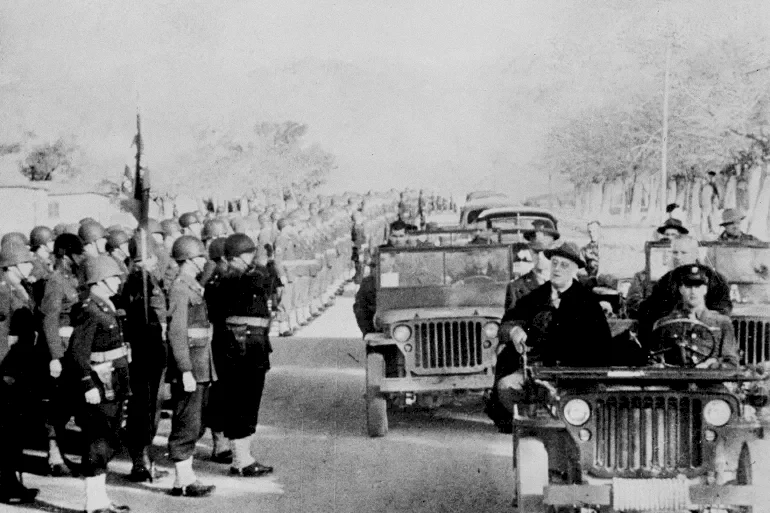
Researchers Emre Atasoy from the University of Warwick and Geoffrey Wasrustrom from the University of California attribute the direct inspiration for the novel to the event of the Tehran Conference in 1943, when Roosevelt, Stalin, and Churchill sat drawing the dividing lines of the post-World War world with a ruler, in their analysis published on the academic platform "The Conversation".
The map forms anew
Historian Anne Applebaum published in "The Atlantic" magazine at the beginning of 2026 an article titled "Trump's American dominance may leave us with nothing", opening with a direct reference to the novel, then framing her key sentence: "Orwell's world is fiction, but there are those who want to turn it into reality".
Applebaum's conclusion was not driven merely by visual similarities between the maps; the idea of a tri-polar world—Asia dominated by China, Europe dominated by Russia, and the Western Hemisphere dominated by America—has been circulated among its promoters for years, and now it seems the idea has found someone to translate it into a new reality.
Analysts highlight the similarities of the changing enemies in the American official discourse with Orwell's world, noting that in mainstream American discourse there are interchangeable enemies such as "the parasitic Europeans", "the deceitful Panamanians", and "the evil Venezuelans" - resembling Orwell's scene of "two minutes of hate": an enemy ready for daily consumption, easily replaceable.
In analysts' views on Trump’s vision of the world, there seems to be something akin to a "Strategy of the Three Continental Blocs": Russia dominates its European neighborhood, China rules Asia, and the United States maintains a grip over the entire American continent (the Western Hemisphere), including Canada, Greenland, Mexico, and even Latin America, all part of one imperial structure.
The alliance changes, and the archives are rewritten
One of the most famous scenes in Orwell's imagined world: Oceania fights Eurasia, and then, in the middle of a public speech, the enemy changes to Eastasia.
But the speaker does not falter, and immediately the false banners are pointed out as the work of saboteurs, and Winston and his colleagues spend 90 hours rewriting every document so that no trace of ancient history remains anywhere. The conclusion: "Oceania has always been at war with Eastasia".
And if power makes right, there’s no need for transparency, democracy, or legitimacy to justify anything.
Returning to contemporary reality, Trump's shift towards Putin has been described as "the biggest and fastest shift in American-Russian relations since World War II"; after decades of shared American hostility towards Moscow, Trump had a "very fruitful" phone call with Putin in February 2025, rebuking Zelensky in the Oval Office, and by August was hosting Putin in Alaska – the first direct meeting in a Western country since the invasion of Ukraine.
At the same time, Western Europe, Canada, and Mexico - the traditional allies - were publicly pressured and reprimanded by the American presidency, and the National Security Document issued in December 2025 described Russia as a "manageable threat", to which the Kremlin responded that it was "largely consistent with our vision".
Bloomberg analyst John Authors commented in his article: "It seems like a Trump-Putin-Xi world, but in reality, it’s an Orwellian world", adding: "When Putin and Trump meet on land that Russia once sold to America, they seem to be managing a global system that ominously resembles that which Orwell envisioned seventy-seven years ago".
War is Peace
"War is Peace" - one of the contradictory slogans hanging on the walls of the Ministry of Truth in the novel - expresses Orwell's idea towards war and the events he experienced, indicating that war is not a failure of politics but a tool in its service; the permanent conflict that cannot be won keeps peoples in need and tension, with attention diverted outward, which is exactly what regimes need to "keep the structure of society intact", according to Goldstein's imaginary book in the novel.
The American-Iranian war gave this framework a contemporary texture; in June 2025, Israel launched a devastating attack on Iranian nuclear facilities, followed by America with direct strikes. Iran responded with hundreds of missiles and drones. A ceasefire held for a few months before coordinated American-Israeli strikes in February 2026 killed Supreme Leader Khamenei and Revolutionary Guard leaders. Iranians closed the Strait of Hormuz and attacked passing ships, shaking a fifth of the world's oil and pushing the price of Brent crude above $126 a barrel.
In this atmosphere, the Toda Institute for Peace noted that Trump renamed the Department of Defense to "Department of War", and the White House released propaganda clips mixing real combat scenes with footage from Hollywood movies. Justifications smoothly transition between nuclear non-proliferation, regime change, and oil supply security - excuses interchangeable at any time, exactly as Orwell described.
What remains of imagination?
What makes the wave of Orwellian comparisons in 2025-2026 different from previous ones - those raised after the Snowden leaks or after the "alternative facts" of Trump's first term - is that its focus is not on surveillance or propaganda, but on the geopolitical structure itself. The part that was described as the most contrived and distanced from reality - the world of three blocs - is the one that has been realized first.
Seventy-seven years ago, Orwell wrote that modern wars "are waged by every ruling group against its subjects, and their goal is not to achieve conquests but to maintain a sound structure of society".
You can read this sentence as literary imagination. And you can read it as a dissection of what you see on the news screens; ironically, Orwell wrote it decades ago believing he was warning of a potential future, not describing an impending present.
Source: Al Jazeera
 Follow the latest Sada News via Google News
After Deschamps' Departure... Zinedine Zidane Tops the Candidates to Lead France

Mbappe Surpasses Messi and Becomes the All-Time Top Scorer in the World Cup

England Defeats France and Achieves Largest World Cup Achievement Since 1966

Messi Refused to Play for Spain and Missed 3 World Cups

Publishers Sue Google for Allegedly Using Books to Train Artificial Intelligence

Google Expands Capabilities of Google Search Console to Support Social Media Accounts

The Mediterranean Table... An Ancient Diet Revealing Its New Secrets for Health and Longev...
