

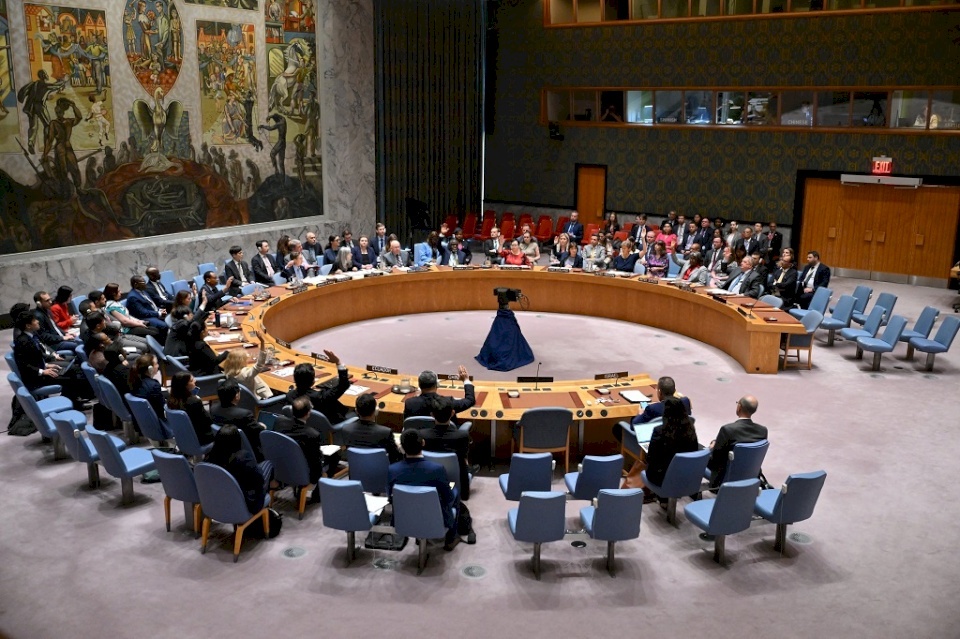
The Security Council Fails to Adopt a Resolution on the Strait of Hormuz
SadaNews - The UN Security Council failed, on Tuesday, to adopt a draft resolution regarding the Strait of Hormuz, submitted by Bahrain on behalf of Saudi Arabia, Bahrain, Jordan, the UAE, Qatar, and Kuwait.
This occurred during a session held by the council, where 11 members voted in favor of the project, while China and Russia used their veto against it, and Pakistan and Colombia abstained from voting.
Bahrain's Foreign Minister Abdul Latif al-Zayani, who chaired the Security Council during April, expressed deep regret over the failure to adopt the draft resolution, stating: "The council has failed to fulfill its responsibility regarding an illegal act that requires clarity and firmness that cannot be postponed."
Al-Zayani warned that "the threats to freedom of navigation and regional security do not fade over time, and they cannot be treated as transient crises," affirming continued efforts in coordination with partners and allies to ensure freedom of navigation, protect international maritime routes, and prevent the recurrence of these threats.
The Bahraini minister added that his country "regrets that the council did not rise to the level of unity of position and the responsibilities it is legally obligated to uphold in light of this serious crisis," noting that the draft resolution represented a "decisive and responsible response to serious developments affecting one of the most vital waterways for international trade."
Al-Zayani emphasized that "Iran has no right to close this waterway to international navigation, thereby denying the peoples of the world access to essential resources for life, violating international law, the United Nations Convention on the Law of the Sea, and moral and humanitarian principles and values."
The Bahraini minister continued, stating that "in light of the global unrest today, it is no longer possible to ignore that obstructing navigation in the Strait of Hormuz represents a systematic behavioral pattern aimed at using this vital passage as a tool for political pressure and bargaining."
The council held a meeting last week, chaired by Al-Zayani, who indicated that the project concerns "Iran's unjust control over international navigation, presenting the council with a challenge that requires a firm stance regarding these illegal and irresponsible actions," reiterating that it "aligns with international law and the provisions of the United Nations Convention on the Law of the Sea."
The draft reaffirmed that all ships and aircraft enjoy the right of passage through the Strait of Hormuz in accordance with international law, encouraging interested countries to coordinate defensive efforts to help ensure the safety and security of navigation through it, including through the escorting of shipping and commercial vessels, and deterring attempts to close the strait or disrupt international navigation or interfere in any other way.
The project reaffirms the right of member states to defend their vessels against attacks and acts of provocation under international law, including those that undermine navigational rights and freedoms, calling for Iran to immediately cease all attacks on shipping and commercial vessels and any attempts to obstruct passage or freedom of navigation in the Strait of Hormuz.
The draft resolution also calls for halting attacks on civilian infrastructure, including water network infrastructures, desalination facilities, and oil and gas installations, expressing readiness to consider imposing further measures on those who conduct actions that undermine navigational rights and freedoms and impede passage or freedom of navigation in the Strait of Hormuz and Bab el-Mandeb.
The project expressed concern over the extension of threats to maritime navigation to Bab el-Mandeb in violation of resolution 2722 (2024), reiterating the importance of protecting maritime security and navigation in accordance with international law.
 Follow the latest Sada News via Google News
12 Martyrs in Gaza Strip since Dawn Today

A Series of Important Decisions Taken.. The Cabinet Discusses Developments in the Deterior...

Organizations of the Temple Prepare for the Largest Raid on Al-Aqsa on What is Called the...

Smotrich: Israel Has No Interest in Joining the War Against Iran

Occupation Issues Military Order to Seize 5 Dunams of Land in Jaba'

Axios: Proposal for a 10-day Ceasefire Between Washington and Tehran and Two Options for M...

In a Rapid Pace.. The Occupation Builds a Huge Earth Barrier Inside Gaza
