

Life on the Sidewalk: How the Egyptian Street Reclaimed the Right to Stay Up After Dark from the Grasp of Closure?
SadaNews - Minutes before the clock strikes nine in Cairo, "Hajj Abdul Tawab" emerges from his ground-floor apartment in an alley of the ancient AL-Labban district in Alexandria, carrying two ornately carved beechwood chairs, placing them meticulously like a professional on the sidewalk adjacent to his home.
Just moments later, his neighbor and friend from the area arrives carrying a game of backgammon, known as 'Tawla', to kick off a new night challenging the government’s closing time decisions with a gathering of lifelong friends.
This meeting has transcended being a mere "neighborly chat;" it has become a sacred ritual to reclaim the customary "right to stay up late," which was restricted by the Egyptian government's decisions to close shops, malls, restaurants, and cafes at nine in the evening, as part of exceptional measures aimed at rationalizing electricity consumption and reducing energy bills in response to the repercussions of the war waged by the United States and Israel against Iran.
Adaptation and Alternatives
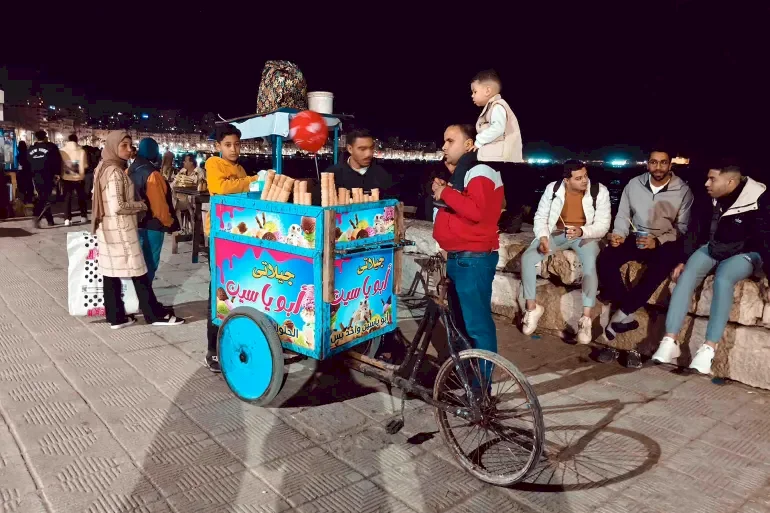
With the implementation of the new closing hours, the streets appeared to be experiencing a state of "administrative schizophrenia." While shops and cafes complied with the decision and shuttered their doors, a parallel life thrived on the surrounding sidewalks and along the coast in coastal cities through gatherings of young people or families.
Many citizens circumvented the government decision and proclaimed what they call the "Republic of the Sidewalk," where the smoke from a kettle blends with the scent of roasted sweet potatoes from an old, rickety wooden cart, as its owner tries to make a living by filling the void left by the closure of snack shops, in a humanitarian scene that resists the darkness with popular alternatives that were never part of government planning calculations.
Ibrahim Awad, a fifty-something employee who was sitting with his colleagues drinking tea on the Alexandria corniche, stated: "We have adapted to the new decisions and have successfully found alternative ways to maintain our late-night habits or outings away from the walls of our homes, after all cafes abide by the order to close their doors at exactly nine, following government orders out of fear of fines and penalties that may reach a permanent closure of the establishment."
Awad added: This "forced migration" to the sidewalk is not a rebellion as much as it is a human need for companionship and an escape from the cramped residential apartments that do not accommodate the energy of youth or the desire of the elderly to converse.
Right to Stay Up Late
The same speaker confirmed that the scene in the neighborhoods of Egyptian cities has not changed, especially since the "right to stay up late" after nine in the evening for Egyptians is not a luxury, but rather a part of their psychological makeup that rejects darkness, whether that is on rickety chairs in front of houses or on the walls of corniches and public squares.
This is echoed by Adel El-Saadani, an employee, who said: What we are seeing now is the transformation of sidewalks into open lounges is a reclamation of the public space, where citizens feel they own the street despite being deprived of the café. He added that these gatherings break the tension resulting from economic pressures and provide a space to relieve political tensions towards regional events.
He pointed out the increasing popularity of citizens along the corniche, which has become an open café attracting waves of young people and families to stay past midnight to enjoy the sea ambiance and the roar of crashing waves against concrete structures.
The Egyptian government urges citizens to rationalize electricity consumption amidst the current exceptional circumstances, aiming to ease the energy bill that has doubled due to the American-Israeli war, which was confirmed by official statements from the Prime Minister's office.
Effectiveness of the Measures
However, government statements translate into heated political discussions on the street about the effectiveness of these measures, as Hajj "Sayed," one of Hajj Abdul Tawab's companions in Al-Labban district, watches the news next to him: "We are here on the sidewalk analyzing and interacting with the news and the implications of military escalation in the region, because it is what dimmed the lights in our streets whenever we read about a military strike in the region; we know that closure may be extended or prices may increase."
Economically on the ground, the decision for early closure sparked a migration of money from the coffers of major shops and "licensed" cafes to the pockets of an informal sector that has begun to organize itself at a stunning pace.
"Mobile cafes" or vehicles providing "café services and snacks" and other simple ideas that blend creativity and skill have become the common denominator for jobs and sources of income for many young people in public spaces after nine in the evening, escaping the specter of unemployment.
Mohsen, a hot drink cart owner, describes his new reality saying: "A few days ago, my work was limited to the morning, but with the evening closure decision, the sidewalk has become my market. People come out from closed cafes looking for any means to stay on the street. I provide them with a cup of tea for a small fee, which is incomparable to café prices before their closure, and I do not consume state electricity; rather I rely on a small gas cylinder and a rechargeable lantern."
Parallel Economy
In this context, economist Alaa Hasballah, a professor of market economics at Alexandria University, believes that while austerity decisions are necessary, they create a "parallel economy" due to the gap left by official closures. It has driven a large segment of youth to seek alternatives outside classical economic pathways as a means of survival and resistance, leading them to create new work patterns based on very small projects and individual skills.
He notes that the alternatives we see along the corniche and street corners are marginal, simple, and temporary initiatives that essentially do not open homes or cover the expenses of a family dependent on real income. What we should seriously pay attention to is assessing the deep economic and social impacts of the early closure decision, as the repercussions of the current regional circumstances may last much longer than the crisis itself.
On the other hand, Dr. Nabila Ibrahim, a sociology professor at Alexandria University, describes the scene as a popular attempt to adapt, but she warns against merely recording it as "social folklore" without addressing the depth of the crisis.
She adds: The "Republic of the Sidewalk" or the phenomenon of "alternative late-night activities" seems to be a spontaneous public response to the bureaucratic calculations of the ministries. While the government achieves its aim of "saving kilowatts," the citizen achieves his goal of "remaining a social being."
The sociology professor questions the effectiveness of the decision against its losses: "If closing at nine in the evening aims to conserve energy due to the repercussions of the war in the region, what about the cost of declining tourism? And what about the dangers of dark roads that increase accident and assault rates?"
She further states: "The loss of a broad segment of society of its evening income opens the door to increased crime rates due to destitution, putting shop owners in a dilemma that forces them to reduce their workforce to cope with rising fuel prices and production inputs."
Nabila proposes an alternative vision that goes beyond the "load-shedding" policy: "Why don’t we offer citizens, universities, and factories a national project to install solar energy networks in installments, in partnership with international expertise, protecting citizens from the continuous price hikes and from the danger of darkness."
Source: Al Jazeera
 Follow the latest Sada News via Google News
After Deschamps' Departure... Zinedine Zidane Tops the Candidates to Lead France

Mbappe Surpasses Messi and Becomes the All-Time Top Scorer in the World Cup

England Defeats France and Achieves Largest World Cup Achievement Since 1966

Messi Refused to Play for Spain and Missed 3 World Cups

Publishers Sue Google for Allegedly Using Books to Train Artificial Intelligence

Google Expands Capabilities of Google Search Console to Support Social Media Accounts

The Mediterranean Table... An Ancient Diet Revealing Its New Secrets for Health and Longev...
