

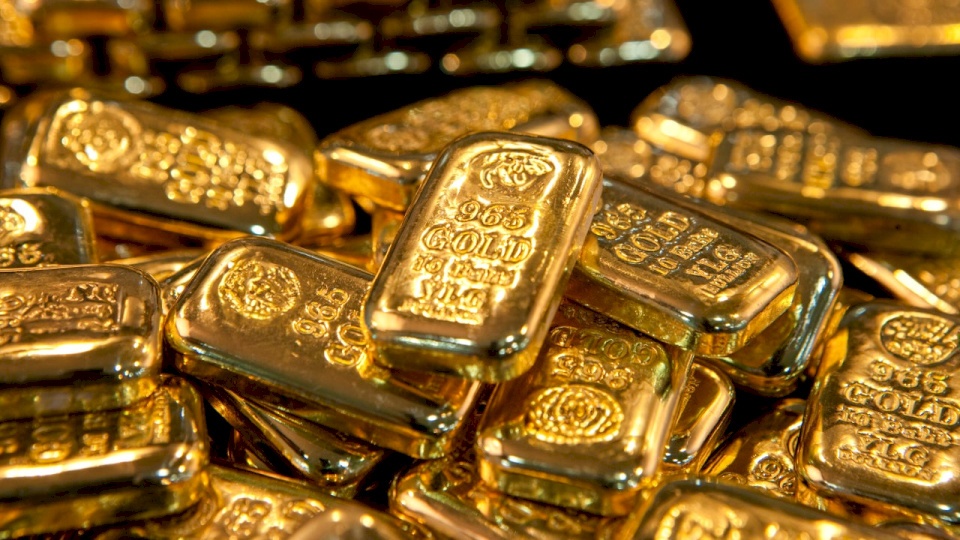
Gold Declines Again as Markets Assess Conflicting Statements on War
SadaNews - Gold has declined as investors evaluate conflicting statements regarding the war in the Middle East, as the postponement of U.S. strikes on Iran's energy infrastructure has provided only a brief respite from the steep decline experienced by the precious metal during the conflict.
The precious metal lost as much as 1.8%, after previously rising about 1%, in a volatile session significantly influenced by fluctuations in equity markets and the inverse relationship with oil.
U.S. President Donald Trump announced a five-day delay on threats of attacks against Iranian power stations, stating on Monday that "fruitful discussions" had taken place, although an Iranian official dismissed the notion of talks.
Rising energy prices resulting from the conflict in the Middle East have increased inflation risks, prompting investors to abandon their positions in gold—known for its liquidity and relative profitability—in favor of other assets.
The metal dropped about 2% in the previous session, marking its ninth consecutive daily decline; the tenth drop would represent the longest losing streak in history.
Temporary Calm Does Not Dismiss Inflation Risks
Despite this pause announced by Trump, the outcome of any negotiations and the future passage of ships through the Strait of Hormuz remain uncertain. Additionally, existing damage to energy infrastructure will require time to rebuild.
This indicates that the threat of inflation remains, as do expectations for interest rate hikes from the Federal Reserve and other central banks, which puts pressure on non-yielding precious metals.
Bloomberg reported that Suki Cooper, global head of commodity research at Standard Chartered, stated that "the gold price correction has exhibited weaker-than-usual performance".
She added that "it is not unusual for gold to experience downward pressure for between four and six weeks after a period of intense strain, as gold proves to be a liquid asset in times of need".
The markets experienced dynamics similar to those after Russia's war on Ukraine in early 2022, when the initial jump in safe-haven assets was followed by a months-long downturn, as energy price shocks moved through markets, increasing inflationary pressures.
Peter Kensella, global head of foreign exchange strategy at Union Bancaire Privee, said: "What you typically see in a major crisis like this is that investors heavily sell off large, well-performing assets to finance margin calls on poorly performing assets, such as stocks or bonds or otherwise".
He added that gold behaved similarly in 2022 and during the global financial crisis in 2008. He continued, "Short-term pricing volatility is all about positioning," noting that long-term influencing factors have not changed.
Gold Loses 17% Since War Began
Although the precious metal has dropped about 17% from the beginning of the war in late February until Monday's close, gold was on an extended upward streak supported by factors including geopolitical and trade tensions and rising central bank purchases.
Moreover, some countries that accumulated gold are energy importers, which means that the rising oil and gas bills due to the war leave fewer dollars to recycle into gold.
Spot gold fell 1.5% to $4,340.80 per ounce at 9:16 AM in Singapore. Silver dropped 3.3% to $66.81, while platinum and palladium also declined.
The Bloomberg Dollar Spot Index, a measure of the U.S. currency, rose 0.2% after ending the previous session down 0.4%.
 Follow the latest Sada News via Google News
London Stock Exchange Enters the Era of 24/7 Trading

Shamaran Petroleum: Suspension of Oil Production in Duhok Fields in the Kurdistan Region o...

Dollar Steadies Near One-Week High Amid War Developments

Trump Imposes Tariffs on Canadian Imports... Ottawa Vows to Respond

Oil Prices Drop After Reports of Mediation Efforts Between the U.S. and Iran

Gold Price Rises Supported by Increased Buying Amid Lower Prices

Due to "Hazardous and Counterfeit Products".. Europe Fines "AliExpress" $627 Million
