

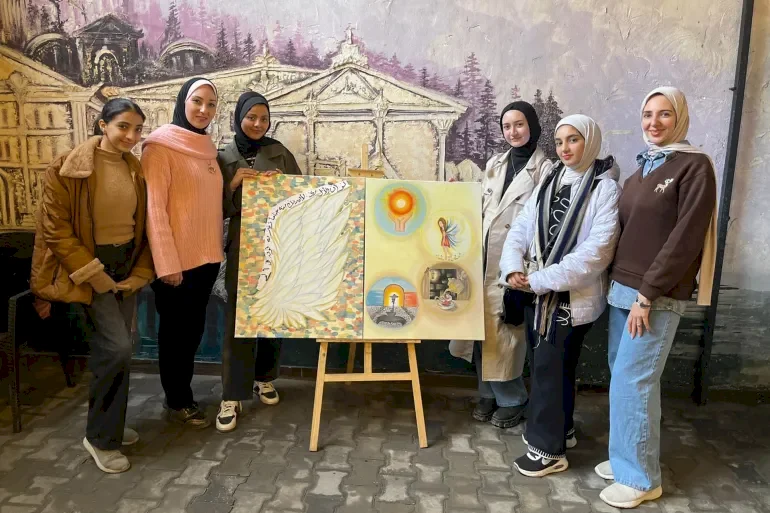
The Purple of Hope: Gaza Girls Unveil Colors in the Face of Annihilation
SadaNews - In one of the shelters scattered across the Gaza Strip, a collective whisper seems to prevail. No music or speeches, just the sound of brushes on canvas, and the breaths of girls searching for some reassurance amid the relentless noise of aircraft.
Here, art is not regarded as a skill or a hobby, but as a psychological necessity and a temporary refuge from the weight of reality. On yellow tables, acrylic colors scatter, some opened in a hurry, as if the color itself is racing against the moment. The trembling hands do not chase beauty; rather, they seek an exit.
The smell of paint mingles with the scent of displacement, creating a harsh blend but charged with the possibility of survival. No one asks: What will you paint? Instead, they ask: What do you carry within you?
For the third year, the Gaza Strip lives under a pressing humanitarian reality, leaving a deep impact on young girls, where feelings of fear, loss, and deprivation have accumulated. In this context, the "Urujwan" initiative emerged to approach the human depths of these girls through art, as an alternative language that expresses what words cannot.
Beyond color, the paintings are not read only at their surface; behind every hesitant line lies a postponed story, and behind every dark hue is a fear that has not found its way to speech. The girls do not start drawing because they have an idea, but because feelings seek a form, turning the white space into an area of acknowledgment, and the color into a silent release.
One of the girls dips her brush into red, not to paint blood, but to say she still feels. Another chooses a dense blue, as if trying to calm an internal noise. There is no single reading for these works, but what they share is that they do not seek to dazzle the eyes, but to lighten the weight on the heart.
In this context, art is not a luxury or decoration, but a psychological necessity. This particular angle is what the "Embodiment of Hope" initiative seeks to establish; that art be a safe space to transform repressed emotions into visual messages, without censorship, and without fear of judgment.
Girls at critical ages, carrying more anxiety than their years, have found in color a way to remain composed.
A White Wing
In the heart of the collective painting, a wide, incomplete white wing stands out, present with strength. It symbolizes not only flight but expresses a psychological need for a temporary escape from the heaviness of reality.
Surrounded by contrasting colors; red next to blue, and orange abruptly cutting across the space, reflecting the turmoil of the inner human condition. Beside the wing, the girls wrote the saying of Elya Abu Madi: "If hope could see, I would gift you a wing to fly above all pain."
Here, the words are not mere ornamentation, but a direct expression of an urgent psychological need; hope is a means of survival, not an abstract idea. The image of the "Phoenix" recurs in the work, a bird or a person born from the ashes. The symbol was not planned but emerged spontaneously from the collective discussion, expressing the girls' desire to rise from pain without denying it or succumbing to it.
A Safe Space
Mrouj Al-Jaru, the coordinator of the Urujwan team, explains the core idea of the project as "creating safe psychological spaces," adding that "Urujwan is a volunteer youth team from Gaza City, working on implementing artistic, cultural, and awareness activities targeting young girls between the ages of 14 and 17, aiming to empower them to express themselves through arts and participate in activities related to their reality."
Al-Jaru clarifies to Al Jazeera that the "Embodiment of Hope" initiative arose from noticing a genuine psychological need among the girls after years of the Israeli annihilation campaign on the Gaza Strip. "We noticed that many girls carry repressed feelings and can’t find a way to express them. Thus, we provided a safe space, free of pressure and judgment, allowing them to rearrange their feelings and build self-confidence."
She notes that the activity started with a discussion session about the saying of Elya Abu Madi, not as a literary material but as a psychological starting point. "What mattered was not the painting itself, but what happens during the painting: interaction, laughter, silence, and the ability to feel safe within a community that resembles you."
Feelings of Joy
For visual artist Farah Ajour (19 years old), the workshop was not just an artistic activity. She says: "During the second displacement, I experienced severe psychological pressure, my energy was dimmed, and I could no longer express what was inside me."
She describes that period as being surrounded by fear and tension, without a space to release. She adds to Al Jazeera: "After participating in this workshop, I felt safe again. Painting here wasn’t required to be beautiful, but honest. This alone made a significant difference."
For Farah, the feeling that she is not alone and that what she feels is understandable and shared was a key element of the experience.
Farah sees that art in Gaza is not a luxury, and she says: "Art here is a means of psychological resistance. When we provide a safe space, feelings automatically turn into colors and messages. These initiatives, despite their simple capabilities, are close to the people and stem from their reality, which is why they leave a genuine impact."
A Dream of Hope
High school student Amal Darwish (17 years old) speaks calmly about her experience: "Before knowing the Urujwan team, I didn’t have a safe space to express myself. My thoughts were scattered, and I felt like I carried things I didn’t know how to release."
She says that joining artistic activities changed her perception of herself, "I became more optimistic and met positive people. Painting helped me understand my feelings, even those I couldn’t name."
For her, the experience was not just artistic but primarily human. Amal concludes her conversation with us with a clear invitation: "I wish I had known the Urujwan team earlier. This space is important for every girl who feels there is something inside her that needs to be said."
Psycho-Social Survival
In this context, Yasser Abu Jame, director of the Gaza Program for Mental Health, sees that art is no longer a luxury or a side activity in the context of war, but has transformed into a means of psychological salvation, especially for girls who find themselves surrounded by accumulated losses without always having the ability to express them in words.
He tells Al Jazeera that drawing, embroidery, writing, and even simple coloring help reorganize internal feelings, giving the girl a sense of control in a reality where she has lost control over almost everything. He adds, "When a girl holds a brush or a pen, she is not just creating a work of art but rearranging internal chaos, and giving herself a moment to breathe amid the daily suffocation."
Source: Al Jazeera
 Follow the latest Sada News via Google News
After Deschamps' Departure... Zinedine Zidane Tops the Candidates to Lead France

Mbappe Surpasses Messi and Becomes the All-Time Top Scorer in the World Cup

England Defeats France and Achieves Largest World Cup Achievement Since 1966

Messi Refused to Play for Spain and Missed 3 World Cups

Publishers Sue Google for Allegedly Using Books to Train Artificial Intelligence

Google Expands Capabilities of Google Search Console to Support Social Media Accounts

The Mediterranean Table... An Ancient Diet Revealing Its New Secrets for Health and Longev...
