

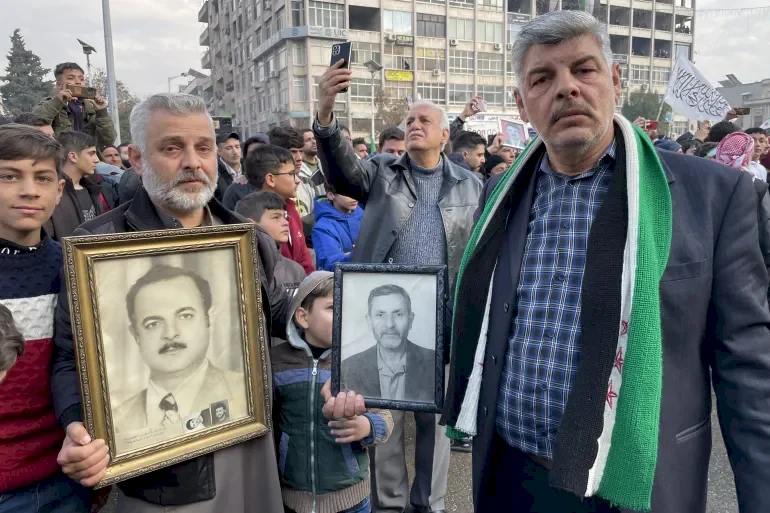
44 Years After the Massacre.. The People of Hama Publish Photos of Their Relatives Killed by Assad
SadaNews - On a cold night in the winter of Hama, Syria, its residents awoke to sounds they had never heard before: tanks and entire military divisions entered the city, marking the beginning of one of the fiercest military operations in Syria's history on February 2, 1982. This event became known as the Hama Massacre.
On that day, the regime of the late Syrian President Hafez al-Assad began executing a massacre against Hama, through brutal and systematic shelling targeting the city, led by his brother Rifaat al-Assad, commander of the Defense Companies.
The pretext was the regime's accusation that armed groups called the "Fighting Vanguard" controlled neighborhoods within the city, but the operation rapidly escalated into a complete siege within days, cutting off electricity, water, and communications, closing roads, and trapping the city's residents within their streets.
The campaign lasted 27 days, carried out by several units and brigades of Assad's army, primarily by the Defense Companies, aiming to eradicate the opposition in the city. According to various accounts, it resulted in the deaths of around 40,000 people and left more than 17,000 missing. The Syrian Network for Human Rights documented the deaths of nearly 10,000 of them and recorded the names of 4,000 missing persons.
Today, the people of Hama and Syrians are commemorating the 44th anniversary of the massacre, the second such observance since the fall of the ousted President Bashar al-Assad's regime. Some even shared photos of their sons or relatives who were killed by Assad's army and the Defense Companies for the first time.
Bloggers wrote: "Today, publicly commemorating the massacre from within Hama and at all levels confirms that truth does not die, and while falsehood may have its rounds, truth has its own cycles. Where is Hafez al-Assad? Where is Rifaat?".
Others commented: "We commemorate the martyrs with painful silence, committed to keeping the memory alive, to remind us of human rights, and to teach future generations that peace and justice are the only way to build our future".
Activists from Hama stated that in February 1982, "Mother of the Water Wheels" was not a battlefield, but a city being punished for wanting to stay alive. Days of bombing, killing, and disappearances, homes leveled to the ground, and families wiped from records yet remaining in the hearts of the residents.
They added that the goal was not to silence a rebellion, but to break the spirit of an entire city. However, after more than four decades, Hama has not broken, and its memory has not fallen silent.
They confirmed that they are "not merely witnesses to history but its guardians. They see the story as lived by its people, so that it is not told by the executioner, and so that the tragedy is not repeated".
Syrians affirmed that in one of the most heinous crimes against humanity in modern Syrian history, the massacre was used as a means to break the will of a people demanding freedom and dignity. After 44 years, the Hama Massacre remains a crime that does not expire, a stain in the record of the Assad regime, and a testament to the resilience of a city that did not bow despite the massacres and destruction.
They said: "In this commemoration, we affirm that memory is an obligation, that justice is a right, and that the blood of the victims is a trust that will not be forgotten".
Syrians have called for the establishment of a museum in Hama dedicated to the massacre and its causes, documenting it in a truthful and honest manner, displaying the names of the victims and the documented narratives of the residents, while continuously demanding the prosecution of all who participated in it. They confirmed that the museum is for remembrance and drawing lessons, to prevent the establishment of any new tyranny.
Source: Social Media
 Follow the latest Sada News via Google News
Report: Trump Asked Netanyahu to Withdraw Troops from Syria and Lebanon

Trump: No Need for American Military Presence in Iraq

The Organization of Islamic Cooperation Welcomes Achievements in the Palestinian Reform Pl...

India Participates in the Second Ministerial Meeting of the Donor Group for Palestine

What Do Syrians Expect from the New People's Assembly?

Water and Food Shortages Threaten Displaced People in Southern Lebanon

Between De-escalation and Bab el-Mandeb.. How Does Tehran View the Escalation in Yemen?
