

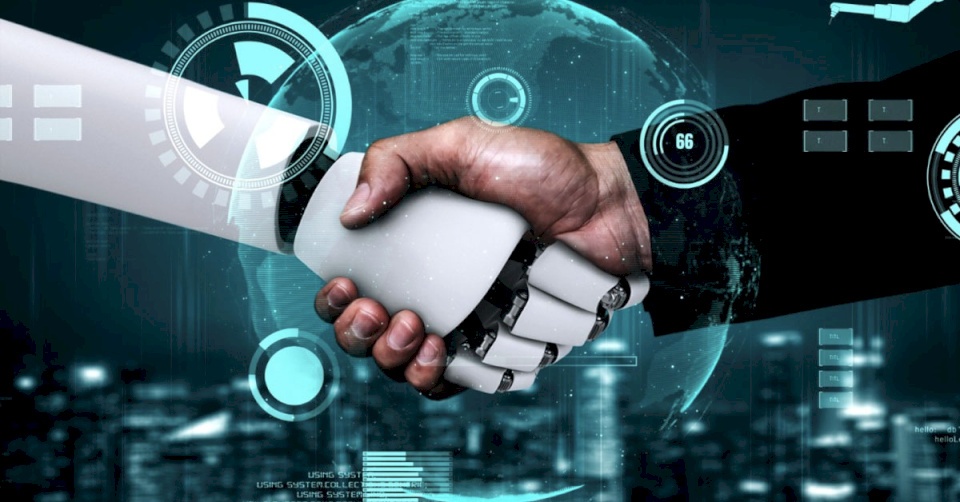
How Artificial Intelligence Steals Our Faces and Our Money?
SadaNews - With the rapid evolution we are experiencing, we have entered an era where sight is no longer a guarantee of truth. Imagine, for example, receiving a video call from your direct supervisor asking for an urgent money transfer for a secret deal, or hearing your father's voice asking for help in a crisis. The voices are the same, and the features are the same, but the entity in front of you is nothing more than a complex algorithm.
Cybersecurity has shifted from protecting data to safeguarding truth itself. Deepfake technology has become the pinnacle of existential threats in the digital age, as generative artificial intelligence is exploited to steal biometric identity, placing banks and governments in direct confrontation with an "invisible enemy" that does not make mistakes.
Dismantling the Threat.. Why is Deepfake More Dangerous Than Its Predecessors?
In the last decade, fraud relied on phishing through malicious links, but today we live in the age of "artificial impersonation," where this technology utilizes Generative Adversarial Networks (GANs). Two AI systems work against each other—one for faking and the other for detecting the deception. They continue this battle until the first system produces content that exceeds the second system's capability to detect.
This evolution has allowed deepfake to surpass "deceiving humans" to "deceiving machines." Systems that once relied on facial recognition or voice as a final security factor are now the biggest vulnerabilities, as attackers no longer need to steal your password; they simply copy you digitally.
From "Physical Security" to "Cognitive Security"
Financial institutions are the first laboratory for testing society's resilience against deepfakes. The banking sector no longer views cybersecurity as just a firewall, but as an ongoing process of "cognitive analysis."
Revolution in Liveness Testing (Liveness 2.0): Leading banks have replaced traditional "smile at the camera" tests with systems that examine precise physical interactions. These systems now monitor blood flow in the face, pupil dilation in response to light, and screen reflections on the cornea. While generative AI may mimic features, it still struggles to simulate the complex physics of light and human biology in real-time.
Behavioral Biometrics: Banks are adopting a "continuous identity" strategy, monitoring how you hold your phone, the angle of its tilt, and the timing of button presses, rather than just confirming your identity at login. Deepfake may steal your face, but it cannot steal your "nervous rhythm" in dealing with devices.
Double Channel Protocols: Banks have started returning to the principle of "multi-physical verification" where, for major transactions, it is not enough to use just face or voice; a physical hardware token or blockchain encryption that cannot be faked programmatically is required.
Governments and the Protection of the "Digital Social Contract"
For governments, deepfake is not just a tool for stealing money, but a weapon for destabilizing political situations and destroying trust in institutions.
Some have begun developing protocols to verify content source (Content Provenance). This means that any official video released by a government entity carries a "digital signature" encrypted within the file structure itself, and if even a single pixel is altered, the user is immediately alerted that the content is "untrustworthy."
Additionally, governments are currently pushing for laws requiring AI companies to place "invisible watermarks" on any automatically generated content, allowing protective software to recognize it instantly even if it appears entirely human.
Security agencies have also created specialized units for "cognitive defense," tasked with monitoring deepfake videos targeting leaders or aiming to incite public panic, and utilizing counter AI to analyze sound frequencies that reveal manipulation in audio layers.
The Technical Gap.. The Arms Race Between "Deception" and "Detection"
The real issue lies in the fact that the tools for deception are evolving faster than the tools for detection, putting us in a difficult technical equation: the cost of producing a high-quality fake video is continually decreasing with the availability of computational capabilities, while precise detection requires expensive technologies and in-depth analysis of big data.
Therefore, modern strategies are moving towards “building resilience” instead of “treatment,” which means training employees and the public to systematically question digital content.
Beyond Technology.. Ethical and Social Responsibility
The battle against deepfakes cannot be won with technology alone; it requires a new digital contract that includes:
Public awareness: Shifting "digital culture" from passive consumption to analytical critique.
Technological accountability: Social media platforms must bear legal responsibility for the false content circulated via their algorithms.
International Cooperation: Deepfakes cross borders; fraudsters may be in one country, victims in another, and banks in a third, requiring unified international security and legal coordination.
Experts say the age of deepfakes imposes a new and painful reality upon us: privacy has ended, and credibility has become a rare commodity. Banks and governments will remain in a constant race to update their digital shields; however, human awareness remains the last line of defense.
In a world where everything can be faked, authenticity will become the most valuable competitive advantage, thus individuals not only protect their bank accounts but contribute to safeguarding humanity's ability to differentiate between truth and digital mirage.
Source: Websites
 Follow the latest Sada News via Google News
After Deschamps' Departure... Zinedine Zidane Tops the Candidates to Lead France

Mbappe Surpasses Messi and Becomes the All-Time Top Scorer in the World Cup

England Defeats France and Achieves Largest World Cup Achievement Since 1966

Messi Refused to Play for Spain and Missed 3 World Cups

Publishers Sue Google for Allegedly Using Books to Train Artificial Intelligence

Google Expands Capabilities of Google Search Console to Support Social Media Accounts

The Mediterranean Table... An Ancient Diet Revealing Its New Secrets for Health and Longev...
