

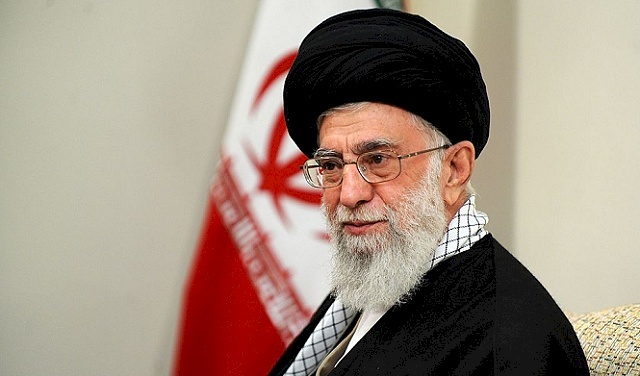
Khamenei: Any American Attack on Iran Will Ignite a Regional War
SadaNews - Iran's Supreme Leader Ali Khamenei warned today, Sunday, of the outbreak of a regional war if the United States attacks Iran, amid a significant American military presence in the region and threats from President Donald Trump against the Islamic Republic.
Khamenei was quoted by the "Tasnim" agency saying, "Americans should realize that if they start a war, it will be a regional war." He likened the protests that the country has witnessed in recent times to a "coup," while reports indicate that tens of thousands have been arrested.
Tasnim reported Khamenei saying that protesters "attacked police, government buildings, official institutions, Revolutionary Guard and army barracks, banks, and mosques, and burned Qurans," adding that the attempt "failed."
On his part, the American president said on Saturday that Tehran is "talking" to Washington, while his Iranian counterpart Masoud Pezeshkian affirmed that war would not be in the interest of either side or the Middle East, amid intense diplomatic efforts to defuse tensions.
Meanwhile, the Secretary of the Iranian Supreme National Security Council, Ali Larijani, spoke of a "progress" towards negotiations with the United States, hosting Qatari Foreign Minister Mohammed bin Abdulrahman Al Thani in Tehran, after meeting with Russian President Vladimir Putin in Moscow.
In parallel with the diplomatic efforts, Iranian army commander Amir Hatami warned the United States and Israel against launching any attacks, stressing that his country's forces are on high alert in response to the American military reinforcements deployed in the Gulf region.
The reinforcements have raised fears among regional countries of the outbreak of a war that would exacerbate the situation in the region. Trump has threatened for weeks with military intervention in Iran in light of the crackdown on protests in the Islamic Republic, which has resulted in thousands of deaths.
Trump told "Fox News" that Tehran is "talking to us, and we will see if we can do something, otherwise we will see what happens." He reiterated that "we have a large fleet heading there." He added, "They are negotiating," referring to the fact that Washington has not informed its allies in the region of specific plans to strike Iran.
Trump had said on Friday that he expected Iran to seek negotiations for an agreement regarding its nuclear and missile programs instead of facing American military action.
Iranian Foreign Minister Abbas Araqchi confirmed on Friday from Turkey that Tehran is ready for nuclear negotiations "if they are fair and just" and "on an equal footing," but that "Iran's missile and defensive capabilities will not be up for negotiation."
In recent days, communications and diplomatic visits between Iran and parties related to Washington have intensified. Pezeshkian said in a call with his Egyptian counterpart Abdel Fattah el-Sisi on Saturday that Tehran "has never sought and will never seek war in any case, and it is deeply convinced that war is not in the interest of Iran, the United States, or the region," according to Iranian presidency sources.
Doha, which has served as a channel for message exchanges between Washington and Tehran on several previous occasions, stated that the Qatari Foreign Minister presented with Larijani on Saturday the "ongoing efforts to de-escalate," and reiterated its support for "all efforts aimed at reducing tensions and peaceful solutions that enhance security and stability in the region."
Larijani had emphasized in earlier statements on Saturday that "contrary to the fake atmospheres created by the media, the formation of a framework for negotiations is in progress."
 Follow the latest Sada News via Google News
Jordanian Army Intercepts 4 Iranian Missiles and 4 Drones

Death of a Moroccan Man During His Arrest in Italy Sparks Calls for Investigation

Due to Trump's Sanctions.. Canada Cancels Joint Ceremony with the US for Bridge Opening

Trump: We will make great progress with Beirut.. Aoun: It is time for Lebanon to be stable

The Lebanese Army Deploys in the South and Comes Under Gunfire; Israel Clarifies

Bezhkian: Directives from the Leader to End the State of No War, No Peace

Meeting Between Aoun and Trump Expected Alongside 'Experimental Areas'
