

"Assistance for the Druze".. An Stalled Item in Syria-Israel Talks
Translation by SadaNews: This month, discussions resumed between representatives of the Israeli government and representatives of Syrian President Ahmad al-Shara's government, in an attempt to renew the ceasefire agreement that had been in place since 1974 during the rule of the father and son Assad, until the fall of the regime in Damascus about a year and three months ago. This step does not directly involve the Israeli occupying army, but it may bring about a change in the reality of the Syrian Golan.
According to indicators published by the Hebrew website Yedioth Ahronoth and translated by SadaNews, these talks are not a step towards a new Middle East or towards peace and normalization with Syria, but are closer to security understandings that guarantee Israel a withdrawal from nine military sites established by the occupying army in the Syrian Golan last year, in addition to the Mount Hermon heights that were taken over last autumn without a fight.
The Israeli army has already begun to study the implications of this arrangement, even though the political leadership promised last week that the army would remain at the top of the Syrian Mount Hermon, a strategic point that helps the northern command control the smuggling routes for weapons between Syria and Lebanon. But reports of the negotiations indicate a preliminary agreement on an Israeli withdrawal and the imposition of strict restrictions on military activity, reaching the prohibition of the air force from conducting attacks throughout Syria.
Freedom of Military Action
Israeli forces enjoyed freedom of action in Syria even during the years of the "between wars" operations, which are secret operations aimed at thwarting Hezbollah's reinforcement, and this freedom increased after the fall of Assad's regime. However, the new president of Syria demands a halt to Israeli air force attacks, making it difficult for Israel to thwart the smuggling of advanced weapons from Iraq and Iran through Syria to Hezbollah, according to the Hebrew website.
Smuggling routes have been severely damaged due to the activities of Israeli intelligence and air forces, but any new agreement between Tel Aviv and Damascus could reopen these routes. Moreover, remnants of military capabilities, such as Russian radar belonging to the previous regime, are still spread throughout Syria, and although Shara's army lacks the expertise to operate them, the agreement may restrict Israel's ability to target them.
Hauran Region
Among the Syrian demands is also to restrict Israeli army attacks in the Hauran region, which extends from the Golan eastward for a distance of 70 to 100 kilometers. This area has been a theater for activities of Iranian-linked groups and armed Palestinian organizations and Hezbollah, which established military infrastructure under the umbrella of the Syrian army. Israel has repeatedly tried to eliminate this infrastructure over the past decade, but any new ban or restriction will complicate the army's task in facing threats.
Assistance for the Druze
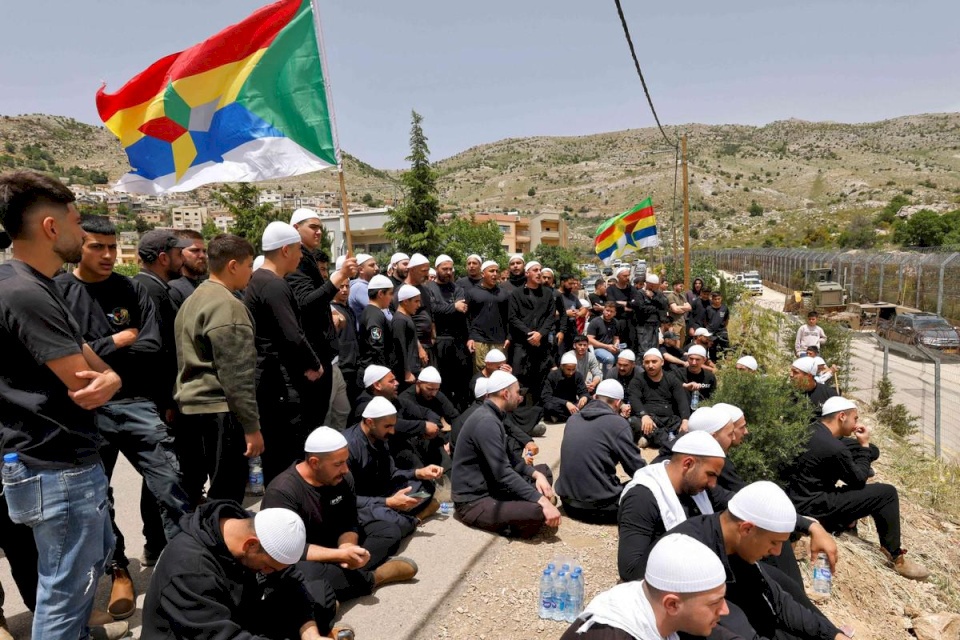
The third most contentious item relates to Israeli assistance to the Syrian Druze in three areas: the suburbs of Damascus, the Druze Mountain in Sweida in southern Syria, and the village of Khadr near Mount Hermon opposite Majdal Shams. Foreign media reported that Israel provided thousands of high-quality weapons seized from Hezbollah and Hamas last year, in addition to protective vests, medicines, and equipment. This assistance, as translated by SadaNews, came to protect the Druze who are subjected to repeated attacks by extremist groups (according to Yedioth Ahronoth), some of which are Bedouin and some linked to the new regime. Their relatives in Israel, including soldiers in the occupying army, continuously demand support, but Shara's government insists on its cessation.
The Russian Role
About a month and a half ago, Russian representatives toured the Syrian Golan heights, including Israeli sites, in coordination with the northern command. The possibility of deploying Russian forces in the Golan has emerged, a controversial step that is not supported by the Israeli army, and its implementation is not expected soon. Russia still maintains forces in the upper region of northwest Syria, and its position may change if its interests in the Middle East shift.
Israeli Concerns
Israeli army officers advise political leadership against withdrawing from the Golan, amid fears of a wide-scale invasion from the east, from Jordan and Syria, similar to the events of October 7. The army is still heavily affected by its failure to confront Hamas's attack on the western Negev, and sees withdrawal from hostile areas at the border as inappropriate in the near future. They emphasize that defending communities is easier when forces are advanced in enemy areas within a buffer zone.
Nevertheless, the army reminds that any withdrawal will be met by an increase in forces along the borders in the Golan, so that their density becomes double what it is now. The Israeli army will still be allowed to attack any direct threat approaching the Golan or detected in the area. Yedioth Ahronoth reported.
Yedioth states: "The question arises regarding the model for addressing threats: will it be through frequent bombing of infrastructure as in Lebanon, or through the Gaza model that has been constrained since the ceasefire with Hamas began, where attacks are limited to specific escalation targets. So far, the few Israeli attacks have been in response to Hamas infringements sending personnel daily to army sites on the yellow line, a scene reminiscent of the years before October 7."
The Israeli occupying army recommends waiting in the hope that there will be a gap between what is written in the political agreement and what is practically permissible on the ground, allowing it to update its attack plans according to reality.
 Follow the latest Sada News via Google News
Axios: Proposal for a 10-day Ceasefire Between Washington and Tehran and Two Options for M...

In a Rapid Pace.. The Occupation Builds a Huge Earth Barrier Inside Gaza

Meeting Between Aoun and Trump Expected Alongside 'Experimental Areas'

Gaza Health Warns of Collapse of Oncology Services Due to Depletion of Treatments and Susp...

The Occupation Demolishes a House in the Town of Sa'ir near Hebron

Israel Reveals Details of Secret Iranian Nuclear Facility in Mount Fas

A Mother, Her Child, and Her Three Daughters Martyred in Israeli Shelling on Gaza City
