

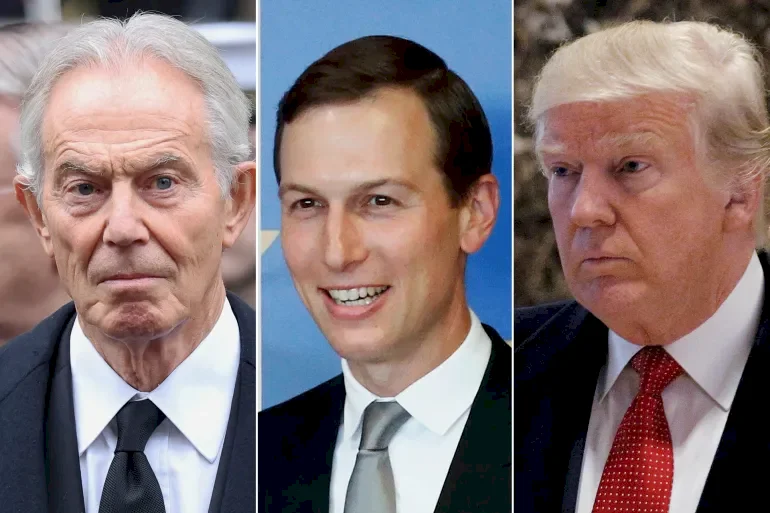
Gaza and the Peace Council: 9 Questions to Understand the New Landscape
SadaNews - The White House announced on Friday evening the formation of what it called the "Peace Council," alongside the establishment of the "Palestinian National Committee for the Governance of Gaza," as part of the second phase of the comprehensive plan proposed by U.S. President Donald Trump to end the war in the Gaza Strip.
In light of these developments, numerous questions arise regarding what is referred to as the "Peace Council," its composition, its powers, and its relationship with the mechanisms managing the Gaza Strip. Below are 9 questions to understand the features of this new landscape.
1- What is the purpose of forming the "Peace Council"?
According to the statement, the Peace Council aims to provide strategic oversight for implementing the comprehensive plan to end the war in Gaza, which is a roadmap of 20 points focusing on lasting peace, stability, reconstruction, and economic development, while ensuring accountability and mobilizing international resources during the transition from war to development.
2- Who are the members of the "Founding Executive Council" of the Peace Council?
The statement clarified that, under the presidency of Donald Trump, a Founding Executive Council has been formed, comprising individuals with experience in diplomacy, development, economics, and infrastructure, including:
U.S. Secretary of State Marco Rubio.
U.S. Envoy Steve Witkoff.
Former U.S. President's advisor and son-in-law Jared Kushner.
Former British Prime Minister Tony Blair.
American billionaire businessman Mark Rowan.
President of the World Bank Group Ajay Banga.
U.S. political advisor Robert Gabriel.
Each member will take on specific issues including governance, regional relations, reconstruction, investment attraction, and funding.
The White House also appointed Ariyeh Lightstone and Josh Greenbaum as advisors to the Peace Council, tasked with leading strategy and daily operations, translating the Council’s mandate and diplomatic priorities into disciplined implementation, according to the statement.
3- What is the "Gaza Executive Council"?
According to the statement, the "Gaza Executive Council" has been formed to support the Office of the High Representative and the National Committee for Governance of Gaza, with the aim of:
Enhancing effective governance.
Accelerating the provision of quality services.
Supporting stability and prosperity for the residents of the Strip.
4- Who are the members of the "Gaza Executive Council"?
The council includes members from the Founding Executive Council, namely: Steve Witkoff, Jared Kushner, Tony Blair, and Mark Rowan, alongside prominent regional and international figures. The announced composition includes:
Former UN envoy Nikolai Mladenov in the position of High Representative for Gaza.
Turkish Foreign Minister Hakan Fidan.
Qatari diplomat Ali Al-Dahadi.
Egyptian Intelligence Chief Hassan Rashad.
UAE Minister of State for International Cooperation Reem Al-Hashemi.
Israeli businessman Yakir Gabay.
Dutch politician Sigrid Kaag.
5- What is the role assigned to Nikolai Mladenov?
The White House announced the appointment of Nikolai Mladenov as High Representative for Gaza, to oversee:
The field linkage between the Peace Council and the National Committee for Governance of Gaza.
Oversight of governance, reconstruction, and development.
Ensuring coordination between civilian and security tracks.
6- How will the security file in Gaza be handled?
The statement revealed the appointment of U.S. General Jasper Giffords as the leader of the International Stability Force, with powers to assist the Peace Council in monitoring compliance with the ceasefire agreement and engaging in necessary arrangements to achieve the comprehensive plan’s objectives, to be executed under the strategic direction of the Council and funded through donations provided by donors according to the Council’s financing mechanisms.
The force’s tasks also include ensuring permanent disarmament in the Strip, destroying and preventing the reconstruction of military infrastructure, as well as providing protection for civilians and coordinating with concerned nations to secure humanitarian corridors.
7- What is the "Palestinian National Committee for the Governance of Gaza" and what is its role?
The White House clarified that the Palestinian National Committee for the Governance of Gaza will handle daily executive responsibilities within the Strip, including:
Rehabilitating essential public services.
Rebuilding civil institutions.
Restoring stability in daily life.
Laying the foundations for sustainable governance capable of self-reliance.
The statement noted that Ali Shath, a former Palestinian planning deputy minister, will head the committee, describing him as a "widely recognized technocratic figure" with deep experience in public administration, economic development, international dealings, and an understanding of the institutional reality in Gaza.
The establishment of the committee was seen as a central step in implementing the second phase of the American plan.
8- How does this framework relate to international legitimacy?
The White House confirmed that this step fully aligns with UN Security Council Resolution 2803/2025, which endorsed President Trump’s comprehensive plan, welcoming the establishment of the "Peace Council" as an international mechanism to advance the settlement process and reconstruction in Gaza.
In this context, the United States affirmed its complete commitment to supporting this transitional framework, in coordination with Israel, Arab states, and the international community, calling on all parties to cooperate with the National Committee, the Peace Council, and the International Stability Force to ensure the rapid implementation of the plan, announcing that additional names would be revealed within the two executive councils in the coming weeks.
9- How did the Arab countries respond to the announcement of the Peace Council?
Several Arab countries welcomed the announcement of the establishment of the "Peace Council" and the start of the second phase of the American plan, with the Gulf Cooperation Council praising the step, considering it part of a broader political track, emphasizing the necessity of establishing a ceasefire and ensuring the flow of humanitarian aid, while renewing support for the rights of the Palestinian people and a two-state solution.
The Saudi Foreign Ministry also supported the establishment of the Palestinian National Committee for the Governance of the Gaza Strip as a temporary transitional body based on UN Security Council Resolution 2803.
For its part, the Jordanian Foreign Ministry welcomed the announcement of the establishment of the Council and the National Committee, appreciating the American role and the efforts led by Qatar, Egypt, and Turkey, while emphasizing the importance of Palestinian territorial unity, supporting early recovery, and paving the way for the Palestinian National Authority to return to governance in the Strip.
 Follow the latest Sada News via Google News
Public Petroleum Authority: Fuel supply continues daily and we urge citizens not to rush t...

8 Martyrs and 20 Injured in a Series of Airstrikes on Gaza

Report: Trump Considers Escalating War and Iran Looks to Expand It to Include Israel

Trump Responds to Mamdani: Netanyahu Will Not Be Arrested in the United States

Israeli Estimates: Mojtaba Khamenei is in Iran and continues to issue instructions

Report: Proposal for a 10-Day Ceasefire Between Washington and Tehran

Hussein Al-Sheikh Congratulates Khalil Al-Hayya on His Election as Head of Hamas's Politic...
