

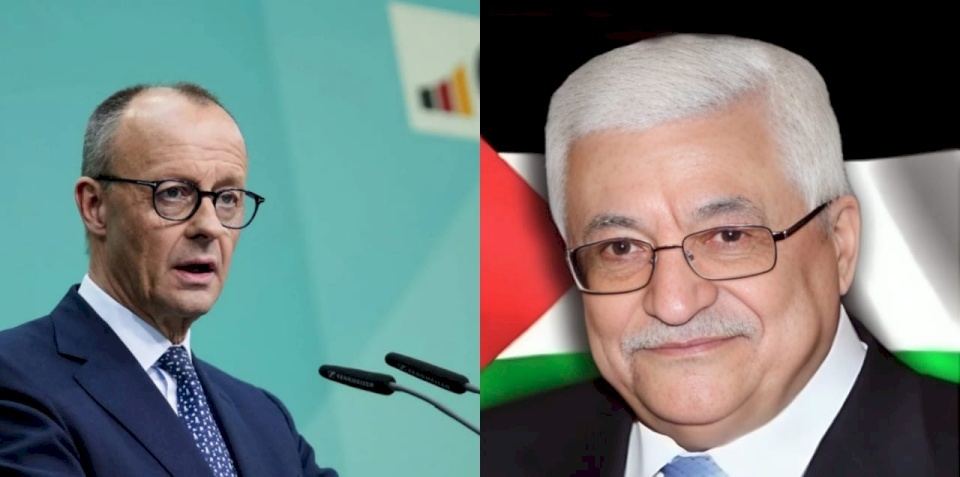
During a Call with the German Chancellor.. President Abbas: We Are Committed to the Comprehensive Reform Program for the Palestinian Authority and Holding Elections
SadaNews - Palestinian President Mahmoud Abbas received a phone call today, Saturday, from German Chancellor Friedrich Merz, during which they discussed ways to enhance bilateral relations between the two countries and peoples. They also reviewed the latest political developments and the situation in Palestine, especially in the Gaza Strip and the West Bank, as well as ways to strengthen regional and international efforts to end the war and achieve a just and lasting peace.
President Abbas welcomed the German Chancellor at the beginning of the call, recalling their important meeting that took place recently in Sharm El-Sheikh during the signing ceremony of the peace plan proposed by U.S. President Donald Trump.
The President highly appreciated Germany's positions supporting international law and the two-state solution, and its rejection of settlement activities, annexation, and displacement policies, expressing his gratitude to Germany for its continuous political, economic, and humanitarian support for Palestine, including support for the establishment of Palestinian state institutions, providing humanitarian assistance to the Gaza Strip, supporting the "UNRWA", and Germany's role in organizing the Gaza Reconstruction Conference in partnership with Egypt and other countries. He also thanked Germany for its support for the New York Declaration and the international efforts stemming from it.
President Abbas reiterated the Palestinian position's fundamentals, clarifying that the Palestinian leadership condemned from the first moment the killing or capturing of civilians, including what was carried out by "Hamas" on October 7, and the need for its rule in the Gaza Strip to end, for it to hand over its weapons, and for Israel to completely withdraw from Gaza according to the second phase of President Trump's plan.
He mentioned that we had previously recognized the State of Israel, and we remain committed to that. The State of Palestine is holding on to the two-state solution based on international legitimacy resolutions, for the independent State of Palestine to live alongside the State of Israel in security and peace.
The President stressed Palestine's firm rejection of anti-Semitism and all forms of racism, hatred, and violence, affirming that this is completely contrary to the values and national and humanitarian principles of the Palestinian people.
President Abbas briefed the German Chancellor on the steps that the State of Palestine has taken to fulfill its commitments to the comprehensive reform program agreed upon with the European Union and the United States, which includes reforming and modernizing school curricula according to UNESCO standards, establishing a unified social welfare system, abolishing the Prisoners' Payments Law, and preparing to hold general elections as soon as the war ends and suitable conditions are provided.
In this context, the President clarified that the State of Palestine will hold municipal elections on April 16, and is concurrently working on preparing a transitional constitution and modern political party law that allows only the participation of those who commit to international obligations and international legitimacy resolutions, reinforcing the principle of one state, one law, and one legitimate weapon.
He reaffirmed that we want a democratic, modern, and unarmed Palestinian state that believes in the peaceful transfer of power and political plurality.
The President also assured Chancellor Merz that the State of Palestine welcomed President Trump's plan and Security Council Resolution No. 2803, emphasizing that the priority now is to implement this plan to end the war, stop the bloodshed, alleviate the suffering of our Palestinian people in Gaza, and prevent forced displacement.
He stressed that the next step must involve implementing the second phase of the plan, which is based on the surrender of Hamas and the factions' weapons to the Palestinian state and the complete withdrawal of Israel from the Gaza Strip, paving the way for the entry of the Palestinian administrative committee and Palestinian police, deploying the initial stability force, and beginning the reconstruction process in an organized and effective manner.
He highlighted the necessity of taking parallel steps in the West Bank simultaneously to stop undermining the two-state solution, which include: stopping settler violence, halting settlement expansion and annexation policies, and releasing the Palestinian tax funds held by Israel, as this has a significant impact on economic and financial stability and the ability of the Palestinian government to fulfill its obligations toward its citizens.
The President informed his German counterpart about the ongoing work and dialogue with President Trump's team to implement the above-mentioned steps within a coordinated international framework that ensures ending the war and moving towards implementing the two-state solution based on international legitimacy and ending the occupation, as a means to achieve comprehensive peace in the region.
President Mahmoud Abbas reaffirmed his keenness to work with Germany and with Chancellor Merz personally to achieve a just and lasting peace, stressing that there is no alternative to peace between the Palestinian and Israeli peoples, expressing his great appreciation for Germany's central role in supporting peace and stability in the region. At the end of the call, both sides agreed to continue their coordination and joint consultations in the upcoming phase.
 Follow the latest Sada News via Google News
Public Petroleum Authority: Fuel supply continues daily and we urge citizens not to rush t...

8 Martyrs and 20 Injured in a Series of Airstrikes on Gaza

Report: Trump Considers Escalating War and Iran Looks to Expand It to Include Israel

Trump Responds to Mamdani: Netanyahu Will Not Be Arrested in the United States

Israeli Estimates: Mojtaba Khamenei is in Iran and continues to issue instructions

Report: Proposal for a 10-Day Ceasefire Between Washington and Tehran

Hussein Al-Sheikh Congratulates Khalil Al-Hayya on His Election as Head of Hamas's Politic...
