

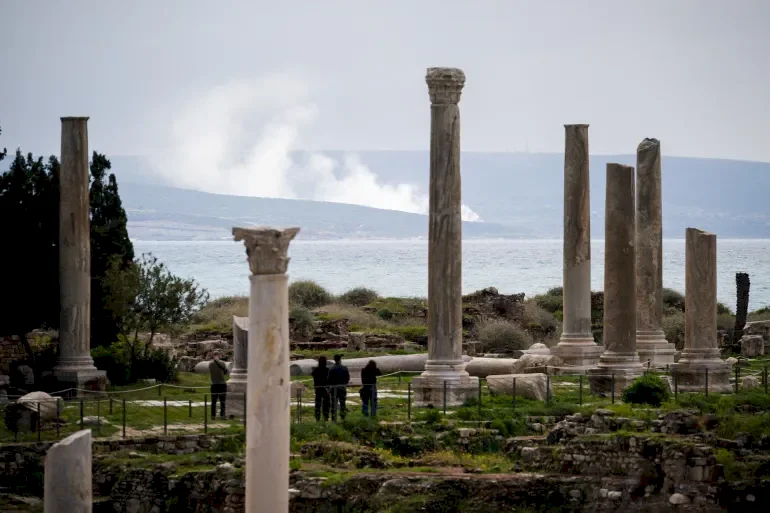
Lebanon's Heritage Under Fire.. "Blue Shields" Attempt to Save Tyre's Antiquities
SadaNews - At the site of Al-Bass in the city of Tyre in southern Lebanon, the "Blue Shield" insignia dominates the entrance of the UNESCO World Heritage-listed site, in an attempt to protect it from Israeli airstrikes following an attack targeting its vicinity.
Although the city, one of the oldest in the Mediterranean basin, houses relics from the Roman era and is about 20 kilometers from the border with Israel, it has faced numerous attacks since the outbreak of war with Hezbollah.
The Israeli army has repeatedly issued warnings to residents to evacuate the area entirely, but many families have not complied with this warning.
The "Blue Shields" initiative, launched by a committee under the United Nations Educational, Scientific and Cultural Organization (UNESCO), encompasses over 30 archaeological sites in Lebanon, including the antiquities of Tyre, which have been marked in a message primarily directed at the Israeli army, as the 1954 Hague Convention obliges warring parties to protect cultural property in times of armed conflict.
Targeting Heritage
On March 6, 2026, Israel launched an airstrike just a few meters from the archaeological site in Tyre, resulting, according to local authorities, in the deaths of eight members of one family, as their home was turned into a pile of rubble.
Nader Saqlawi, the director of archaeological excavations in the southern region at the Ministry of Culture, states: "They were our neighbors.. They thought that being near the archaeological site would protect them since World Heritage is not supposed to be bombarded during wars and armed conflicts."
Saqlawi recounts that when a team went to the site to assess the damage two days after the strike, "I found some human remains.. on the roof of the museum," which is under construction.
The windows of the museum were shattered due to the blast of the airstrike, which did not damage the archaeological cemetery dating back to the second and third centuries, nor the massive triumphal arch, the aqueducts, and the racetrack within the site, which are remnants of the prosperity of the Roman era.
Mission and Risks
War between Israel and Hezbollah renewed on March 2, after the Iran-backed party launched a barrage of rockets towards Israel in response to the killing of Supreme Leader Ali Khamenei during the first US-Israeli strikes on Iran.
In Tyre, archaeological experts must conduct more precise investigations to uncover possible damages from the airstrikes.
Expert David Sassin, from the International Alliance for the Protection of Heritage in Conflict Areas (ALIPH), states: "Lebanon is full of archaeological treasures.. and there is not enough space in Beirut's warehouses to transport all the threatened antiquities."
Moreover, transporting antiquities to Beirut under military protection "remains fraught with risks," according to Sassin, in the absence of guarantees to keep them safe from airstrikes.
Appeals from Guardians of History
During the previous war in 2024, gold coins, jars, and valuable sarcophagi were transported to Beirut where they are still preserved.
In that same year, the city of Tyre was attacked, which also affected the medieval Shama castle, partially destroying it. Saqlawi says: "The Israelis know everything.. They are fully aware of what exists at that site."
Mustafa Najdi, one of the guardians of the archaeological site, talks about the moments during the strike: "I heard a very loud explosion and the glass shattering. I fled the area and notified the authorities.
There were remains, and the situation was very difficult," he adds: "No one cares about us (…); we hope that everyone who can exert pressure to stop this savagery will do so.. This civilization represents history and represents Lebanon and represents everyone, both Lebanese and non-Lebanese."
Source: AFP
 Follow the latest Sada News via Google News
FIFA Referees Committee, Led by Colina, Clarifies Cases from Egypt vs. Argentina Match

The Egyptian Federation Files Official Complaint Against Referee Letexier

Do You Know How to Comfort Someone Who is Crying? Here's What to Say and Do in Tough Momen...

"Backrooms": From Digital Legend to Cinematic Phenomenon

Prediabetes.. The Silent Bomb Carried by Millions Without Their Knowledge

From Sweden 1958 to the Epic of Egypt 2026.. Argentina's History with World Cup Comebacks

After the South Africa Precedent.. Nigeria Investigates the Encroachment of Technology Com...
