

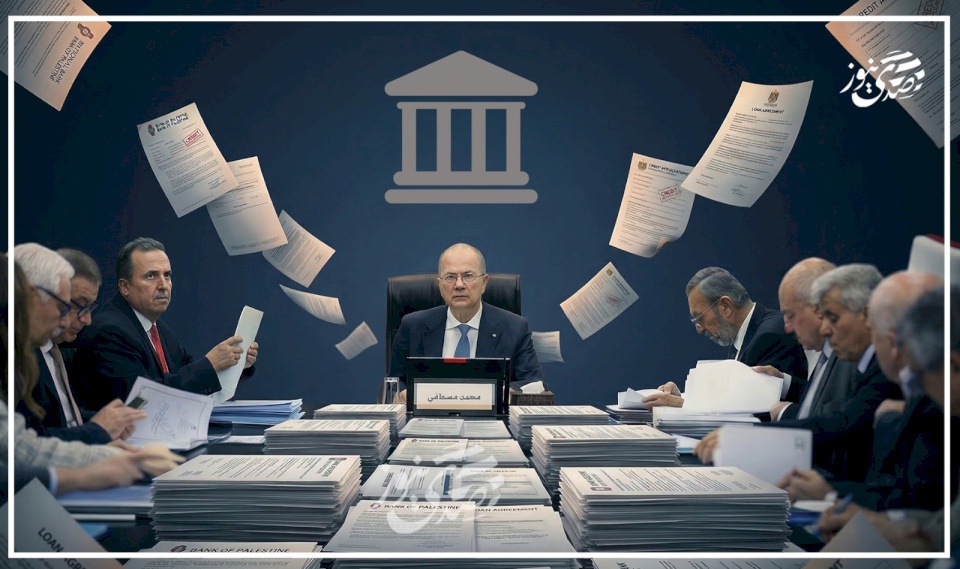
Report: The Government and the Endless Cycle of Bank Borrowing at the Expense of a Whole Economy Teetering Under the Weight of Destruction
- Analysts: The government and the endless cycle of bank borrowing at the expense of a whole economy teetering under the weight of destruction
- The current management of the financial crisis threatens the stability of the banking sector and warns of serious economic repercussions
- A question awaiting an answer: Why doesn't the government seek solutions away from the banks after its loans exceeded $3.6 billion?
- Calls for restructuring the administrative apparatus of the Palestinian Authority and implementing financial reforms and bold decisions
- Calls for a political and legal battle with Israel to release clearance funds instead of waiting for the unknown.
Exclusive to "Sada News": Over the years, the Palestinian Authority has not responded to much advice from experts about the necessity to streamline its administrative apparatus and reduce the salary bill that drained the "tricks" of the authority before October 7, 2023, as public sector employees have not received their full salaries since November 2022. This means that the financial crisis faced by the Palestinian Authority is not the result of two and a half years of war, even though it exacerbated the situation, but rather the harvest of years of mismanagement of public funds and increasing expenditure despite limited revenues.
The easier option comes with high risk
Nevertheless, the National Authority still resorts to "patchwork" solutions in managing its financial affairs amidst a crisis that threatens its existence, as stated by Finance Minister Dr. Stepan Salama. The government, whenever it closes doors in front of it, resorts to the easier option of borrowing from the banking sector, despite experts' warnings that continuing this policy threatens the stability of the banking sector and poses a risk to its resilience, especially in light of rising political risks and the absence of adequate guarantees and clear solutions and plans.
Banks have lent the government more than their capital
Analysts and economic experts noted that reaching government debt of about $3.6 billion means that banks have practically lent the government more than their capital base, which is about $2.5 billion. Therefore, it is inappropriate in any case to exert further pressure on banks for banking facilities to finance the salary bill or others, as this has become a burden on the banking apparatus and threatens its stability. They affirmed that the government must look for other options and not rely solely on raising public debt and increasing borrowing from banks, as this has serious repercussions both on the stability of the banking apparatus and on the economic cycle.
An economic expert told "Sada News" that borrowing by the government from the banking sector is not an open-ended option. There are banking standards that must be adhered to, especially since the Palestinian government lacks some aspects mentioned in Basel Standards, which are international rules governing the operation of banking systems worldwide to ensure their stability. For example, it is necessary for the government entity receiving loans to be a sovereign state that controls its resources, necessitating the presence of a central bank and the approval of budgets by an elected parliament. He said, "Wise risk management policy dictates stopping the granting of loans to the government in light of rising political risks, especially since these loans are not allocated to enhance productive projects but rather to pay salaries. No government in the world borrows for the purpose of paying salaries; borrowing should be for the sake of establishing developmental or productive projects."
Experts believe that exceeding the public government debt ratio of 130% compared to the GDP and reaching government loans and its employees to about $5 billion out of approximately $12 billion of granted facilities signals a red light for the banking apparatus to combat the risk of serious disruptions in its banking operations and operations, the repercussions of this disruption are not only financial or economic but also social and political, similar to what happened in many countries around the world, including neighboring ones where the state’s economy completely collapsed and its social and political fabric unraveled after trust fell in the financial and banking system specifically, which was the last straw that broke the camel's back and made even the loyalists rearrange their social and political ranks.
He adds, "In Palestine, the banking system still enjoys stability and resilience, and our overall situation is better than that of brotherly Arab countries, but the government's continued access to facilities without payment guarantees will pose serious risks." He points out that granting the government and its employees and the companies that provide services to it a high percentage of facilities means depriving the economic cycle of facilities that should have gone to support productive projects."
Demands for solutions outside the banking sector
The expert called on the government to seek other solutions outside the banking sector, primarily by restructuring its administrative apparatus to reduce expenses, as well as setting a cap on government salaries, and perhaps also granting unpaid leaves to certain job categories similar to what other countries have done until the crisis ends, with the United States being at the top of these countries that rule the world politically, economically, and militarily. Moreover, exploring the possibility of privatizing government sectors or selling state-owned assets.
He also stressed the importance of not betting on the future and waiting for the "unknown," calling on the Palestinian Authority to engage in a political and legal battle with Israel to recover clearance funds which represent two-thirds of the public treasury revenues, and it is impossible for the authority to continue providing essential services to citizens without them.
Warning of Structural Risks to the Economy and the Banking Sector
For his part, economic expert Dr. Saeed Sabri tells Sada News that amidst the escalating financial crisis facing the Palestinian Authority, a fundamental question emerges regarding the risks of continuing to rely on the banking sector as the main source of financing the financial deficit. He says, "Palestinian banks have played an important role over the past years in providing liquidity to the government through loans and credit facilities, which has helped maintain a minimum of financial stability during tough times. However, continuing this approach under the current economic conditions may create a range of structural risks to both the economy and the banking system simultaneously."
Dr. Sabri asserts that the first of these risks is the increased exposure of banks to government debt. As the percentage of loans granted to the government within the lending portfolios rises, the banking sector's sensitivity to sovereign risks increases. He points out that the size of lending from the banking sector to banks reflects the significant role that the banking sector has played in supporting financial stability over the past years, but at the same time increases banks' sensitivity to any potential default in public finances or delays in payment.
The second risk, according to Sabri, is linked to the impact on the economic cycle. When banking liquidity increasingly flows towards funding the government, the banks' ability to finance the private sector diminishes, particularly small and medium-sized enterprises, which represent the backbone of the Palestinian economy.
He says, "This phenomenon is economically known as the crowding out of the private sector by the public sector, where the expansion of government borrowing reduces the available financing opportunities for investment and production, negatively impacting economic growth and job opportunities."
He noted that continuing this pattern of financing may place additional pressures on the stability of the banking system itself. Palestinian banks operate on the basis of purely professional standards and derive from their commitment to these standards the trust granted to them by the public, especially depositors, as banks largely depend on the efficiency of managing their liquidity levels to achieve a precisely calculated balance between the requirements of all their clients from depositors and borrowers, as well as external correspondent banks. Necessary Implementation of Financial Reforms
As for solutions, Dr. Sabri tells Sada News that it is essential for the Palestinian Authority to shift towards options that reduce pressure on the banking sector rather than deepen it. This begins with reforms in public finance that include improving tax collection efficiency, broadening the tax base, and controlling public expenditures directing it towards productive sectors that generate sustainable growth and revenues.
The government can also work on diversifying funding sources through alternative tools such as development bonds or financial instruments aimed at Palestinian expatriates and investment institutions, which allows for attracting new savings without overly relying on local banks. Also, cooperation with international financial institutions can be enhanced to provide favorable financing lines linked to economic reform programs.
Sabri believes that in the medium term, the most sustainable solution remains linked to stimulating economic growth itself. The wider the productive base expands and local revenues increase, the less the need for domestic borrowing will be. Thus, banking liquidity can be redirected to support investment and the private sector, which forms a real basis for enhancing economic and financial stability in Palestine.
 Follow the latest Sada News via Google News
Soaring Oil Prices Burn the Pockets of the Palestinian Citizen "The Poor"

Millions of Dollars in Losses.. "SadaNews" Reveals Shocking Figures for Traders from Pales...

The Problem of Shekel Overcrowding Worsens.. Fuel Station Owners Threatened with Closure o...

The Palestinian Economy at a Crossroads: 4 Files Awaiting Resolution

Inflation Expectations in Israel Stabilize at 1.5%

Ministry of Economy Announces the Opening of Import Application Submissions for Commodity...

Relative Stability of the Dollar Near 3.04 Shekels and Predictions of Returning Inflationa...
