

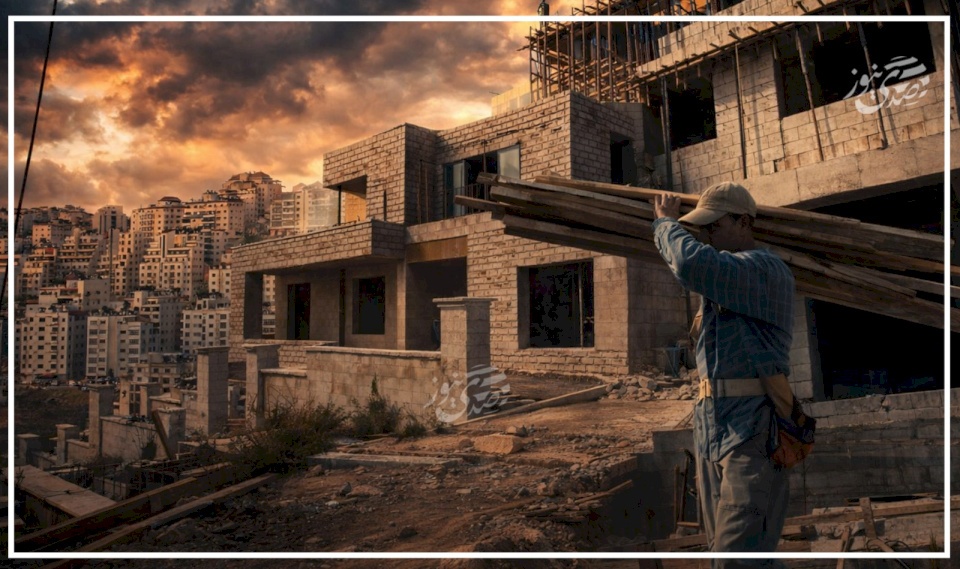
The Real Estate Market in Palestine: No Growth on the Horizon Without Stability Guarantees
Special to "SadaNews": The real estate market in the West Bank experienced a clear stagnation in 2025, affected by the ongoing war and its economic and psychological repercussions, without reaching a state of complete collapse.
The volume of real estate transactions significantly decreased, especially in the sectors of investment apartments and land, due to weak liquidity and the hesitation of individuals and investors to make long-term decisions in the absence of stability.
Three Scenarios on the Horizon,
Ahmad Al-Qadi, the president of the Palestinian Contractors Union, told "SadaNews" that the future of the contracting and construction sector in Palestine cannot be predicted without understanding the developments in the political situation and its outcomes. He outlines three phases on the horizon: the first is short-term, in which investors in this sector are expected to remain cautious as they watch the political situation in the West Bank and Gaza Strip; the second phase begins with the transition to a ceasefire, during which the sector may start to recover, and banks may begin to inject funding into it; the third phase starts with the reconstruction phase in Gaza, which could lead to a qualitative shift in the sector if the construction processes are executed by Palestinian hands within a national plan.
Regarding the West Bank specifically, Al-Qadi indicated that any revival in this sector is linked to four factors: the first is implementing administrative reforms in the national authority to enable it to meet its obligations to the sector by repaying its debts exceeding 700 million shekels; the second is activating externally supported developmental projects and providing the necessary funding for them; the third involves curtailing the policies of occupation and settlers in the areas aimed at strangling the Palestinian economy, including stops to displacement operations in Area C; and the fourth is improving supply chains for this sector, which face obstacles at Israeli ports and crossings, as supply operations dropped by about 50% following the outbreak of the war.
Al-Qadi states, "This sector is not an ordinary economic sector; it is a mirror of the political reality, and without overcoming the existing obstacles, it will continue to suffer," indicating that the war and Israeli assaults have caused a significant decline in this sector.
Contribution of the Sector to GDP and Employment
It is noted that the contracting sector constitutes about 12-13% of the GDP and employs about 20-25% of the workforce in Palestine, actively engaging directly and indirectly in about 160 economic sectors.
Stagnation in 2025
Real estate expert Manal Al-Abdallah told "SadaNews" that the real estate market in the West Bank experienced stagnation in the past year, but did not reach a state of collapse. The real demand (for basic housing) exists, but citizens postponed purchasing decisions due to the difficult economic conditions in the West Bank and their impact on individual income levels.
She indicated that the Palestinian real estate market in 2025 was a constrained one, not collapsed, governed by exceptional conditions that imposed caution and slowdown, noting that most investors halted their projects due to a liquidity shortage, which is the main bottleneck.
Prices Are Stable but..
Regarding prices, Al-Abdallah says, "Prices remained stable in form, but they are actually eroded." The declared prices did not drop sharply, but project owners offered under-the-table discounts, including long-term facilities and acceptance of offers below the actual price, explaining that practically, prices have decreased, even if they remained stable in terms of numbers.
The Palestinian Monetary Authority issued results of the real estate prices index in Palestine for the third quarter of 2025, where the general index showed relative stability compared to previous quarters, recording a slight increase of 0.71% compared to the previous quarter of the same year, reaching 107.5 points, consistent with the performance of the sub-indices.
Land and Apartments..
Al-Abdallah clarified that the demand for purchasing land in 2025 generally decreased, leading to a decline in sales; however, their prices remained unaffected as their value is stored as a future investment like apartments.
She states, "The movement of land sales has seen a greater slowdown, but it has maintained its position as a long-term savings vehicle, especially land close to major cities."
Regarding apartments, the supply exceeds demand; however, basic residential apartments are relatively resilient, while investment apartments (for rent) were affected, with rents declining or stabilizing. The increased supply relative to demand has made renters currently stronger than landlords, noting that the rental investment yield is relatively weak.
She adds, "The demand for residential apartments remains but is limited, especially for purchasing with the aim of basic housing, while the demand for investment apartments designated for rent has declined due to the falling rental yield."
She pointed out that rental apartments recorded a state of stability or slight decline, with the bargaining power shifting to tenants and the investment feasibility of rented properties diminishing.
Where Does the Ramallah Market Stand Specifically?
Ramallah differs from other cities as it is an administrative and financial center, with the highest relative liquidity density, but the demand there has not disappeared; it resembles a state of stagnation.
Al-Abdallah states, "The reality of the real estate market in Ramallah today is characterized by slow sales and tough negotiations between buyers and sellers, making investors very cautious, awaiting a signal from the market."
Will 2026 Be a Year for Buying or Selling?
Al-Abdallah states that opportunities for purchasing this year will be excellent for those with liquidity, especially regarding good residential apartments at compressed prices, built on well-studied land. As for selling, she believes it is not the right time unless one is compelled to do so, and the price is appropriate.
Predictions for 2026..
Al-Abdallah predicts that the real estate market will not witness a boom in 2026, but the most likely scenario (closest to reality) is that the market will experience slow growth during the first six or nine months of the year, with postponed housing demand beginning to appear, noting that she does not expect jumps in prices, but the market may rearrange itself anew.
By the end of 2026, Al-Abdallah believes the market will most likely witness gradual improvement rather than an explosion, accompanied by a slight increase in prices (5-10% at most), pointing out that land close to Ramallah will begin to regain its attractiveness during this period, and patient investors will start to enter.
She states, "Real estate in Palestine will remain slow and psychologically exhausting, as the market is no longer a quick-return one; it requires long patience, dormant capital, and cool nerves," noting that 2026 will be a year of slow recovery, with Ramallah recovering first, stating that there are opportunities for purchase, but not for quick profit.
She expected 2026 to be a year of gradual rebalancing, with no sharp jumps or collapses, and real estate remaining a long-term option more than a quick profit tool.
 Follow the latest Sada News via Google News
Soaring Oil Prices Burn the Pockets of the Palestinian Citizen "The Poor"

Millions of Dollars in Losses.. "SadaNews" Reveals Shocking Figures for Traders from Pales...

The Problem of Shekel Overcrowding Worsens.. Fuel Station Owners Threatened with Closure o...

The Palestinian Economy at a Crossroads: 4 Files Awaiting Resolution

بنك إسرائيل يخفض توقعات النمو ويحذر من ارتفاع العجز

Exchange Rates of Currencies Against the Shekel on Tuesday (July 21)

Inflation Expectations in Israel Stabilize at 1.5%
