

Mustafa: Rebuilding Gaza will provide job opportunities if achieved with a national vision
SadaNews: Prime Minister Dr. Mohammad Mustafa confirmed that the government is committed to building a more just and stronger economic and social environment, based on the Palestinian individual and their ability to work and innovate.
The Prime Minister emphasized that updating the national strategy for creating new job opportunities in the national economy will be prioritized in the coming phase. This represents an important program related to national sovereignty, achieving social justice, institutional reform, reconstruction, and empowering our people.
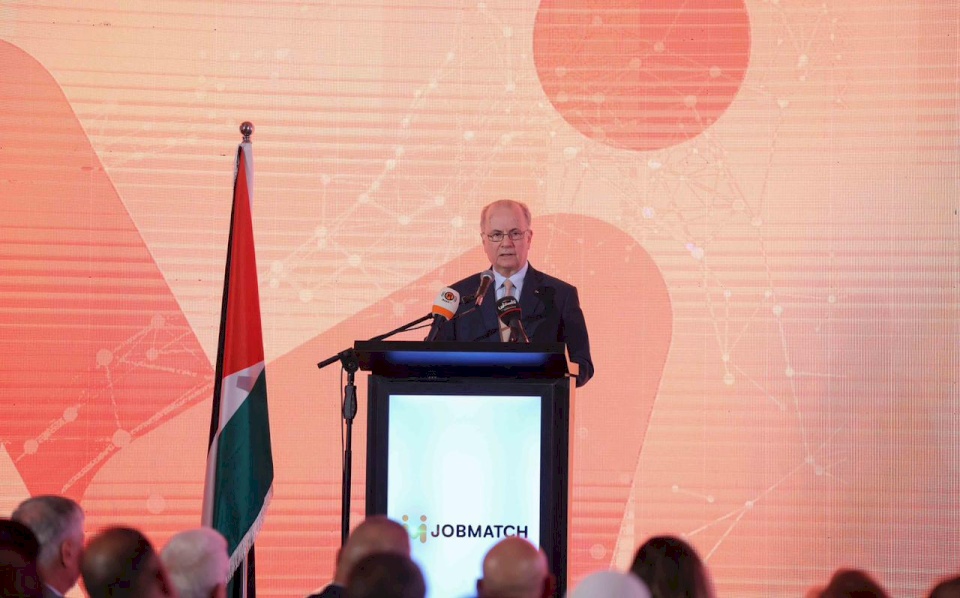
This was stated during his speech at the launch event of the national platform for aligning job opportunities, today Monday in Ramallah, in partnership with the Belgian Development Agency Enabel, with support and funding from the European Union, in the presence of the Governor of Ramallah and Al-Bireh Laila Ghannam, Minister of Labor Dr. Inas Dhdahda Al-Attari, Director of the Belgian Development Agency in Palestine and Jordan Heidi De Pauw, the Belgian Consul General in Jerusalem Ambassador Anick Van Kalster, Head of Cooperation at the Belgian Consulate in Jerusalem Vincent Viani, Head of Cooperation at the European Union Mario Varente, and a number of ministers, ambassadors, officials, and private sector representatives, as well as local, regional, and international partners.
Mustafa said: "The job alignment platform is not just a new digital tool, but a step in a larger path that the government is working on to reorganize the labor market, improve access to job opportunities, and develop labor market policies based on accurate and reliable data, leading to the update of the comprehensive national strategy for work in Palestine".
He added: "Organizing the labor market is not merely a technical task, but part of the battle for economic recovery, and building an environment capable of creating jobs, protecting workers' rights, and directing investment towards productive sectors to create new job opportunities in them. Hence, it is vital to link the launch of the platform with a broader national vision to address unemployment".
Mustafa affirmed that the Palestinian private sector is a key partner; it is the main driver of job creation, investment, and innovation, and it is capable of enabling us to turn our national vision into tangible results on the ground.
The Prime Minister said: "Our goal is to gradually reduce dependence on the Israeli market and redirect labor towards the national economy, building a balanced economic relationship, not that of an occupier to citizens whose rights are suppressed. We need to shift a large part of imports from Israel and the world to national production as much as possible, to create job opportunities for our people".
Mustafa added: "The digital economy and green economy have significant roles in the future of the Palestinian economy, as the digital economy provides a broader space that cannot be restricted by the occupation, and the green economy is the path capable of creating jobs and sustainable employment in renewable energy, resource efficiency, clean technology, water solutions, environmental innovation, and investing in them is a national necessity, not a secondary option".
The Prime Minister emphasized that rebuilding Gaza will provide job opportunities if accomplished according to a national vision that transcends relief towards development, placing our people in Gaza at the forefront of beneficiaries, and providing the West Bank with operational solutions through supply chains, industries, and supporting services.
He said: "The recovery and reconstruction in beloved Gaza is one of our top national and economic priorities, and reconstruction should become an opportunity to localize engineering and construction expertise, and to build Palestinian capabilities capable of implementing sustainable development projects that contribute to building our national economy".
The Prime Minister added: "It is important to remember that more than 150 thousand Palestinian workers have been unable to access their workplaces inside the Green Line for over two years and have lost their sources of livelihood. The losses of these workers are enormous, exceeding 5 billion dollars annually, including remittances that were flowing through banks exceeding 4 billion dollars. This, in addition to the loss of most of the workforce's employment in the Gaza Strip, has led to around 550 thousand unemployed people outside the labor market".
For her part, the Minister of Labor said: "Today, we launch the first national employment platform in Palestine and the region, which is a sovereign step that reorganizes the Palestinian labor market on fair and modern bases supported by data and artificial intelligence".
Al-Attari added: "We needed a unified national platform because labor market data was scattered. The gap between education and market needs is widening, the private sector is declining due to restrictions, women and youth face challenges in accessing opportunities, unemployment has reached unprecedented levels, and the occupation has destroyed the labor market sector from all aspects".
Al-Attari continued: "The ministry has worked over the past two years to launch emergency and supportive employment programs for workers, providing approximately 25,000 job opportunities, both permanent and part-time, developing the vocational training sector and its digital pathways, supporting entrepreneurs, and self-employment grants, and enhancing cooperatives. It has also developed a national database that includes more than half a million job seekers".
The Minister of Labor indicated that the ministry has begun, since the beginning of the year, to sign multiple partnership agreements with the university education sector in Palestine, in order to provide data and information about Palestinian university graduates, networking with foreign universities, as well as networking with vocational training sectors to gather data and information about vocational training graduates in the governmental and private sectors, in addition to forming regional and international partnerships to expand the scope of work, especially through collaboration in remote work.
Al-Attari added: "Agreements have also been signed with job advertisement sites in Palestine. The ministry has completed the signing of four agreements with the major sites including 'Jobs', 'Opportunities', 'Jobi', and 'Smart Index', which represent 95% of private sector job advertisements in Palestine, by allowing these sites to post job vacancies and reach Palestinian skills more effectively, utilizing artificial intelligence tools in the matching process between jobs and applicants".
Governor of Ramallah and Al-Bireh Dr. Laila Ghannam confirmed that the launch of the platform represents an important step amid the difficult economic conditions experienced by our people, reflecting the spirit of solidarity between state institutions and international partners to enhance the resilience of citizens. She added that the platform responds to an urgent need to organize the labor market and provide a more just and transparent environment for youth, women, and graduates, affirming the governorate's support for any effort that contributes to empowering citizens.
For his part, Mario Varente, Head of Cooperation at the European Union, pointed out that the platform represents a pioneering model in investing in Palestinian skills and human resources, emphasizing that the EU places great importance on enhancing job opportunities and economic development in Palestine. He noted that the EU's support for this initiative comes from its commitment to a long-term partnership with Palestinian state institutions, emphasizing that digital transformation in the labor sector is one of the most important tools for creating new opportunities and quality employment programs for youth, improving access to decent work locally and internationally, as well as enhancing resilience and governance, calling on all partners to use the platform to find suitable opportunities for their skills and build a more resilient work future.
For her part, Belgian Consul General in Jerusalem Ambassador Anick Van Kalster indicated that Belgium views the launch of the platform as an advanced step towards developing a modern and effective employment system, relying on technology and innovation to connect job seekers with employers, confirming that Belgium will continue its support for development programs that enhance the Palestinian youth's ability to access decent work opportunities, praising the existing partnership between the Ministry of Labor and the Belgian Development Agency Enabel, which resulted in establishing a national platform with a strategic impact on the labor market, providing an opportunity to build an economic future for Palestine.
For her part, the Director of Enabel's Office in Jordan and Palestine, Ms. Heidi De Pauw, stated that the launch of the "Job Alignment" platform comes within our vision to support digital transformation and enhance the capabilities of Palestinian institutions in building more efficient and inclusive employment services. She added that the platform represents one of the most prominent projects that embody the close cooperation between Enabel and the Ministry of Labor, as it allows for the use of data and technology to create innovative employment pathways, plan employment and recruitment programs, and provide job opportunities that match the needs of the local and international market, thus enhancing the resilience of the Palestinian citizen and economic development.
During the official launch of the platform, a speech by the Director General of the International Labor Organization Gilbert Houngbo, Director General of the Arab Labor Organization Faiyez Al-Mutairi, as well as speeches by labor ministers from Arab and international countries such as Jordan, Iraq, Morocco, Pakistan, and Spain were presented, affirming the pioneering step taken by the Ministry of Labor in launching the "Job Alignment Platform" to build a system that contributes to enhancing and organizing the Palestinian labor market, creating job opportunities for job seekers, empowering them, enhancing their resilience, and building the Palestinian economy.
 Follow the latest Sada News via Google News
Soaring Oil Prices Burn the Pockets of the Palestinian Citizen "The Poor"

Millions of Dollars in Losses.. "SadaNews" Reveals Shocking Figures for Traders from Pales...

The Problem of Shekel Overcrowding Worsens.. Fuel Station Owners Threatened with Closure o...

The Palestinian Economy at a Crossroads: 4 Files Awaiting Resolution

A Severe Blow to the Economy of the West Bank.. New Israeli Measures at the Karama Commerc...

Exchange Rates of Currencies Against the Shekel (24 July)

The United States Imposes New Sanctions on Network Linked to the Muslim Brotherhood and Ha...
