

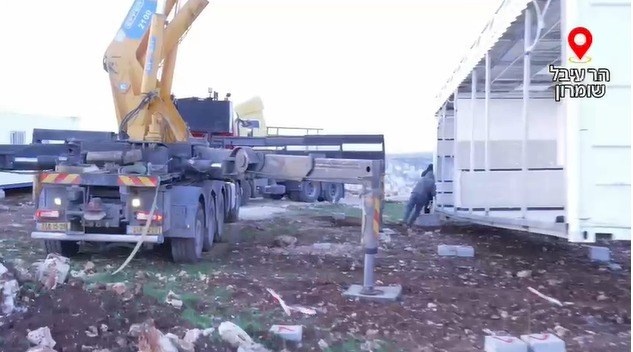
Settlers Establish New Settlement Site on Mount Ebal North of Nablus
SadaNews: The Wall and Settlement Resistance Authority reported that settlers established a new colonial site on Mount Ebal, north of the city of Nablus, early this morning. This operation was described as taking place during the night, with the participation of the Samaria Settlements Council and the settlement movement Amani, near the site that the occupation claims is the biblical altar attributed to Joshua bin Nun. According to what was published by colonial settlement groups, students from a religious agricultural school were brought to the site in a step aimed at consolidating a permanent colonial presence in the area. Rabbi Eliakim Levonon from Samaria was also present at the site, indicating the ideological and religious nature of the colonial initiative.
This move comes in the context of the accelerating developments in the colonial project in the West Bank, and among what the settlers promote under the title "One Million Settlers Plan in Samaria," which aims to double the number of settlers in northern West Bank by establishing new settlement outposts and expanding existing ones. This step also coincides with the decision made by the occupation's cabinet on May 29, 2025, which calls for establishing 22 new colonial sites in the West Bank, including the site established on Mount Ebal.
The behavior of the settlers last night is understood as an attempt to start executing the government decision on the ground informally, by establishing preliminary outposts and bringing settlers to the location, paving the way for it to later be transformed into an officially recognized settlement by the occupation authorities. This has become a repeated pattern in expansion mechanisms, where settlement sites begin as outposts established by settlers before they are later "legalized" and provided with infrastructure and government services.
The site established on Mount Ebal carries special sensitivity due to its geographical location overlooking the city of Nablus and several surrounding Palestinian villages. Additionally, there is an attempt by the occupation to employ religious and biblical narratives to justify control over the site and transform it into a settlement and tourist attraction, thereby enhancing the colonial presence in the area and solidifying Israeli control over vast swathes of surrounding land.
The Wall and Settlement Resistance Authority indicated that what occurred on Mount Ebal represents a clear example of the mechanism of colonial expansion adopted by the occupation government, where settlers are pushed to create colonial settlement facts on the ground informally in implementation of governmental decisions, in a new form added to the functional exchanges between the two parties, along with the cover of the war and regional tension to impose as many realities as possible. The authority emphasized that the establishment of the colonial site comes as part of the actual implementation of the recent cabinet decision to establish new colonial sites, and an additional attempt to tighten control over the area surrounding the city of Nablus and to confiscate more Palestinian land for the benefit of the colonial project.
 Follow the latest Sada News via Google News
Smotrich: Israel Has No Interest in Joining the War Against Iran

Occupation Issues Military Order to Seize 5 Dunams of Land in Jaba'

Axios: Proposal for a 10-day Ceasefire Between Washington and Tehran and Two Options for M...

In a Rapid Pace.. The Occupation Builds a Huge Earth Barrier Inside Gaza

Meeting Between Aoun and Trump Expected Alongside 'Experimental Areas'

Gaza Health Warns of Collapse of Oncology Services Due to Depletion of Treatments and Susp...

The Occupation Demolishes a House in the Town of Sa'ir near Hebron
