

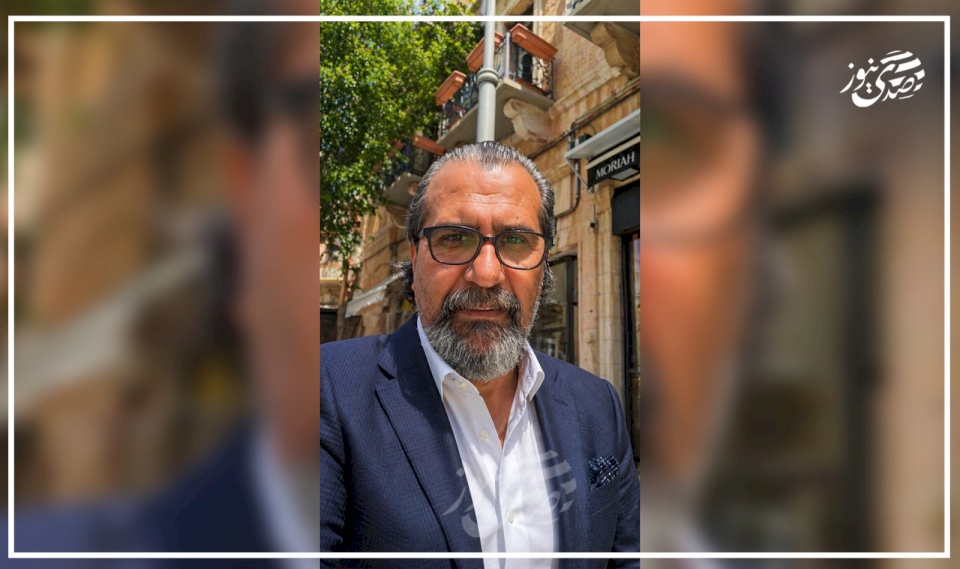
Jerusalem in the Face of the Conflict of Concepts
In colonial conflicts, defeat does not begin when land is lost, but when the language defending it falls... Occupation does not merely confiscate geography, it continuously seeks to appropriate meanings, concepts, and terms, because control over consciousness always precedes the ultimate control over place... Those who observe the Palestinian scene over the past three decades realize that the most dangerous outcome of the Oslo process was not the security coordination, the reduction of the national project, or the transformation of the authority into an administrative function under the occupation, but rather the reshaping of Palestinian political consciousness through a complete system of terms that infiltrated official discourse, until they appeared as immutable facts beyond discussion...
At the heart of this battle stands Jerusalem as the greatest victim of the war of concepts... The city, which has suffered from occupation, colonization, and forced annexation, has also become a victim of a Palestinian political discourse that has reproduced many of the axioms desired by the occupation and the settlement system... Among the most obvious examples of this is the persistent insistence on using the term (East Jerusalem) as a natural and ordinary description of the area occupied in 1967... The truth is that this term is not politically innocent as some attempt to portray, but rather carries an implicit recognition of the idea of dividing Jerusalem into two separate political entities ... East Jerusalem and West Jerusalem, as if the city were originally two separate cities then searched for borders between them...
This usage does not reflect the historical or legal reality of Jerusalem. Jerusalem is a single city that has been subjected to occupation in two phases; the western part was occupied by Israel in 1948, while the eastern part was occupied in 1967. The city itself has never been two independent political entities to speak of (two Jerusalems)... Therefore, the more accurate expression politically, nationally, and legally is (Eastern Jerusalem) not (East Jerusalem)... because the former refers to a part of one city, while the latter implies the existence of an independent city called East Jerusalem, alongside another city called West Jerusalem.
Moreover, what is even more dangerous is that the use of the term (East Jerusalem) reflects not only a linguistic malfunction but also reveals the extent of infiltration caused by the Oslo discourse into the Palestinian political mind... Since the Palestinian issue was reduced to a state project on the 1967 borders, the national language has undergone a comprehensive reengineering process... The territory occupied in 1948 has been excluded from the realm of serious political discourse. Palestine has been narrowed down to the West Bank and Gaza Strip, and Jerusalem has been reduced to that part occupied in 1967. As if the occupation that occurred in 1948 has become a definitive reality that should not be approached, questioned, or even reminded to new generations...
The settlement school has succeeded in transforming what was supposed to be a temporary political minimum into a permanent national ceiling. Over time, terms no longer reflect reality but have become a means of creating a new reality. When a Palestinian official speaks daily about (East Jerusalem as the capital of the Palestinian state), he inadvertently institutionalizes the narrative that what is called West Jerusalem has become outside any national, historical, or legal discussion... Thus, the occupation that took place in 1948 is transformed from a continuous crime into a settled fact, while the entire dispute is confined to what occurred in 1967...
However, the legal and historical facts do not say that... The resolution 181 issued by the United Nations General Assembly in 1947 did not grant sovereignty over Jerusalem to either the proposed Arab state or the proposed Jewish state, but rather stipulated a special status for the city as a separate entity under a special international regime. Regardless of the political stance towards the resolution itself, the undeniable legal truth is that the international community did not recognize Israel's sovereignty over West Jerusalem after its occupation in 1948, nor did it recognize the annexation of the eastern part following its occupation in 1967. Therefore, talking about (Israeli West Jerusalem) and (Palestinian East Jerusalem) is merely a political product of the settlement phase, not a reflection of a stable legal reality...
It is ironic to note that the official Israeli discourse is more consistent with its political project than the official Palestinian discourse. Israel constantly speaks of a unified Jerusalem because it seeks to impose its sovereignty over the entire city... Meanwhile, some of the official Palestinian discourse speaks in a language suggesting the existence of two separate cities, at a time when it should defend the unity of the city and reject the results of the occupation in both halves. Thus, the Palestinian, unknowingly or sometimes knowingly, becomes a partner in entrenching the conceptual division of Jerusalem, while the occupation continues to impose the forced unity of the city under its sovereignty...
Another prominent manifestation of the war of concepts is the widespread use of the term (Holy of Holies) in Arab media and cultural discourse when referring to the area of the Al-Aqsa Mosque or some of its parts, despite the fact that this term is originally associated with the Jewish religious narrative regarding the alleged temple, and constitutes a central part of the conceptual structure upon which the Israeli project relies to justify its sovereign and religious claims within the Al-Aqsa Mosque compound. When this expression is circulated repeatedly without scrutiny, it no longer remains merely a neutral linguistic description, but gradually transforms into a tool for reproducing the Israeli narrative within Arab consciousness itself. The danger of this matter lies in the fact that terms do not merely convey ideas, they also establish them and grant them symbolic and epistemological legitimacy. Therefore, the continuous reference to the Al-Aqsa Mosque compound as (Holy of Holies) contributes, albeit unintentionally, to entrenching historical and religious postulates that are still disputed and controversial, and grants them a natural presence in public consciousness, which may reflect in the future on the nature of political and legal perceptions of the city and its sanctities. Hence, the importance of adhering to established historical Arabic and Islamic terms, foremost among them being (the Blessed Al-Aqsa Mosque) and (the Noble Sanctuary), as they are expressions that align with the Palestinian Arab historical narrative and maintain their conceptual independence, rather than adopting terms that originated in the context of another narrative seeking to solidify rights and claims that have not achieved historical or legal consensus within the most sensitive and significant areas of Jerusalem...
The real problem does not lie in a word here or a term there, but in the intellectual and political structure that produced this language. Terms are not merely descriptive tools, but a direct reflection of the political vision. Those who adopt Oslo terms can ultimately only see Jerusalem through the lens of Oslo, and see Palestine through the lens of Oslo, and measure all national rights by the standard allowed by the settlement process, rather than by the standard of historical and legal right... However, recognizing the dangers of the war of concepts is not enough by itself unless it transforms into a comprehensive national program.
To rebuild Palestinian and Arab awareness towards Jerusalem is vital. The current battle is not just a confrontation on the ground or in the corridors of international politics, but also a confrontation over meaning, memory, and narrative. Therefore, it is necessary for Palestinians, at all official, party, and popular levels, to once again make Jerusalem the center of gravity in the national discourse, not as a negotiating file among many files, but as the most complete expression of the Palestinian cause in its historical, national, and civilizational dimensions.... At the official level, there is an urgent need for a comprehensive review of the political, media, and educational discourse, which restores honor to the national concepts that have been marginalized over decades of settlement. The battle for Jerusalem cannot be fought in a language that adopts, directly or indirectly, the results imposed by the occupation. Hence, the reconstruction of the Palestinian political lexicon becomes an integral part of the national liberation project, so that terms regain their connection to historical and legal rights, not to the borders drawn by balances of power or imposed by temporary agreements that over time have turned into quasi-permanent references...
Moreover, at the party and factional level, the responsibility necessitates transcending narrow political divisions regarding Jerusalem specifically and working to produce a unifying national discourse that reinforces the unity of the city and the unified narrative related to it. Jerusalem has always been the major point of convergence in Palestinian and Arab consciousness, and any project to bring it back to the forefront should commence from considering it a shared national denominator that transcends organizational alignments and immediate factional calculations... At the societal and cultural level, there is an even more urgent need to launch a comprehensive societal movement aimed at restoring the presence of Jerusalem in the daily consciousness of new generations. The war of perceptions waged by the occupation primarily aims at weakening the symbolic and cognitive connection to the city and gradually transforming it into an abstract political title or an issue that concerns only its immediate residents. Therefore, re-integrating Jerusalem into educational curricula, cultural production, national media, youth activities, and the digital space represents a strategic necessity no less important than any other form of confrontation... Additionally, the Arab dimension of the cause calls for organized Palestinian efforts to re-establish Jerusalem in the Arab consciousness as an Arab and human liberation issue, not just an internal Palestinian matter. For decades, the occupation has sought to isolate the city from its Arab and Islamic depth, while the Palestinian national project should work to reconnect Jerusalem with its civilizational and historical depth and to reproduce a discourse that affirms that defending it is defending the identity of the region, its collective memory, and its civilizational standing...
In light of the escalating conflict of concepts and the war of perceptions, recovering the national narrative becomes a daily task that goes beyond political elites to encompass society as a whole. The narrative does not live solely by legal documents, but also thrives in the language that people use, in the concepts that form in their consciousness, and in the mental images that are passed from generation to generation. Hence, protecting Jerusalem begins with protecting its meaning, just as liberating consciousness from the effects of the settlement discourse is a fundamental condition for any project aiming to liberate land or defend national rights...
It is time to restore the Palestinian national language as part of the liberation battle. Jerusalem is not (Eastern) and (Western) in the political sense that has been promoted over the past decades, but is a single city, half of which was occupied in 1948 and the other half in 1967. Recognizing this truth is not merely a linguistic exercise but a political stance that refuses to transform the results of occupation into permanent realities and rejects reducing Palestine to what remains of it after each round of concessions... The most dangerous thing that the Palestinian official discourse does today is not only coexist with the reality imposed by the occupation but sometimes contributes to its linguistic and political reproduction. When the terms of the settlement become the sole reference for understanding and expression, the issue evolves from a national liberation cause into a boundary dispute, the occupation transforms into a disagreement over demarcation lines, and Jerusalem shifts from an entirely occupied city into a negotiating file pertaining to only a part of it.
Thus, the battle for Jerusalem begins with the recovery of the narrative, and the recovery of the narrative begins with the recovery of the language. The city that had its west occupied in 1948 and its east in 1967 does not need terms that consolidate its fragmentation but requires a political discourse that reaffirms its historical, legal, and national unity. Unless the Palestinian political mind is liberated from the legacy of Oslo and its concepts and terms, the liberation battle will remain captive to the language formulated by its adversaries, and the national narrative will remain besieged within the conceptual cage that the occupation built and nurtured under the settlement school over more than three decades.
 Follow the latest Sada News via Google News
The Separation of Tracks in Palestine: Gaza vs. the West Bank

Jerusalem in the Face of the Conflict of Concepts

Palestinians and the Upcoming Elections: When Economy Becomes the Gateway to Politics

Were Palestinians Harder on Themselves than Their Opponents?

Digital Economy in Palestine: Between the Consumption Gap and the Production Opportunity

Fifty Billion on the Edge of the Abyss

Cool-Headed Thinking in a Heated Environment: Towards a Roadmap for Palestinian National S...
