

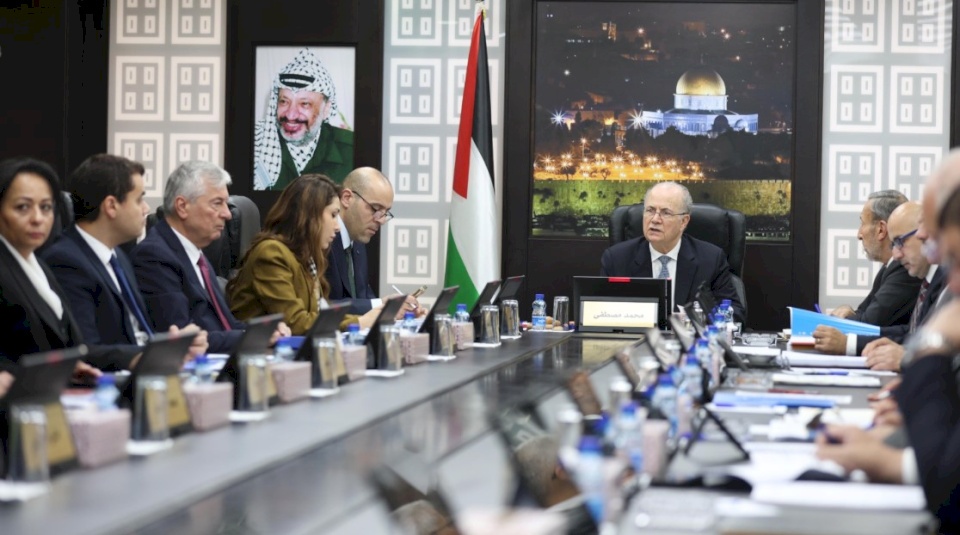
Approved a series of decisions.. The Cabinet directs to implement more reform steps to control spending and govern public finance management
SadaNews - The Cabinet renewed its call to the international community and international organizations to exert more pressure on Israel to provide medical treatment for more than 20,000 injured individuals in the Gaza Strip, amid a lack of medical supplies in the area due to the destruction of most health centers by the occupation, and the imposition of strict restrictions on the entry of medicines and medical supplies. It warned of a worsening humanitarian situation and the danger of a complete collapse in the sector due to renewed aggression, targeting civilians, and preventing the entry of trucks and humanitarian aid.
The Cabinet also discussed, in its weekly session today, reports on the rise of settler terrorism, as last week witnessed a total of 31 attacks targeting 11 Palestinian villages, which included the destruction and vandalism of dozens of citizens' vehicles and property damage, as well as the establishment of new colonial outposts, coinciding with the occupation's demolition of 26 Palestinian facilities, in addition to 46 notices for the demolition of other facilities.
Furthermore, the Cabinet condemned the occupation forces' killing of a young man and a child in the town of Beit Ummar and the detention of their bodies, considering it a double crime that reflects the brutality of the occupation and the systematic "ease of killing" policy adopted by its military leaders. The Council also held the occupation leaders fully responsible for the attacks of violent settler militias, including the burning of two mosques in the villages of Jaljuliya and Mazari al-Nubani last week, emphasizing that these crimes constitute a gross violation of the sanctity of places of worship and a serious escalation that necessitates urgent international action. At the same time, it called on the international community to take practical steps to classify these militias as terrorist organizations and hold accountable those responsible for their crimes.
The Council also listened to a briefing from the Minister of Finance regarding the financial situation and the efforts made over the month to secure financial resources, amid the continued complete detention of clearance funds by the occupation for nearly 15 months.
In this context, the Cabinet emphasized the continuation of the reform agenda, particularly in the areas of governance and public finance management, praising the sponsorship of His Excellency the President of this path and his approval of the legislative amendments proposed by the Cabinet to Law No. (26) of 2024 regarding Value Added Tax, which enables the launch of a program for institutional building in the Ministry of Finance, the formation of a Supreme Council for Public Revenues, and the restructuring and development of directorates in the governorates, enhancing compliance with international standards in combating tax evasion and smuggling, achieving integration among various administrations, and contributing to revenue improvement to ensure continued provision of vital services during this difficult phase. These steps are a continuation of previous measures taken by the government to control spending and direct revenues towards vital sectors within the emergency budget for 2026.
The Council also listened to the Minister of Agriculture regarding the progress of the campaign for the identification and vaccination of livestock in various governorates, which started from the hot areas with the aim of protecting livestock and immunizing it against emerging diseases that have begun to spread in several neighboring countries, especially the mutated foot-and-mouth disease. In this context, financial allocations were approved for the launch of the vaccination and identification campaign despite the severe financial crisis, alongside efforts to provide more vaccines amid increasing global demand. The ministry succeeded in identifying and vaccinating about 10,000 livestock heads during the first two days of the campaign's launch.
Additionally, the Cabinet approved the general policy for the telecommunications and information technology sector (2026-2028), aimed at developing and regulating the telecommunications sector, enhancing competitiveness and digital transformation, improving the quality of government digital services, developing digital skills, and raising institutional preparedness, leading to building digital trust and data governance.
The Cabinet also approved the recommendations of the permanent administrative committee regarding the adoption of several organizational structures for various government departments, in line with the government reform program and streamlining institutions and activating them to improve the services provided to citizens.
Within the framework of the government's plan to develop the health sector and digitize services, the Cabinet approved replacing the paper health insurance card with a smart card; this will contribute to speeding up patient transactions, increasing security and privacy, improving data accuracy, and reducing the use of paper and printing costs, which also allows for the future development of smart card services.
The Council also discussed, in the second reading, a draft amended regulation for organizing nurseries and the executive instructions annexed to it for the year 2026.
The Council also approved the reformation of dispute review committees in the Supreme Council for Public Procurement Policies, which contributes to governance and the study of complaints submitted by suppliers, contractors, or service providers under the provisions of the public procurement law.
In another context, the Council formed a task force consisting of various relevant authorities to follow up on the issues of waste dumps and propose radical technical and administrative solutions to this file.
The Cabinet also adopted a memorandum of understanding between the Moroccan Ministry of Economic Inclusion and the Palestinian Ministry of Labor in the field of labor; to develop self-employment programs and small projects, exchange expertise, and benefit from the Moroccan experience in applying safety and health measures and work environment, as well as another memorandum of understanding between a Malaysian college and the Palestinian Ministry of Education and Higher Education.
 Follow the latest Sada News via Google News
Trump: If Iran Wants Trouble, Let it Pursue Nuclear Weapons

Approved a series of decisions.. The Cabinet directs to implement more reform steps to con...

Israeli Army: We seized 250 firearms and 40 weapon manufacturing machines since the beginn...

Launch of the Fifth Round of Negotiations Between Lebanon and Israel

UN Committee: Israel Deliberately Targets Children as Part of 'Genocide' in Gaza

Martyr in Israeli Shelling South of Gaza Strip

Prime Minister: The Israeli blockade costs the Palestinian economy $11 billion annually