

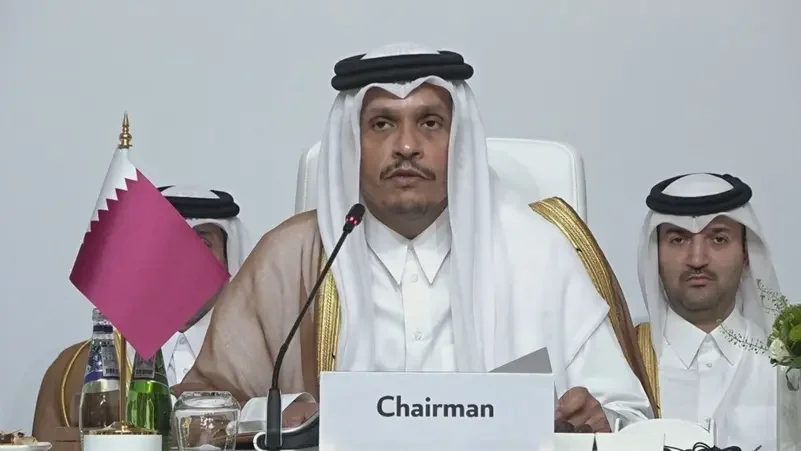
Qatar's Prime Minister Talks About Understandings on Hormuz, Lebanon, and the Investment Fund in Iran
SadaNews - Qatar’s Prime Minister and Minister of Foreign Affairs, Sheikh Mohammed bin Abdulrahman Al Thani, discussed the features of the regional arrangements for the post-war phase in Iran, addressing the Strait of Hormuz issue, a new regional security framework with Iran, a mechanism for verifying the ceasefire in Lebanon, as well as the proposed investment fund worth $300 billion in an interview with the Financial Times.
He confirmed in his interview with the Financial Times that the Strait of Hormuz remains open, noting that Doha received confirmation that there would be no order to close it.
He stated that navigation in Hormuz is expected to return to its levels within 30 days of the agreement.
He stressed that establishing a communication line between Washington and Tehran is necessary to prevent disruptions in opening Hormuz and during the mine clearance process, adding that the agreed communication line in Switzerland is essential to counter misinformation.
Sheikh Mohammed bin Abdulrahman pointed out that the Switzerland talks laid the groundwork for negotiations on a permanent settlement, indicating that work is still in its early stages, and that Qatar continues to mediate with Pakistan to reach a final settlement.
He clarified to the newspaper that any model for managing Hormuz should be discussed with Iran, Oman, and Gulf states, emphasizing that Qatar would oppose any Iranian plan to impose fees for passing through the Strait of Hormuz.
He said, "It is unacceptable to have our gateway to the world under the control of one party."
The Qatari Prime Minister revealed to Al Jazeera on Monday that there have been problems facing the negotiation track since signing the memorandum, particularly regarding the Strait of Hormuz and Lebanon, but he affirmed that mechanisms have been put in place to avoid such problems, so that the focus remains on negotiations and reaching an agreement.
In his reading of the scene in the region, the Qatari Prime Minister emphasized that the current regional goal is to build a new security framework among the countries of the region and Iran.
Regarding the Lebanese front, Sheikh Mohammed bin Abdulrahman indicated that there is a mechanism to prevent escalation in Lebanon, which includes verifying the ceasefire.
He criticized the Israeli behavior in this context, saying that Israel overreacts to clashes instead of calming the situation.
The Investment Fund in Iran
The Qatari Prime Minister described in his statement to the Financial Times the proposed $300 billion investment fund with Iran as "an ambitious number," noting that Gulf countries may be asked to finance the investment fund with Iran in the future.
The memorandum of understanding stipulates that Washington "commits - in cooperation with regional partners - to establish a mutually agreed final plan worth no less than $300 billion for the reconstruction and economic development of Iran."
The memorandum added that "the implementation mechanism for this plan will be completed within a final agreement over the course of 60 days. The United States will also grant all the necessary licenses, exemptions, and approvals to complete related financial transactions."
The text does not specify the parties that will contribute to financing the fund, which is considered one of several economic incentives offered by the United States to Iran to encourage it to sign a final agreement.
Regarding the energy sector, he confirmed that QatarEnergy will not lift the "force majeure" status except with a guarantee of safe operation.
The term "force majeure" refers to a legal provision found in contracts - especially long-term gas and oil supply contracts - that allows the supplying party to exempt itself from contractual obligations, such as delivering gas shipments on time without paying financial penalties, according to Anadolu Agency.
QatarEnergy had suspended liquefied natural gas production after the United States and Israel launched their war on Iran on February 28, following a drone attack on the company's massive Ras Laffan facility.
Iran and the United States announced on June 14 that they had reached a 14-article memorandum of understanding mediated by Pakistan, aimed at stopping the war and addressing disputes between the two sides through dialogue and negotiations.
The memorandum, known as the "Islamabad Understanding," came into effect on June 18, after it was electronically signed by Iranian President Masoud Pezeshkian and his American counterpart Donald Trump.
The understanding includes provisions related to ending the war, including in Lebanon, reopening the Strait of Hormuz, and lifting the maritime blockade imposed by the United States on Iran.
 Follow the latest Sada News via Google News
Settlers Attack Burin, Injuring a Citizen and His Children, and Damaging Two Vehicles

Qatar's Prime Minister Talks About Understandings on Hormuz, Lebanon, and the Investment F...

Four Citizens Injured and 60 Trees Uprooted in Settler Attack South of Hebron

"Experimental Project" Between Israel and Lebanon for Handing Over Land to the Lebanese Ar...

Trump Accuses Senate of Undermining His Position Against Iran

Currency Exchange Rates Against the Shekel on Wednesday (June 24)

Weather: Hot conditions with a rise in temperatures
